
Decoding a Planet's True Temperature
Summary
By the end of this article, you will understand why our first measurements of distant atmospheres are often misleading, and how scientists use computer models to correct for these illusions and reveal the true vertical structure of planets like Jupiter.
Quick Facts
- Surprise: The H3+ ion, a key atmospheric probe, was first discovered in Jupiter's aurora about 30 years ago.
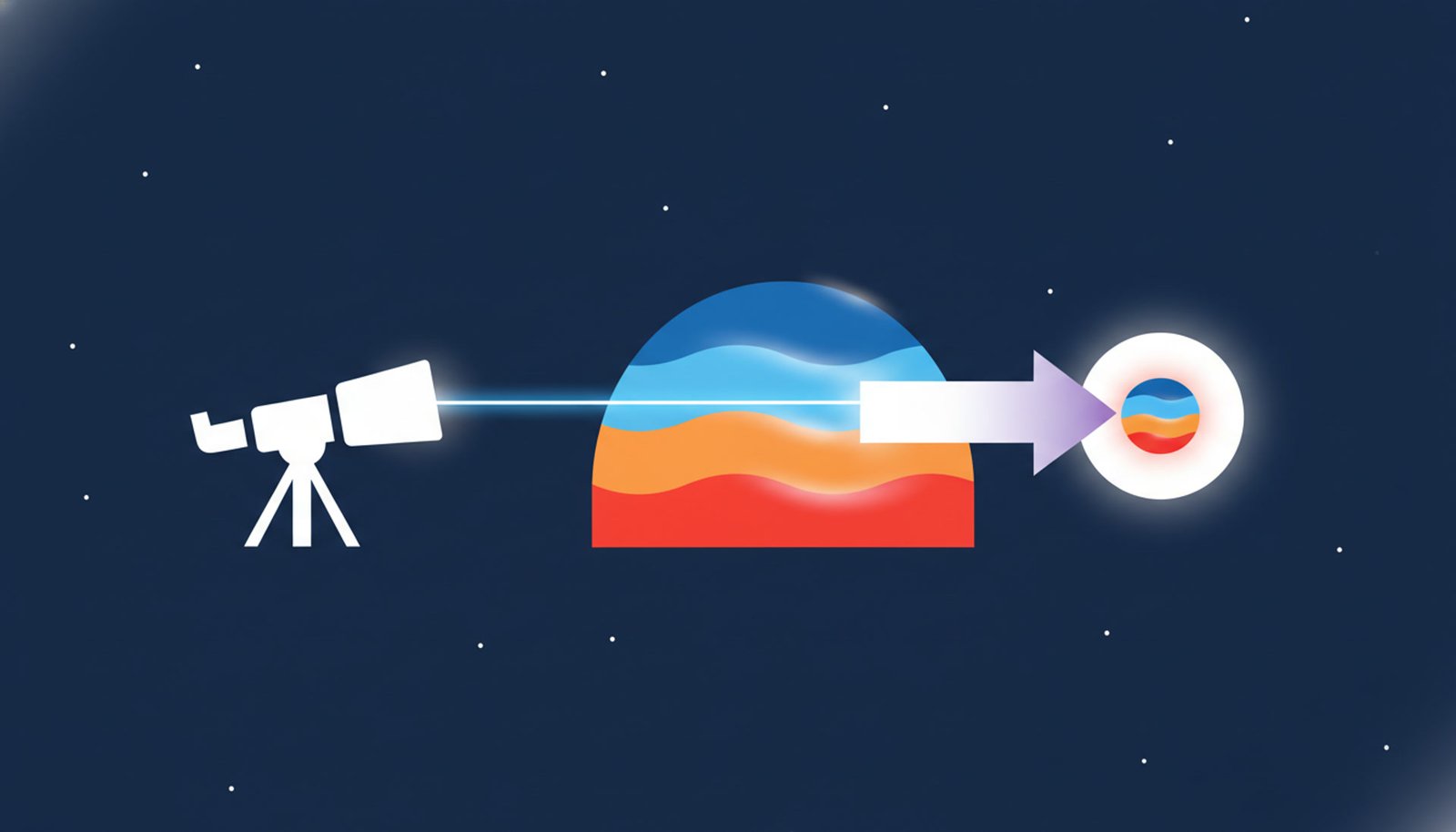
- Salient Idea: Measuring a planet's atmosphere from afar is like looking at a multi-story building from above and trying to guess the temperature on each floor—you only get an average.
- Surprise: Standard observations of giant planets underestimate the amount of H3+ by 20% or more because of temperature gradients.
- Salient Idea: The same observed temperature changes on Uranus can be explained by the sun's angle (day vs. night), not necessarily by real atmospheric heating events.
- Surprise: Scientists combined 1995 data from the Galileo spacecraft with 2016 data from the Keck telescope to build a new, more accurate temperature profile of Jupiter.
The Discovery: Seeing the Layers, Not the Lump
For decades, scientists have used the H3+ ion as a cosmic thermometer for giant planets. But they faced a persistent problem: their ground-based telescopes see the entire upper atmosphere at once, a ‘column-integrated’ view that averages everything together. This is like listening to an orchestra from outside the concert hall; you hear the sound, but you can’t pick out the individual instruments. The research team knew the atmosphere had layers with different temperatures and densities. The Story of this research is their solution: they built a ‘digital twin’ of the atmosphere in a computer. By creating a synthetic, layered atmosphere and simulating what a telescope would see, they could finally start to un-blend the signal. They found that the hotter, higher layers of H3+ dominate the light we see, systematically tricking us into measuring a higher temperature and a lower density than what’s really there.
The sheer diversity and uncertainty of conditions in planetary atmospheres prohibits this work from providing blanket quantitative correction factors; nonetheless, we illustrate a few simple ways in which the already formidable utility of H3+ observations… can be enhanced.
— L. Moore et al.
The Science Explained Simply
The key principle here is that the brightness of H3+ emissions increases exponentially with temperature. Imagine two equal groups of H3+ ions, one at 500K and one at 800K. The 800K group will glow far more intensely. This is NOT like looking at two rocks at different temperatures; this is about energized gas emitting light. When a telescope looks through an atmosphere with a cool layer below and a hot layer on top, the hot layer’s light completely overpowers the cool layer’s. The resulting measurement is therefore heavily weighted towards the hotter temperature. This ‘hot-weighting’ effect means the final number is not a true average. It’s a biased measurement that hides the cooler, lower-altitude gas, making us underestimate how much H3+ is there in total.
In a non-isothermal atmosphere, H3 column densities retrieved from such observations are found to represent a lower limit, reduced by 20% or more from the true atmospheric value.
— L. Moore et al.
The Aurora Connection
The H3+ ion was first discovered in Jupiter’s powerful aurora. Auroras are colossal curtains of light created when energetic particles, guided by the planet’s magnetic field, slam into the upper atmosphere. This process dumps enormous amounts of energy, heating the region intensely. H3+ plays a crucial role as a thermostat, radiating this excess energy back into space as infrared light and cooling the atmosphere. But how much cooling? To know that, we need to know the *true* temperature and density of H3+. This research provides the tools to get past the biased, column-integrated view and build a more accurate picture of the auroral energy budget. It helps us answer: how much energy is coming in from the solar wind and magnetosphere, and how efficiently is the planet getting rid of it? This is fundamental to understanding how planetary atmospheres respond to space weather.
A Peek Inside the Research
This wasn’t just theory; the scientists put their method to the test. Knowledge and Tools were key. First, they built a 1-D ionospheric model, a computer program that solves the physics and chemistry equations for a column of gas. They fed it data on solar radiation to simulate how the atmosphere gets ionized. For Jupiter, they went a step further, combining two very different datasets: a direct, in-situ measurement of electron density from the 1995 Galileo probe flyby, and a remote, column-integrated H3+ spectrum from the 2016 Keck Observatory. By forcing their model to reproduce *both* observations simultaneously, they were able to derive a self-consistent vertical temperature profile—a feat impossible with either dataset alone. This data fusion demonstrates a powerful new way to probe worlds we can’t visit directly.
Key Takeaways
- Column-integrated observations average out vertical details, leading to interpretation errors.
- Hotter, higher-altitude H3+ glows exponentially brighter, skewing temperature measurements high.
- Retrieved H3+ column densities are a lower limit, not the true value, in non-isothermal atmospheres.
- Forward-modelling (creating a 'digital twin') allows scientists to deconstruct the blended signal and infer the properties of individual atmospheric layers.
- Understanding the true temperature structure is vital for calculating energy balance, especially in auroral regions.
Sources & Further Reading
Frequently Asked Questions
Q: What is H3+ and why is it so important?
A: H3+ is a simple ion made of three hydrogen atoms and missing one electron. It’s abundant in the upper atmospheres of giant planets and glows brightly in infrared light, which our telescopes can see. This glow acts as a natural thermometer, allowing us to study the temperature and chemistry of these distant regions.
Q: Does this mean all our old measurements of Jupiter’s temperature are wrong?
A: They’re not ‘wrong’, but they are incomplete. They represent a biased average weighted towards the hottest parts of the upper atmosphere. This new work provides a method to correct for that bias and build a more detailed, layer-by-layer picture.
Q: Why can’t we just send more probes like Galileo to measure the layers directly?
A: Sending probes is incredibly expensive, complex, and provides only a single snapshot in one location at one time. Developing remote-sensing correction methods like this allows us to use ground-based telescopes to monitor the entire planet over many years, which is far more practical.


Ganymede's Lopsided Sky
Summary
By the end of this article, you will understand how Jupiter’s largest moon, Ganymede, gets its thin atmosphere, and why its position in its orbit causes this atmosphere—and its auroras—to be strangely lopsided.
Quick Facts
- Surprise: Ganymede's atmosphere is primarily created by plasma from Jupiter crashing into its icy surface, a process called sputtering.
- Salient Idea: The oxygen atmosphere takes longer than one full orbit (~7 Earth days) to form, meaning its current state is a 'memory' of where it's been.
- Surprise: Jupiter's gravity, though weak at that distance, is strong enough to help shape Ganymede's long-lived oxygen exosphere.
- Surprise: The moon's 'afternoon' side is hotter, which enhances the sputtering process and contributes to a denser atmosphere at dusk.
The Discovery: Modeling a Moon in Motion
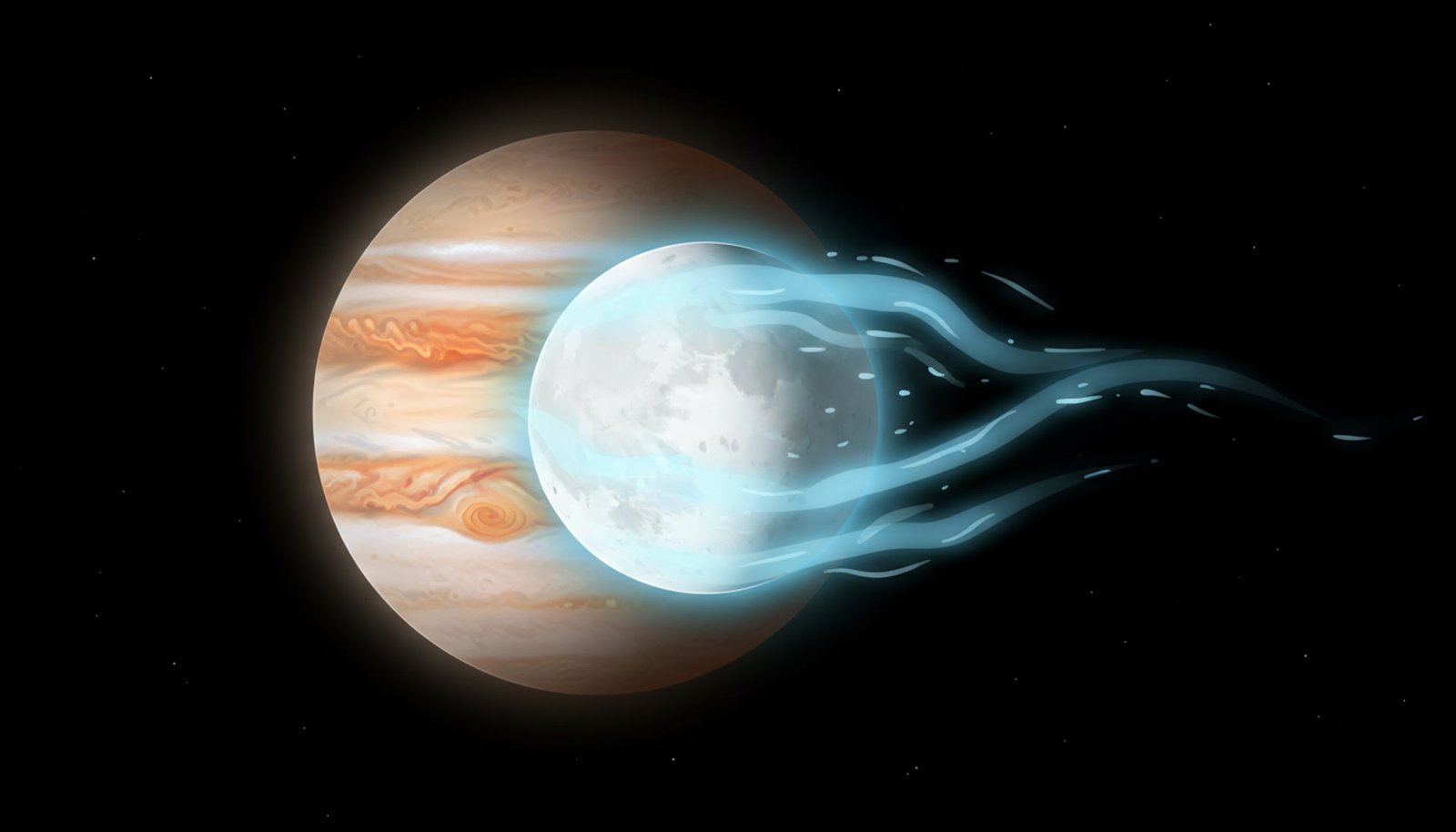
For years, scientists struggled to explain why Ganymede’s auroras, observed by the Hubble Space Telescope, were often brighter on one side. Static models of its atmosphere just didn’t fit. The Story of this breakthrough lies in a new approach: simulating Ganymede not as a stationary object, but as a moon in constant motion. Using a powerful 3D computer model called the Exospheric Global Model (EGM), researchers tracked millions of virtual water and oxygen particles as they were sputtered off the ice. They simulated Ganymede’s full 7.2-day orbit around Jupiter. The model revealed a Surprise: the oxygen atmosphere builds up so slowly that it creates a lag, bunching up on the dusk side. This simulated atmospheric asymmetry perfectly matched the lopsided auroras. It was the first model to show the atmosphere ‘breathes’ with its orbit.
Original Paper: ‘On the orbital variability of Ganymede’s atmosphere’ by F. Leblanc et al.
The O2 exosphere should peak at the equator with a systematic maximum at the dusk equator terminator.
— F. Leblanc et al.
The Science Explained Simply
Ganymede’s atmosphere is NOT like Earth’s, which is a thick, stable blanket created from within. To understand it, we must build a fence around the concept. Ganymede’s atmosphere is an ‘exosphere’, a near-vacuum where molecules are constantly being created and lost. Its source is external: a relentless sandblasting by energetic particles trapped in Jupiter’s immense magnetic field. This process, called sputtering, kicks water ice molecules off the surface. Some of these molecules are broken down into oxygen (O2). Because this process is ongoing, the atmosphere is more of a temporary halo than a permanent feature. The key difference is its origin: it’s a direct result of space weather, not geology.
Ganymede’s atmosphere is produced by radiative interactions with its surface, sourced by the Sun and the Jovian plasma.
— Abstract from the paper
The Aurora Connection
Ganymede is the only moon in our solar system with its own magnetic field. This creates a small magnetic bubble that shields it from some of Jupiter’s plasma. However, at the poles, this shield is open, allowing Jovian plasma to funnel down and strike the surface. This impact does two things at once: it creates the oxygen atmosphere through sputtering, and it excites that very same oxygen, causing it to glow. These are Ganymede’s auroras. This research shows that the observed asymmetry in the auroras—brighter on the dusk side—is a direct map of the lopsided oxygen atmosphere below. The auroras aren’t just pretty lights; they are a visual confirmation of the dynamic, orbiting ‘weather’ patterns in Ganymede’s exosphere.
A Peek Inside the Research
This discovery wasn’t made with a telescope alone; it required immense computational power. The team’s Knowledge and Tools centered on a 3D Monte Carlo simulation. This program acts like a virtual Ganymede, tracking the fate of millions of individual ‘test-particles’ representing different molecules. It calculated their ejection speed from sputtering, their trajectory under the pull of both Ganymede’s and Jupiter’s gravity, and even the tiny chance they would collide with each other. Simulating just 4.5 orbits took two weeks on 64 CPUs. This painstaking digital reconstruction was the only way to reveal the slow, lagging formation of the oxygen exosphere that happens over days—a process too subtle to capture in a single snapshot.
Key Takeaways
- A moon's atmosphere can be dynamic, changing its shape and density based on its orbit around a planet.
- Ganymede's personal magnetic field channels Jovian plasma to its poles, making them the primary source of its atmosphere.
- The slow-moving, heavy oxygen molecules are influenced by non-inertial forces, pushing them toward the equator.
- Observing a moon's aurora can reveal hidden asymmetries in its tenuous atmosphere.
Sources & Further Reading
Frequently Asked Questions
Q: Why is the atmosphere thicker on the ‘dusk’ side?
A: It’s a combination of factors. The surface is warmest in its local ‘afternoon’ (the dusk side), which makes the sputtering process more efficient. Furthermore, the heavy oxygen molecules take a very long time to spread out, so they tend to cluster in the region where they are most actively produced.
Q: Does Ganymede have weather?
A: Not like Earth. It’s far too thin for clouds or wind. However, its atmospheric density changes dramatically depending on where it is in its orbit and the time of day, which is a unique form of ‘space weather’.
Q: Why is Ganymede’s magnetic field so important for its atmosphere?
A: Ganymede’s magnetic field acts like a funnel. It guides the energetic plasma from Jupiter down to the polar regions. This focuses the sputtering process at the poles, making them the primary ‘source regions’ for the entire atmosphere.

SMILE: X-Raying Earth's Invisible Shield
Summary
By the end of this article, you will understand how scientists are using X-rays—usually considered background noise—to create the first-ever movies of Earth’s invisible magnetic shield as it battles the solar wind.
Quick Facts
- Surprise: The mission's key signal is a type of X-ray that astronomers usually treat as unwanted background noise.
- Salient Idea: For the first time, we'll get a 'movie' of the magnetosphere's boundary instead of single-point measurements.
- Surprise: It's the first-ever joint mission from start to finish between the European Space Agency (ESA) and the Chinese Academy of Sciences (CAS).
- Salient Idea: SMILE will spend over 80% of its 51-hour orbit continuously watching the Earth-Sun interaction.
- Surprise: Its X-ray camera uses special 'lobster-eye' optics to get a super wide-angle view of the sky.
The Discovery: Turning Noise Into a Signal
For years, astronomers studying distant galaxies were annoyed by a faint, variable X-ray glow that contaminated their images. This ‘noise’ was eventually traced back to our own solar system. It happens when charged particles from the solar wind smash into the edge of Earth’s atmosphere (the exosphere). This process, called Solar Wind Charge Exchange (SWCX), creates a faint X-ray emission. The Story of SMILE is a brilliant pivot: what if, instead of trying to remove this ‘noise’, we built a mission specifically to capture it? Scientists realized these X-rays perfectly outline the invisible boundaries of our magnetosphere. SMILE was born from this idea to turn a problem into a revolutionary solution for seeing our planet’s defenses in action.
The SMILE mission (Branduardi-Raymont & Wang)
The international space plasma and planetary communities are looking forward to the step change that SMILE will provide by making visible our invisible terrestrial magnetosphere.
— G. Branduardi-Raymont & C. Wang, SMILE Mission Scientists
The Science Explained Simply
The X-rays SMILE sees are NOT coming from the Sun. Instead, they are made right here at Earth. Here’s how: the solar wind is a stream of highly charged ions. Earth is surrounded by a vast, thin cloud of neutral atoms called the exosphere. When a solar wind ion gets close to a neutral atom, it steals an electron. The ion is now in a highly excited, unstable state. To become stable, it releases energy by spitting out a photon of light—specifically, a soft X-ray. This is Building a Fence: it’s not a reflection or a solar emission. It is a local light show powered by a cosmic collision. Where the solar wind is densest—at the magnetopause and cusps—the X-ray glow is brightest, giving SMILE a perfect target to film.
SMILE combines this with simultaneous UV imaging of the northern aurora and in-situ plasma and magnetic field measurements.
— Abstract from the research paper
The Aurora Connection
The aurora is the beautiful end-product of a long chain of events that starts with the solar wind. SMILE is designed to see the entire chain. Its Soft X-ray Imager (SXI) will watch the cause: the large-scale boundary where the solar wind slams into Earth’s magnetic shield. At the very same time, its UltraViolet Imager (UVI) will watch the effect: the glowing oval of the northern aurora, where energized particles rain down into our atmosphere. By having both cameras running simultaneously, scientists can directly answer questions like: ‘When the magnetic shield gets compressed by a solar storm, how quickly and in what way does the aurora respond?’ It forges an undeniable link between the macro-scale physics of deep space and the beautiful light shows above our poles.
A Peek Inside the Research
Before building a multi-million dollar spacecraft, you have to be sure it will work. A huge part of the work for SMILE involved Knowledge and Tools in the form of computer simulations. Researchers used Magneto-Hydro-Dynamic (MHD) models to predict what the magnetosphere would look like under different solar wind conditions. Then, they calculated the expected X-ray glow from these models. Finally, they fed these virtual X-ray maps into a simulator for the SXI instrument, including all its limitations and sources of background noise. This painstaking process allowed them to prove that SMILE could, in fact, accurately locate the magnetopause with a precision of 0.5 Earth radii and a time resolution of 5 minutes, meeting its core science goals before a single piece of hardware was built.
Key Takeaways
- Solar Wind Charge Exchange (SWCX) is a natural process that generates X-rays at the boundary of our magnetosphere.
- Imaging this X-ray light allows us to see the location, shape, and motion of the invisible magnetopause.
- By watching the aurora in UV light at the same time, SMILE directly links global space weather drivers to their effects in our atmosphere.
- This global view is essential for testing and improving the computer models that predict space weather.
- SMILE turns a nuisance into a powerful diagnostic tool, a classic story of scientific innovation.
Sources & Further Reading
Frequently Asked Questions
Q: Why can’t we just see the magnetic field directly?
A: Magnetic fields themselves are completely invisible. We can only detect their effects. SMILE uses the X-rays as a tracer, like adding dye to water to see the flow. The X-rays light up the boundary where the solar wind plasma interacts with the field, making the invisible visible.
Q: What is ‘space weather’ and why does it matter?
A: Space weather refers to the changing conditions in space driven by the Sun, like solar flares and Coronal Mass Ejections (CMEs). These events can disrupt satellites, damage power grids on Earth, and pose a radiation risk to astronauts. SMILE will help us understand and better forecast these events.
Q: Why is the orbit so important?
A: SMILE will be in a huge, highly elliptical orbit that takes it far above Earth’s north pole. From this high vantage point, it can stare down at the dayside magnetosphere for over 40 hours at a time, capturing long, uninterrupted movies of the solar wind interaction without the Earth getting in the way.
Stars That 'Sing' for Their Planets
Summary
By the end of this article, you will understand how a planet can create a radio signal on its host star, and how scientists use this ‘auroral footprint’ to hunt for exoplanets and their crucial magnetic fields.
Quick Facts
- Surprise: We're not listening to the planet, but to the star's radio 'shout' caused by the planet.
- The TRAPPIST-1 system of seven planets is a prime target for this type of radio detection.
- This phenomenon is a scaled-up version of the interaction between Jupiter and its volcanic moon, Io.
- A planet's magnetic field is a key ingredient for protecting a potential atmosphere and enabling life.
- The radio signal would pulse in time with the planet's orbit, like a cosmic lighthouse.
The Discovery: Tuning In to a Star's Echo
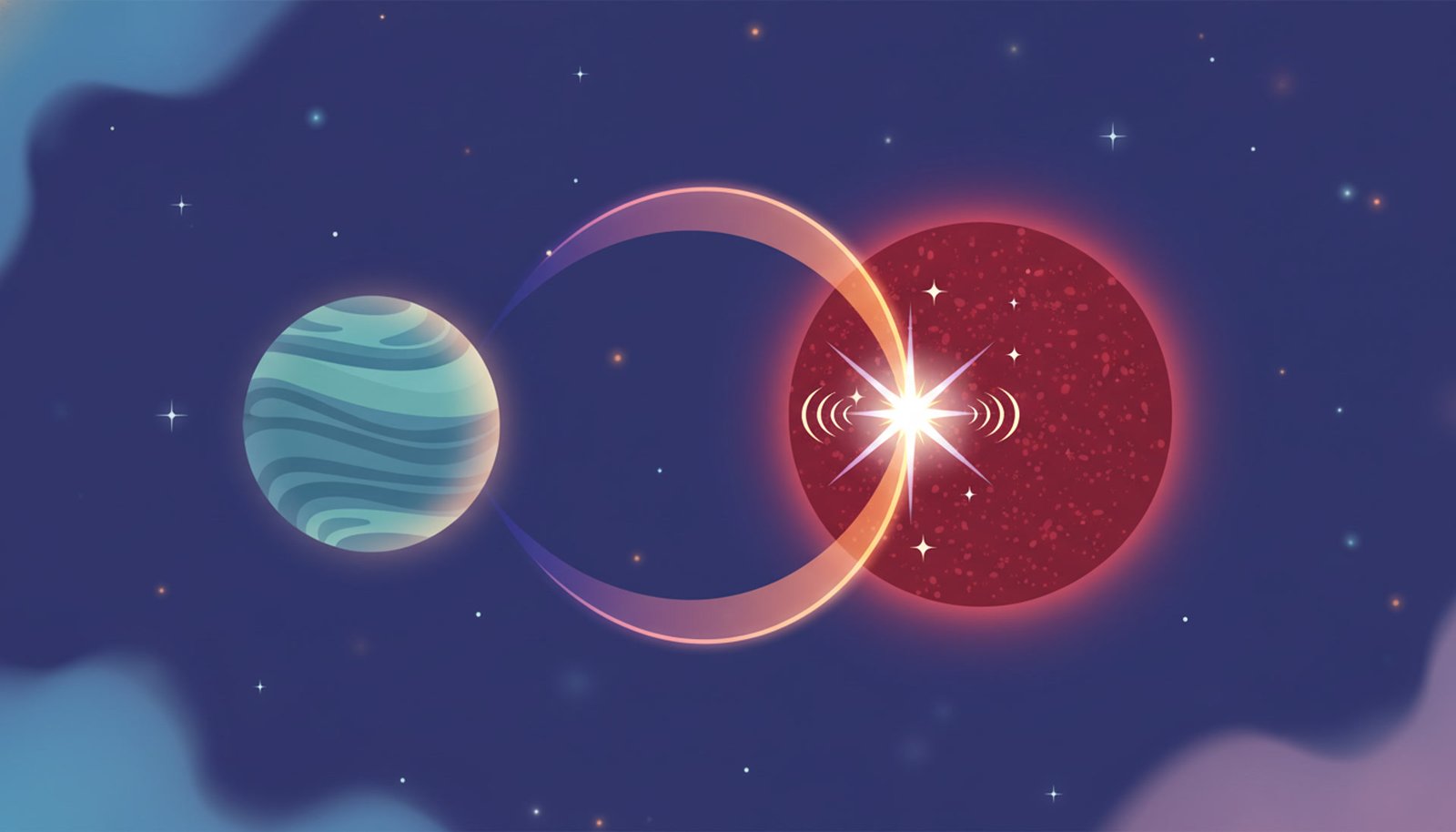
How do you find a planet that’s too small and quiet to detect directly with a radio telescope? A team at the University of Leicester came up with a clever solution. Their Story is one of inspiration. They looked at our own solar system, specifically at Jupiter and its moon Io. Io’s movement through Jupiter’s magnetic field creates a powerful electrical circuit, leaving a glowing auroral ‘footprint’ in Jupiter’s atmosphere. The researchers theorized that exoplanets orbiting close to M-dwarf stars could do the same thing on a much grander scale. They built a model to calculate the energy transferred from the planet to the star and predicted the strength of the resulting radio signal. Their work identifies 11 specific systems that might be ‘singing’ right now, waiting to be heard.
Original Paper: ‘Exoplanet-Induced Radio Emission from M-Dwarfs’ by Turnpenney et al.
A region of emission analogous to the Io footprint observed in Jupiter’s aurora is produced.
— Sam Turnpenney et al.
The Science Explained Simply
Imagine a river: the stellar wind flowing from the star. Now, put a rock in it: the exoplanet. Normally, the wake flows downstream. But if the river flows slower than the speed of ‘sound’ in that medium (the Alfvén speed), something amazing happens: the disturbance can travel upstream. This is a sub-Alfvénic interaction. This is NOT the planet beaming radio signals into space. Instead, the planet’s presence creates a disturbance in the star’s magnetic field, forming two ‘Alfvén wings’ that act like cosmic wires. These wires carry energy back to the star’s surface. When that energy arrives, it accelerates electrons in the star’s atmosphere, which then release that energy as a focused beam of radio waves.
Energy can be transported upstream of the flow along Alfvén wings.
— NorthernLightsIceland.com Team
The Aurora Connection
The phenomenon described in the paper is a direct cousin to the auroras we see on Earth and Jupiter. The ‘Io footprint’ on Jupiter is a persistent auroral spot caused by the magnetic connection to its moon. This research predicts a similar ‘exoplanet footprint’ on M-dwarf stars. For a planet to create this effect, it needs either a protective magnetic field or a thick atmosphere to act as an obstacle. Therefore, detecting this radio signal is a powerful clue that the planet has a magnetic shield. That shield is the single most important factor in protecting an atmosphere from being stripped away by the stellar wind—a prerequisite for life as we know it and for any planet to host its own auroras.
A Peek Inside the Research
This wasn’t just a guess; it was a feat of calculation. The researchers used a model of stellar wind (the Parker spiral) to determine the plasma conditions around the star. They then calculated the ‘Poynting flux’—the amount of energy carried along the Alfvén wings. Finally, they estimated how much of that energy would be converted into radio waves by the electron-cyclotron maser instability (ECMI). To make their predictions, they had to estimate planetary properties, like magnetic field strength, using scaling laws. They ran these calculations for 85 known exoplanets orbiting M-dwarfs to create a priority list for radio telescopes like the VLA and the future SKA, turning a theoretical idea into a concrete observation plan.
Key Takeaways
- Planets moving through stellar wind can send energy 'upstream' to their star.
- This energy transfer happens along magnetic 'Alfvén wings'.
- The energy hitting the star's atmosphere can trigger a powerful radio burst via the ECMI mechanism.
- This method allows us to potentially detect Earth-sized planets and measure their magnetic fields.
- M-dwarf stars are ideal targets because their habitable zones are very close, strengthening the interaction.
Sources & Further Reading
Frequently Asked Questions
Q: So, are we listening to aliens?
A: No, we are not listening for intelligent communication. We are listening for a natural radio emission caused by the physical interaction between a planet and its star, similar to how Jupiter’s moons create auroras.
Q: Why can’t we just listen to the planet’s own radio signal?
A: For Earth-sized planets, the radio signals they might produce are at very low frequencies. These signals get trapped by the planet’s own ionosphere and can’t escape into space for us to detect. This indirect method bypasses that problem by having the much more powerful star do the broadcasting.
Q: Does this mean these planets have life?
A: Not directly, but it’s a huge step. A strong magnetic field is essential for protecting a planet’s atmosphere, which is a key requirement for habitability. Finding a magnetic field would be a very promising sign.
Cosmic Tug-of-War: Magnetic Fields Move Worlds
Summary
By the end of this article, you will understand the invisible magnetic web that connects stars and planets, a force so powerful it can create cosmic shocks, cause stellar storms, and even drag entire planets out of their orbits.
Quick Facts
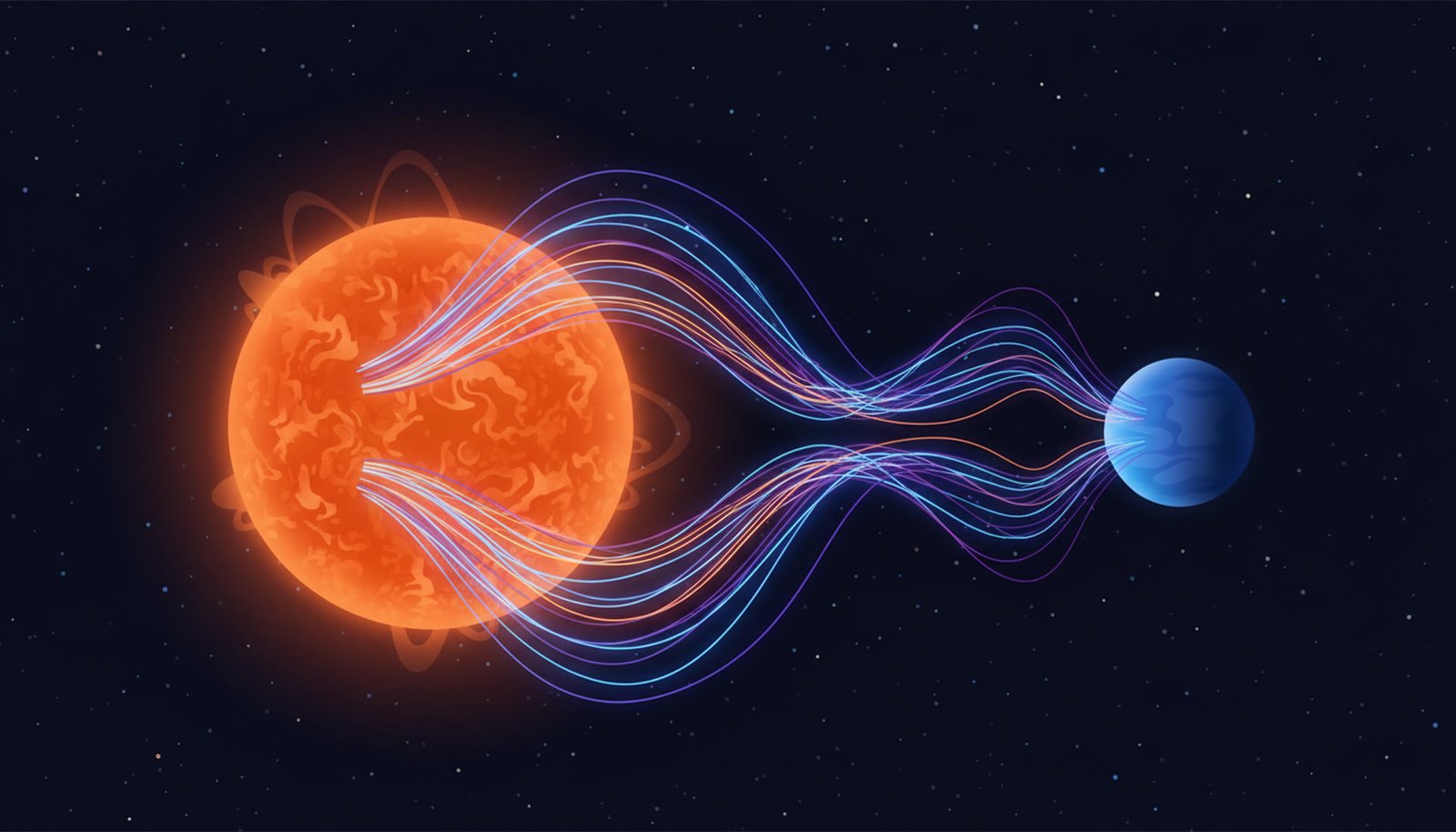
- A planet orbiting close enough to its star moves through a dense magnetic 'atmosphere', creating a shockwave like a boat moving through water.
- This magnetic connection can transfer enough energy to create a bright 'hot spot' on the star's surface that follows the planet's orbit.
- The magnetic drag is so strong it can cause planets to migrate, either spiraling into their star or being pushed further away over millions of years.
- A planet's own magnetic field acts like a shield; its orientation (north pole up or down) drastically changes the strength of the interaction.
- Astronomers have noticed a 'dearth' of close-in planets around fast-rotating stars, possibly because this magnetic interaction has already pulled them into the star.
The Discovery: More Than Just Gravity
When astronomers began discovering thousands of ‘hot Jupiters’—gas giants orbiting incredibly close to their stars—they found phenomena that gravity alone couldn’t explain. The Story began with puzzling observations: some host stars showed strange, synchronized flare-ups, while others seemed to have ‘cleared out’ zones with no close-in planets. Scientists realized these planets were so close they were orbiting *inside* the star’s extended magnetic field. This triggered a wave of research into star-planet magnetic interaction (SPMI). The models reviewed in this paper show how this interaction can explain the mysteries: planets ‘poking’ their stars to cause flares, and a magnetic ‘drag’ so powerful it could make planets spiral to their doom, explaining the empty zones.
Original Research Paper: ‘Models of Star-Planet Magnetic Interaction’
Magnetic interactions are today a serious candidate to explain these fascinating phenomena.
— Antoine Strugarek, Astrophysicist
The Science Explained Simply
Imagine a planet so close to its star that the star’s magnetic field is stronger than the stellar wind pushing outwards. This is the sub-Alfvénic regime. Now, this isn’t just a static field; it’s a dynamic plasma environment. As the planet orbits, it plows through this magnetic medium, creating a disturbance. The key concept is the Alfvén Wing. Instead of the disturbance spreading out, the energy gets focused and channeled along the magnetic field lines, creating two ‘wings’ that connect back to the star. This is NOT like a simple magnetic attraction. It’s an active, energetic connection that transfers momentum and power, acting like both a brake and a generator. It’s a constant, powerful interaction driven by the planet’s motion.
A close-in planet can be viewed as a perturber orbiting in the likely non-axisymmetric inter-planetary medium.
— Antoine Strugarek, Astrophysicist
The Aurora Connection
The beautiful auroras on Earth happen when the solar wind interacts with our planet’s magnetic field, channeling energy and particles into our atmosphere. Star-planet magnetic interaction is this exact process, scaled up to an incredible degree. The Alfvén wings are like the magnetic field lines that guide particles to Earth’s poles, but they carry vastly more energy. When this energy slams back into the star’s atmosphere, it can create a starspot—a stellar aurora. When it hits the planet’s atmosphere, it can trigger planetary auroras that would be thousands of times more powerful than our own. Studying these extreme interactions helps us understand the fundamental physics that protects Earth’s atmosphere and gives us our own gentle light shows.
A Peek Inside the Research
Modeling these interactions is incredibly hard. Early researchers used clever analogies, like treating the star-planet system as a simple electric circuit (the ‘unipolar inductor’ model). The planet’s motion acted as a generator, the magnetic field lines were the wires, and the planet and star were resistances. While useful, this was too simple. The real progress came from 3D magnetohydrodynamic (MHD) simulations. These are complex computer models that treat the star’s wind as a magnetized fluid. Researchers spend immense effort creating realistic ‘boundary conditions’ for the planet and star to ensure the simulation is accurate. These models, like those shown in the paper, are the tools that allow us to visualize the invisible magnetic games playing out between stars and their planets.
Key Takeaways
- Gravity isn't the only major force in solar systems; star-planet magnetic interaction (SPMI) is critical for close-in planets.
- 'Alfvén wings' are channels of energy that flow along magnetic field lines between a star and a planet, similar to a current in a wire.
- The interaction depends on whether the planet is magnetized ('dipolar') or not ('unipolar'). A magnetized planet has a shield, a non-magnetized one gets permeated.
- Observing the effects of SPMI, like pre-transit dips in starlight, could be one of the best ways to detect magnetic fields on distant exoplanets.
- These magnetic forces can heat planets, strip their atmospheres, and influence their entire evolutionary path.
Sources & Further Reading
Frequently Asked Questions
Q: Can this magnetic interaction happen between the Sun and Earth?
A: Yes, but it’s much, much weaker. Earth is far outside the Sun’s sub-Alfvénic zone, where the solar wind dominates. The interactions described in the paper are for exoplanets orbiting hundreds of times closer to their star than Earth does to the Sun.
Q: Can we actually see these magnetic fields?
A: Not directly, but we can see their effects. We can look for synchronized stellar flares, absorption of starlight from a planet’s bow shock just before it transits, or radio emissions from the planetary aurorae. These are the observable clues that tell us the magnetic interactions are happening.
Q: Could this force eventually destroy a planet?
A: Absolutely. The magnetic torque can cause a planet’s orbit to decay, making it spiral closer and closer to its host star until it’s consumed. This is a leading theory for why we don’t find many planets in extremely close orbits around certain types of stars.

Earth's Magnetic GPS: Mapping the Aurora
Summary
By the end of this article, you will understand why your compass doesn’t point to the geographic North Pole and how scientists use special ‘magnetic maps’ to track space weather and predict where the aurora will appear.
Quick Facts
- Earth's magnetic field is not perfectly aligned with its rotation axis; it's tilted.
- The magnetic poles are constantly moving, requiring scientists to update their maps every five years.
- By convention, we call the pole in the north the 'magnetic north pole', but the actual dipole axis of Earth's field points southward.
- The most precise magnetic 'grids' (like QD coordinates) are non-orthogonal, meaning their lines don't intersect at 90-degree angles, especially in the South Atlantic.
- Magnetic Local Time (MLT) is a system where 'noon' is defined by the Sun's position relative to the magnetic field, not geographic longitude.
The Discovery: Beyond the Bar Magnet
For centuries, we’ve known Earth acts like a giant bar magnet. Scientists first built coordinate systems based on this simple idea, called Centered Dipole (CD) coordinates. It was a good start, but observations of space phenomena didn’t quite line up. So, they created a more refined model where the ‘bar magnet’ was shifted from the Earth’s center—the Eccentric Dipole (ED) model. But even that wasn’t enough. The real magnetic field is complex and lumpy. The breakthrough came when scientists abandoned simple magnets and started using computers to trace the actual magnetic field lines from the full International Geomagnetic Reference Field (IGRF). This created incredibly accurate but mathematically tricky systems like Corrected Geomagnetic (CGM) and Quasi-Dipole (QD) coordinates, which are now essential for modern space science.
Original Paper: ‘Magnetic Coordinate Systems’ in Space Science Reviews
The improved accuracy comes at the expense of simplicity, as the result is a non-orthogonal coordinate system.
— K.M. Laundal & A.D. Richmond
The Science Explained Simply
Imagine a regular map grid where every line of latitude and longitude crosses at a perfect 90-degree angle. That’s an orthogonal system. Now, imagine stretching and warping that grid in some places. The lines would no longer be perpendicular. That’s a non-orthogonal system, and it’s exactly what the most accurate magnetic coordinates are like. This is NOT a mistake; it’s a true representation of Earth’s complex field. The key idea is that these coordinates are constant along a given magnetic field line. So if you travel up or down a field line, your Quasi-Dipole latitude and longitude don’t change. This makes them incredibly powerful for studying things like the aurora, which are guided by these very lines.
The deviation from orthogonality is particularly significant in the South Atlantic and in the southern parts of Africa.
— K.M. Laundal & A.D. Richmond
The Aurora Connection
The aurora is like a giant neon sign in the sky, lit up by charged particles from the solar wind that are guided by Earth’s magnetic field. If you plot auroral sightings on a regular geographic map, they appear in a scattered, messy pattern. But if you use a magnetic coordinate system like Corrected Geomagnetic (CGM) coordinates, the pattern snaps into focus: a perfect ring around the magnetic pole, known as the auroral oval. This is because the particles follow the magnetic field lines, not lines of geographic longitude. These coordinate systems are the ‘Rosetta Stone’ that allows us to understand the shape, location, and dynamics of the aurora, connecting what we see in the sky to the vast magnetic structures that protect our planet.
A Peek Inside the Research
Scientists can’t just ‘look’ at a magnetic field line. The work involves complex computation. They start with the International Geomagnetic Reference Field (IGRF), a global model built from satellite and ground-based magnetometer data. Using this model, they perform a process called field line tracing. A computer program starts at a specific point in the ionosphere (e.g., 110 km altitude) and calculates the direction of the magnetic field vector. It then takes a small step in that direction, recalculates, and repeats, stepping along the invisible magnetic line through space. By tracing this line to its highest point (the apex) or to where it crosses the equator, they can define accurate magnetic coordinates. This hard computational work is what makes modern, precise space weather forecasting possible.
Key Takeaways
- Geospace phenomena like the aurora are organized by the magnetic field, not geography.
- Scientists use different magnetic coordinate systems for different purposes, from simple dipole models for deep space to complex ones for the ionosphere.
- Simple models (like Centered Dipole) treat Earth like a perfect bar magnet, which is a good first approximation.
- Advanced models (like Quasi-Dipole) trace the real, messy magnetic field lines for high accuracy near Earth.
- Using vectors in advanced, non-orthogonal magnetic coordinates requires special mathematical handling to avoid errors.
Sources & Further Reading
Frequently Asked Questions
Q: Why are there so many different magnetic coordinate systems?
A: Different systems are tools for different jobs and different regions of space. Simple ‘dipole’ systems are good for high altitudes where the field is simple, while complex ‘field-line traced’ systems are needed for accuracy in the ionosphere where the aurora happens.
Q: What’s the difference between the magnetic pole and the geomagnetic pole?
A: The ‘magnetic pole’ (or dip pole) is where the field lines point straight down, which is what a compass would lead you to. The ‘geomagnetic pole’ is a theoretical concept based on the best simple dipole approximation of Earth’s field. They are in different locations and both move over time.
Q: Do I need to worry about this for my compass?
A: For basic navigation, your compass works fine by pointing to the magnetic dip pole. These advanced coordinate systems are specialized tools for scientists studying plasma physics and space weather on a global scale.
Auroral Whirlpools: The Hidden Electric Dance
Summary
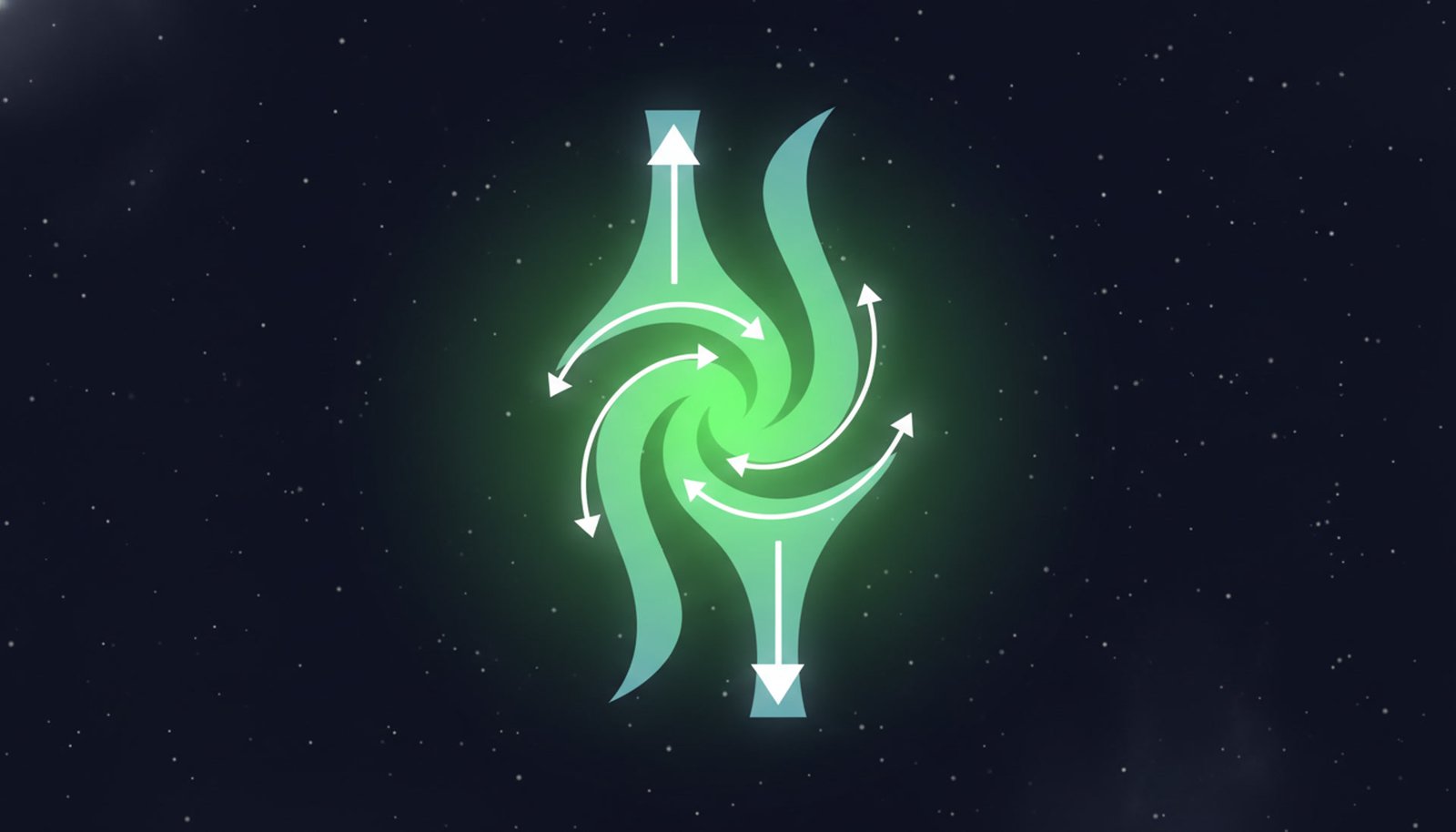
By the end of this article, you will understand why auroras don’t just hang there as curtains, but can form stunning street-like patterns of whirlpools, and how this is driven by a complex electrical circuit connecting Earth to deep space.
Quick Facts
- Surprise: These beautiful auroral whirlpools can form in less than a minute.
- The aurora isn't just light; it's the visible part of a giant electrical circuit in the sky.
- Surprise: The swirling is caused by a tug-of-war between two different types of horizontal currents in the ionosphere.
- These vortices are often the first sign of an explosive release of energy called an auroral substorm.
The Discovery: Cracking the Auroral Code
Scientists have long observed that at the start of a powerful auroral display (a substorm), simple arcs of light can suddenly brighten, split, and twist into a row of swirling vortices. But what causes this rapid, beautiful chaos? To solve this, Dr. Yasutaka Hiraki didn’t use a telescope. He used a supercomputer. The Story of this discovery is one of digital recreation. He created a 3D simulation of the ionosphere, placed a simple auroral arc inside it, and then simulated a surge of energy from space—an enhanced electric field. The result was stunning: the simulated arc buckled and deformed into a perfect vortex street in just 30-40 seconds, matching real-world observations. By analyzing the flow of currents in his simulation, he pinpointed the exact electrical feedback loop responsible for the dance.
Ionospheric current system accompanied by auroral vortex streets – Hiraki, Y. (2016)
Our previous work reported that an initially placed arc intensifies, splits, and deforms into a vortex street during a couple of minutes, and the prime key is an enhancement of the convection electric field.
— Yasutaka Hiraki, Author
The Science Explained Simply
This swirling isn’t just a random pattern. It’s caused by a specific process called Cowling Polarization. To understand it, let’s build a fence around the concept: this is NOT like water swirling down a drain. It’s an electrical feedback loop. Imagine two types of currents flowing horizontally in the ionosphere: the Hall current and the Pedersen current. When a bright aurora forms, it acts like a roadblock for the main Hall current. This causes electrical charge to pile up on the edges of the aurora. This pile-up creates a *new* electric field. This new field then drives a Pedersen current, which flows in a different direction and helps complete the circuit. The interaction between the original current, the roadblock, and the new current is what kicks off the spinning motion that forms the vortex.
One component is due to the perturbed electric field by Alfvén waves, and the other is due to the perturbed electron density (or polarization) in the ionosphere.
— Yasutaka Hiraki, Author
The Aurora Connection
These vortex streets, while appearing as local phenomena, are deeply connected to the grand-scale behavior of Earth’s magnetic field. They are the ionospheric footprints of Alfvén waves—powerful magnetic waves that travel from the Earth’s distant magnetotail, a region where immense energy from the solar wind is stored. When this stored energy is suddenly released during a substorm, it sends these waves racing towards Earth. The waves deliver the extra energy and electric field that destabilize the calm auroral arcs. So, when you see a vortex, you’re witnessing the precise moment that energy from millions of miles away makes its dramatic entrance into our atmosphere, all guided by the invisible architecture of our planet’s magnetic shield.
A Peek Inside the Research
This research is a perfect example of how modern science uses Knowledge and Tools. The core of this work is a ‘three-dimensional magnetohydrodynamic (MHD) simulation’. This is a fancy way of saying they created a virtual box of plasma (the superheated gas that makes up the aurora) and programmed in the fundamental laws of physics that govern how electricity, magnetism, and fluids interact. They then set the initial conditions—a calm atmosphere with a simple auroral arc—and pressed ‘play’. By observing how this digital aurora evolved when ‘poked’ by an external electric field, they could dissect the complex, high-speed chain of events in a way that is impossible to do by just looking at the sky.
Key Takeaways
- Salient Idea: Auroral shapes are dictated by the delicate balance of invisible electrical currents.
- Magnetic waves, called Alfvén waves, act as messengers, carrying energy from deep space down to our atmosphere.
- A process called 'Cowling Polarization' creates a feedback loop where currents generate new electric fields, which in turn drive new currents, causing the swirls.
- Computer simulations are essential for untangling these fast, complex interactions that we can't fully see with cameras alone.
Sources & Further Reading
Frequently Asked Questions
Q: Why do the vortices form in a ‘street’ or a row?
A: This pattern, known as a von Kármán vortex street, is common in fluid dynamics when a flow is disturbed. The instability in the auroral arc naturally settles into this organized, repeating pattern of counter-rotating swirls, which is the most energy-stable configuration.
Q: Can we see these auroral whirlpools with the naked eye?
A: Yes, but it requires a very active and fast-moving aurora. They happen quickly, so they are often better captured by sensitive, high-speed cameras that can reveal the swirling structure that might look like a chaotic flicker to our eyes.
Q: What’s the difference between Pedersen and Hall currents?
A: In the ionosphere, an electric field pushes charged particles. The Pedersen current flows in the direction of this electric field. However, because of Earth’s magnetic field, electrons are deflected sideways, creating the Hall current, which flows perpendicular to both the electric and magnetic fields.
Electron Showers Lower the Aurora's Ignition Point
Summary
By the end of this article, you will understand the hidden feedback loop that makes auroras suddenly explode in brightness, and why a ‘rain’ of electrons is the key to flipping the switch.
Quick Facts
- Auroras don't just 'turn on'; they need a strong enough 'push' from an electric field to intensify.
- Previous theories predicted this 'push' needed to be much stronger than what we actually observe in nature.
- The missing piece was a 'rain' of electrons that changes the electrical properties of the atmosphere.
- This electron shower makes the atmosphere more conductive, like adding salt to water.
- This increased conductivity lowers the 'ignition threshold' for an aurora by more than 50%.
The Discovery: Solving an Auroral Puzzle
For years, scientists were puzzled. Their models showed that for a quiet auroral arc to erupt into a dazzling display, it needed a very strong ‘push’ from a background electric field—about 25 to 45 millivolts per meter (mV/m). Yet, real-world radar observations showed these intensifications happening at much lower levels, around 10-20 mV/m. There was a disconnect between theory and reality. Dr. Yasutaka Hiraki’s research presents the Story of the solution. He introduced a crucial, previously under-appreciated effect: the ionization caused by precipitating electrons. These falling electrons energize the atmosphere, making it a better conductor. This single change in the model dramatically lowered the required energy threshold, perfectly aligning the theory with real-world observations.
It was found that the threshold of convection electric fields is significantly reduced by increasing the ionization rate.
— Yasutaka Hiraki, Researcher
The Science Explained Simply
Imagine Earth’s connection to space as a giant electrical circuit. The magnetosphere is the power source, and the ionosphere (our upper atmosphere) is like a resistor. Energy travels down this circuit via Alfvén waves. Now, this is NOT just about the waves delivering power. The key idea is that as these waves hit the atmosphere, they cause electrons to ‘precipitate’ or rain down. This rain of electrons ionizes the neutral air, which dramatically *lowers* the atmosphere’s electrical resistance. With lower resistance, the same amount of power from the magnetosphere can drive a much stronger current and amplify the Alfvén waves even more. This creates a runaway feedback loop, causing the aurora to suddenly and intensely brighten. It’s a self-fueling process.
The Aurora Connection
This research directly explains one of the most beautiful sights in the Arctic: the explosive onset of an auroral substorm. You might see a faint, quiet green arc hanging in the sky for minutes. Then, seemingly without warning, it erupts into swirling, dancing curtains of light that fill the sky. That sudden change is the moment the system crosses the now-lowered threshold. The positive feedback loop kicks in, the Alfvén wave instability grows exponentially, and the energy flowing down Earth’s magnetic field lines intensifies dramatically. The electron ‘rain’ didn’t just add to the light; it changed the rules of the game, allowing the main event to begin with less of a push.
The prime key is an enhancement of plasma convection, and the convection electric field has a threshold.
— Yasutaka Hiraki, Researcher
A Peek Inside the Research
This breakthrough didn’t come from a new telescope, but from powerful computer modeling and theoretical physics. Dr. Hiraki used a set of complex mathematical equations to simulate the magnetosphere-ionosphere (M-I) coupling system. This ‘digital twin’ of the auroral circuit allowed him to change one variable at a time. He modeled how Alfvén waves propagate and interact with the ionosphere. The crucial step was adding a term to his equations representing the ionization from precipitating electrons (the ‘q’ value). By running simulations with different ‘q’ values, he demonstrated precisely how this effect lowered the instability threshold, providing a clear, mathematical explanation for a long-standing mystery in space physics.
Key Takeaways
- Auroral intensification is driven by an instability of energy waves (Alfvén waves) traveling along Earth's magnetic field lines.
- Electron precipitation creates a positive feedback loop: the waves cause electrons to fall, which in turn makes it easier for the waves to grow stronger.
- The ionosphere isn't a static resistor in a cosmic circuit; its conductivity is dynamic and changes based on space weather.
- This model successfully explains why auroras can flare up suddenly even when the background energy conditions seem relatively calm.
Sources & Further Reading
Frequently Asked Questions
Q: What are Alfvén waves?
A: Alfvén waves are a type of electromagnetic wave that travels along magnetic field lines in a plasma. You can think of them like a vibration traveling down a guitar string, except the ‘string’ is one of Earth’s magnetic field lines, and the ‘vibration’ is carrying electrical current and energy that powers the aurora.
Q: So the falling electrons ARE the aurora?
A: Yes and no. The light of the aurora is produced when falling electrons strike atmospheric gases. But this research shows their *other* job is just as important: they change the conductivity of the atmosphere, which allows the *entire system* that accelerates them to become more powerful and unstable.
Q: Why is a ‘threshold’ so important?
A: A threshold explains why auroral displays aren’t constant. They can remain calm for a long time and then suddenly erupt. The system has to build up enough energy to cross that tipping point, and this research shows that electron precipitation effectively lowers the bar, making those eruptions happen more easily.
Hubble's Aurora Hunt: Our Cosmic Shield Detector
Summary
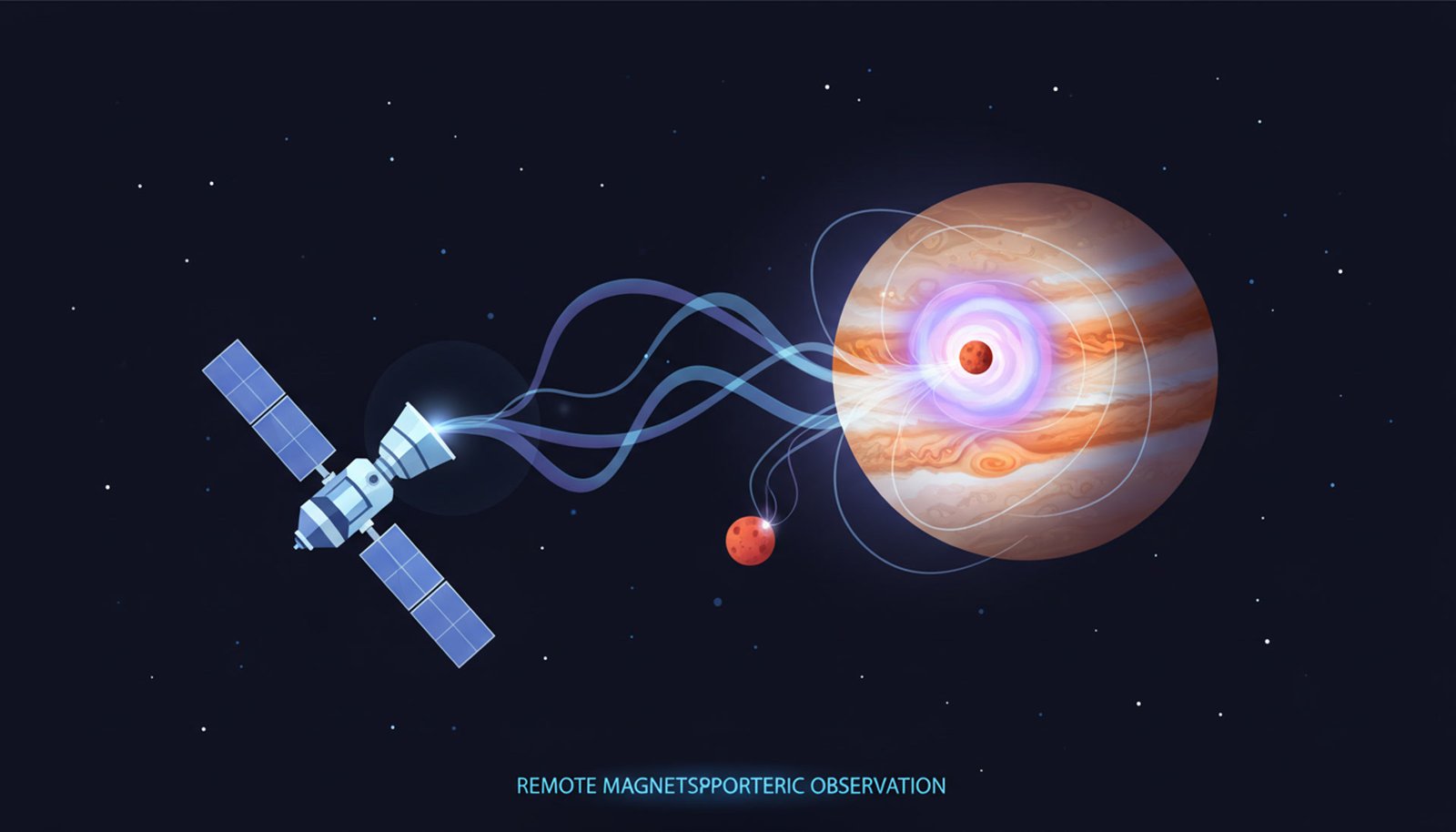
By the end of this article, you will understand how scientists use the Hubble Space Telescope to read the ‘light shows’ on giant planets, and how these auroras act as a powerful diagnostic tool for invisible magnetic fields and dangerous space weather.
Quick Facts
- Uranus's magnetic field is so tilted and off-center that its magnetosphere 'tumbles' as it rotates.
- Moons like Io and Ganymede create their own personal auroral 'footprints' on Jupiter's atmosphere.
- To see the full picture, scientists need two views at once: Hubble's 'big picture' from far away and a probe like Juno's 'close-up' from inside the system.
- Uranus's aurora is so faint that astronomers had to schedule Hubble's observations to coincide with solar storms hitting the planet.
- Unlike Earth's green auroras (from oxygen), Jupiter and Saturn's are mainly ultraviolet, caused by hydrogen.
The Discovery: The Perfect Cosmic Team-Up
For years, scientists have paired the Hubble Space Telescope with deep space probes for a one-two punch of discovery. The Story is one of perfect synergy: a probe like Cassini orbiting Saturn gets ‘in the mud’, measuring particles and magnetic fields up close, but it’s too close to see the whole picture. At the same time, Hubble, from its distant perch, captures the entire auroral oval in a single snapshot. By combining these two views, scientists can directly link a specific storm in the solar wind or a change in the magnetotail to a visible flare-up in the aurora. This paper highlights a unique opportunity in 2016-2017 when the Cassini mission at Saturn and the new Juno mission at Jupiter were both in their prime, creating a ‘Grand Finale’ of comparative studies.
Read the Original ‘White paper submitted in response to the HST 2020 vision call’
Such synergistic observations proved to be essential to assess complex magnetospheric processes.
— L. Lamy et al.
The Science Explained Simply
An aurora is NOT like a neon sign that is simply switched on. It is a dynamic process. It begins when charged particles—from the solar wind or a volcanic moon like Io—get trapped in a planet’s magnetic field. This field, like an invisible funnel, channels these high-energy particles toward the poles. As they accelerate down the magnetic field lines, they violently collide with gas in the upper atmosphere (like hydrogen on Jupiter). This collision excites the gas, causing it to glow. So, the aurora is a direct visual trace of where energy is being dumped into a planet’s atmosphere. Let’s build a fence: this is fundamentally different from a planet just reflecting sunlight. This is light the planet is *creating* itself in response to its space environment.
The Aurora Connection
Auroras are the best window we have into a planet’s magnetosphere—its protective magnetic shield. On Earth, this shield deflects the harmful solar wind, protecting our atmosphere and enabling life. Giant planets have magnetospheres thousands of times stronger. The size, shape, and brightness of their auroras tell us exactly how that shield is interacting with the solar wind, its own moons, and its rapid rotation. The Salient Idea is that by studying the ‘weird’ auroras of a planet like Uranus, with its tumbling magnetic field, we learn about the fundamental physics that governs all magnetic fields, including the one that keeps us safe here on Earth. They are cosmic laboratories for space weather.
Aurorae are therefore a direct, powerful, diagnosis of the electrodynamic interaction between planetary atmospheres, magnetospheres, moons and the solar wind.
— L. Lamy et al.
A Peek Inside the Research
Getting these images isn’t easy; it’s a testament to Knowledge and Tools. Scientists use specialized instruments on Hubble like STIS (Space Telescope Imaging Spectrograph) that can see in Far-Ultraviolet (FUV) light, which is invisible to our eyes but where hydrogen auroras shine brightest. The real challenge comes with the ice giants. The paper describes the difficult hunt for Uranus’s aurora. After failed attempts, they realized the emissions were too faint to see under normal conditions. Their solution was clever: they used models to predict when a solar storm (an interplanetary shock) would hit Uranus, and scheduled Hubble’s precious time to observe right then, maximizing their chances of seeing the aurora flare up. This shows research is not just pointing and shooting; it’s a game of strategy and prediction.
Key Takeaways
- Auroras are visual fingerprints of a planet's invisible magnetosphere.
- Comparing different planets (Jupiter vs. Uranus) reveals universal rules of plasma physics.
- The Hubble Space Telescope is currently our most powerful tool for observing alien auroras in ultraviolet light.
- Combining remote (HST) and in-situ (space probes) data is the gold standard for planetary science.
- Studying other magnetospheres helps us understand the dynamics of Earth's own protective magnetic shield.
Sources & Further Reading
Frequently Asked Questions
Q: Why can’t probes like Juno just take pictures of the whole aurora?
A: A probe like Juno flies very close to the planet. It’s like trying to take a picture of an entire football stadium while standing on the field. You get incredible detail of the grass and players near you, but you can’t see the whole game at once. Hubble provides that wide, contextual view from the nosebleed seats.
Q: Are auroras on other planets different colors?
A: Absolutely! The color of an aurora depends on what gas is being excited in the atmosphere. Earth’s are famously green and red from oxygen and nitrogen. Jupiter and Saturn’s atmospheres are mostly hydrogen, so their main auroras glow in pink and ultraviolet, which our eyes can’t see without special instruments.
Q: Do planets without magnetic fields have auroras?
A: Generally, no. A strong, global magnetic field is the key ingredient for creating the distinct auroral ovals at the poles. Planets like Venus and Mars lack this shield, so while they have some high-altitude ‘airglow’, they do not have the structured, powerful auroras we see on Earth or the giant planets.
The Magnetic Key to Earth's Shield
Summary
By the end of this article, you will understand how the direction of the interplanetary magnetic field (IMF) acts like a key, either locking Earth’s magnetic shield tight or opening cosmic highways for solar particles to create auroras.
Quick Facts
- Störmer's original theory from 1907 described 'forbidden zones' that particles couldn't enter.
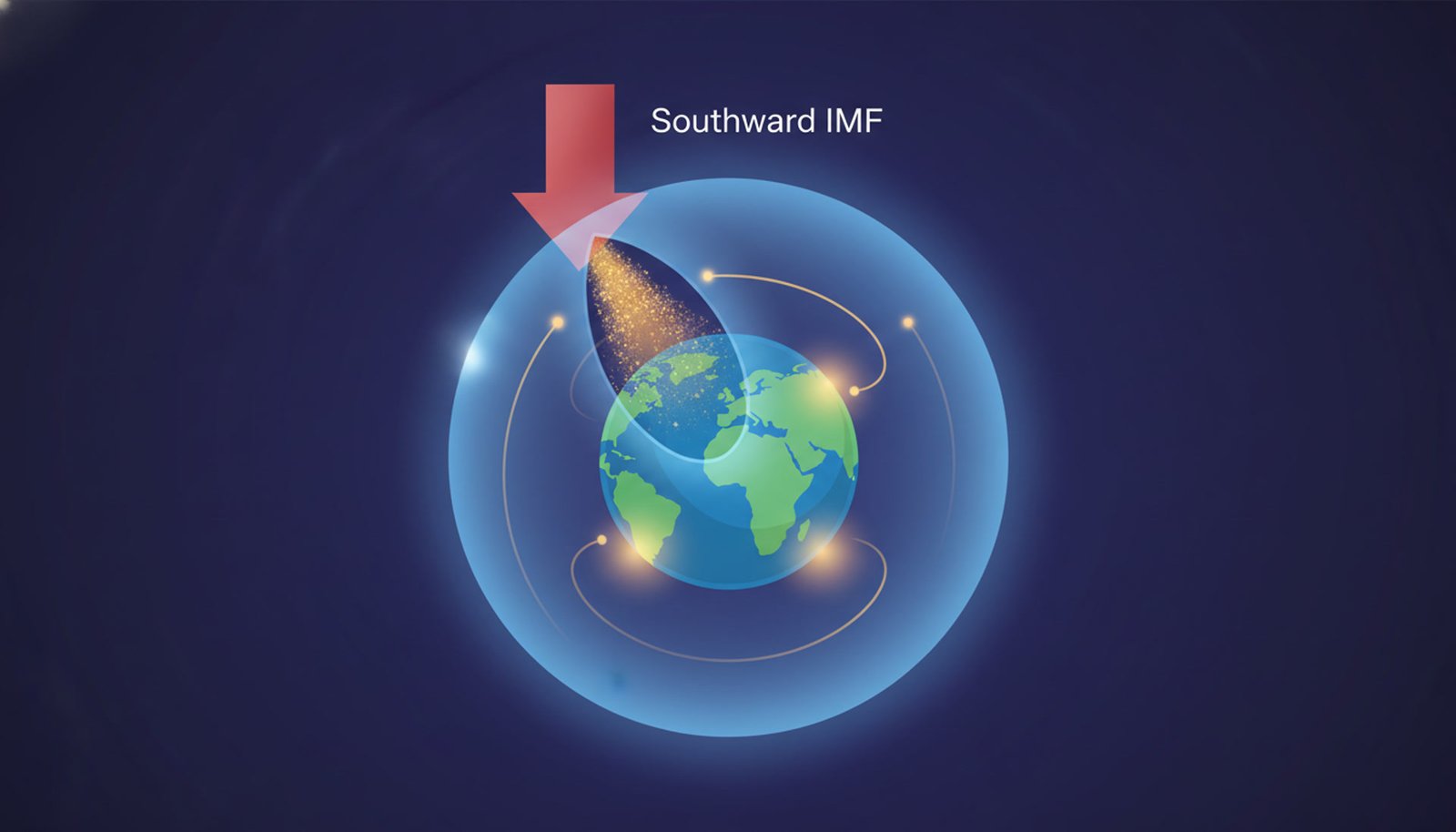
- A southward IMF can create interconnected magnetic field lines—a direct path from interplanetary space to Earth's polar caps.
- A northward IMF actually strengthens Earth's shield, making it harder for particles to get in and trapping existing particles more securely.
- The concept is visualized as a 3D 'potential landscape' where particles are like beads rolling around. A southward IMF carves a new valley into this landscape.
- This theory helps explain why auroras are so much more intense when the interplanetary magnetic field is oriented southward.
The Discovery: Updating a Century-Old Map
In 1907, Carl Störmer created a mathematical map for charged particles moving around Earth. His theory showed there were ‘allowed’ and ‘forbidden’ zones, explaining why some cosmic rays could reach us and others were deflected. But his model treated Earth’s magnetic field in isolation. The Story of this research is how J.F. Lemaire updated that map by adding one crucial detail: the Interplanetary Magnetic Field (IMF) carried by the solar wind. Lemaire showed that when the IMF points southward, it fundamentally changes the rules. It lowers the energy barriers and creates ‘interconnected’ pathways, allowing solar particles to flow into regions that were previously forbidden. This solved the long-standing problem of how auroral electrons could so effectively penetrate our defenses.
A southward turning of the IMF orientation makes it easier for Solar Energetic Particle and Galactic Cosmic Rays to enter into the inner part of the geomagnetic field.
— J.F. Lemaire, The Author
The Science Explained Simply
Imagine the space around Earth as a mountainous landscape of magnetic potential. In Störmer’s original theory, trapped particles, like those in the Van Allen belts, are stuck in a deep, closed-off valley called the ‘Thalweg’. To get in or out, a particle needs enough energy to climb over the high mountain pass. Now, let’s build a fence around this concept. This isn’t just about magnetic field lines guiding particles. It’s about an energy barrier. The Salient Idea is that a southward IMF doesn’t just nudge the particles; it lowers the entire mountain pass. Suddenly, particles with much lower energy can stream into the valley from interplanetary space, or escape from it. A northward IMF does the opposite: it raises the pass, locking the door even tighter.
The ‘pass’ between the inner and outer allowed zones opens up, when -F increases.
— J.F. Lemaire, The Author
The Aurora Connection
The aurora is the result of energetic particles from the sun hitting our upper atmosphere. But how do they get there? Lemaire’s work provides the answer. A southward IMF creates what he calls ‘interconnected magnetic field lines.’ Think of these as direct highways leading from the solar wind, over the lowered ‘mountain pass,’ and down into the polar regions (the cusps). Particles can then spiral freely down these highways without needing to overcome a huge energy barrier. This is why aurora forecasts are so dependent on the ‘Bz’ component of the IMF. A negative Bz (southward) means the cosmic highways are open for business, leading to a much higher chance of vibrant auroras.
A Peek Inside the Research
Instead of relying on massive, computer-intensive simulations that trace billions of individual particles, this study used a powerful analytical approach. Lemaire extended Störmer’s original mathematical framework, which assumed perfect cylindrical symmetry. By adding a uniform north-south magnetic field, he could derive a new, simple equation for the ‘Störmer potential.’ This elegant mathematical work allowed him to see the big picture: how the entire topology of allowed and forbidden zones shifts. It’s a prime example of how a deep understanding of the underlying physics and clever mathematics can reveal fundamental truths that might be missed in the complexity of a full simulation.
Key Takeaways
- Earth's magnetic field isn't a static shield; it's dynamically influenced by the Sun's magnetic field.
- The direction (north/south) of the Interplanetary Magnetic Field (IMF) is more important than its strength for particle entry.
- Störmer's theory was expanded to include the IMF, solving a century-old puzzle about particle access.
- A southward IMF lowers the 'geomagnetic cut-off,' allowing lower-energy particles to penetrate deeper into the magnetosphere.
- This model explains the entry mechanism for particles that cause strong auroras and populate the radiation belts.
Sources & Further Reading
Frequently Asked Questions
Q: What happens when the IMF is pointing northward?
A: When the IMF is northward, the magnetic ‘mountain pass’ gets higher. This makes it much harder for solar particles to enter the inner magnetosphere and makes it more difficult for particles already trapped in the radiation belts to escape.
Q: Is Störmer’s original theory wrong then?
A: No, it’s not wrong, just incomplete for describing real-world space weather. It’s a foundational model that works perfectly for a pure dipole magnetic field. Lemaire’s work is an extension that adds another layer of reality—the external IMF—to make it more accurate.
Q: Does this apply to other planets?
A: Absolutely! Any planet with a significant magnetic field, like Jupiter or Saturn, will experience similar effects. The interaction between their magnetospheres and the solar wind’s IMF will determine how particles get in and create their own massive auroras.

Plasma Storms Found in the Northern Lights
Summary
By the end of this article, you will understand how scientists discovered the first direct evidence of ‘cavitating turbulence’—a process where intense plasma waves create dynamic, energy-filled bubbles inside the aurora.
Quick Facts
- This was the first direct proof of this violent plasma process happening naturally anywhere in space or astrophysics.
- The electron beams that create the beautiful aurora are also the power source for these plasma storms.
- The 'plasma bubbles,' known as cavitons, are only a few meters wide but occur hundreds of kilometers up in the atmosphere.
- Scientists used a powerful radar in Norway to listen for the specific 'echoes' these plasma waves produce.
- The key evidence was a unique signal—a 'central peak'—which is the smoking gun for cavitons.
The Discovery: Listening to a Plasma Storm
On a November night in 1999, scientists at the EISCAT radar in Norway were studying an intense aurora. They weren’t just watching the lights; they were probing the plasma high above. Their experiment was designed to detect two types of plasma waves: Langmuir and ion-acoustic. Suddenly, their screens lit up with a pattern that had been theorized but never seen in the wild. They detected strong signals from *both* types of waves at the same altitude and time. Even more telling was a Surprise feature in the ion-acoustic data: a strong, stationary central peak. This specific combination was the predicted ‘fingerprint’ of cavitating Langmuir turbulence. The data showed that the aurora’s electron beam was powerful enough to not just create waves, but to make those waves violently carve out bubbles in the plasma itself.
Original Paper: ‘Cavitating Langmuir Turbulence in the Terrestrial Aurora’
The data presented here are the first direct evidence of cavitating Langmuir turbulence occurring naturally in any space or astrophysical plasma.
— B. Isham et al.
The Science Explained Simply
This process is called ‘cavitating Langmuir turbulence.’ Imagine a powerful beam of auroral electrons shooting through the ionosphere’s plasma. This creates high-frequency energy waves, called Langmuir waves. Now, this is NOT like ripples in a pond. When these waves become incredibly intense, they act like a snowplow, physically pushing the surrounding charged particles out of the way. This creates a temporary, low-density ‘bubble’ or cavity—a caviton. The Langmuir waves then become trapped inside their own bubble, which makes them even stronger, until the whole structure collapses. This is the difference between gentle ‘weak’ turbulence and this violent, self-reinforcing ‘strong’ turbulence.
In its most developed form, this turbulence contains electron Langmuir modes trapped in dynamic density depressions known as cavitons.
— Research Paper Abstract
The Aurora Connection
The Northern Lights are more than just a beautiful display; they are the visible result of Earth’s magnetic field guiding high-energy electrons from the solar wind into our upper atmosphere. These same beams of electrons act as the engine for cavitating turbulence. The aurora provides the ‘pump’ of energy needed to drive plasma waves to their breaking point, where they begin to form cavitons. This discovery shows that the beautiful, dancing curtains of light are also sites of incredibly energetic and complex plasma physics. Understanding this process helps us model space weather and how energy from the sun is deposited into our atmosphere, which can affect satellites and radio communication.
A Peek Inside the Research
This discovery relied on the perfect combination of Tools and Knowledge. The tool was the EISCAT incoherent scatter radar, which can measure the faint echoes from different plasma waves. The knowledge came from the Zakharov equations, a set of theoretical physics equations from the 1970s that describe this exact behavior. The researchers ran computer simulations using these equations, feeding them the plasma conditions measured during the aurora (see Figure 4). The simulated radar signal was a near-perfect match for what they observed in reality (Figure 3), specifically the enhanced ‘shoulders’ and the critical ‘central peak’. This match between observation and simulation turned a strange radar signal into a landmark discovery.
Key Takeaways
- The aurora is a natural laboratory for extreme plasma physics.
- Strong Langmuir turbulence creates temporary, low-density cavities (cavitons) in plasma.
- These cavitons trap high-frequency plasma waves, causing them to intensify until they collapse.
- Simultaneous radar detection of Langmuir and ion-acoustic waves, plus a central peak, is the signature of this process.
- Computer simulations were essential to confirm that the observed radar data matched the theory of cavitation.
Sources & Further Reading
Frequently Asked Questions
Q: What is ‘Langmuir turbulence’?
A: It’s a type of disturbance that happens in plasma, which is a gas of charged particles. When a beam of electrons passes through it, it can create waves, much like a speedboat creates a wake in water. This paper is about a particularly strong, or ‘cavitating,’ form of this turbulence.
Q: Why is this discovery so important?
A: Scientists had created this effect in labs and predicted it happened in space, but this was the first time they found direct proof of it occurring naturally. It confirms a fundamental theory of plasma physics and shows it happens in places like the aurora, pulsars, and the sun’s corona.
Q: Can we see these ‘cavitons’ with our eyes?
A: No, they are far too small, only a few meters across, and occur in the very thin plasma of the ionosphere hundreds of kilometers up. We can only detect their effects using highly sensitive instruments like the EISCAT radar.
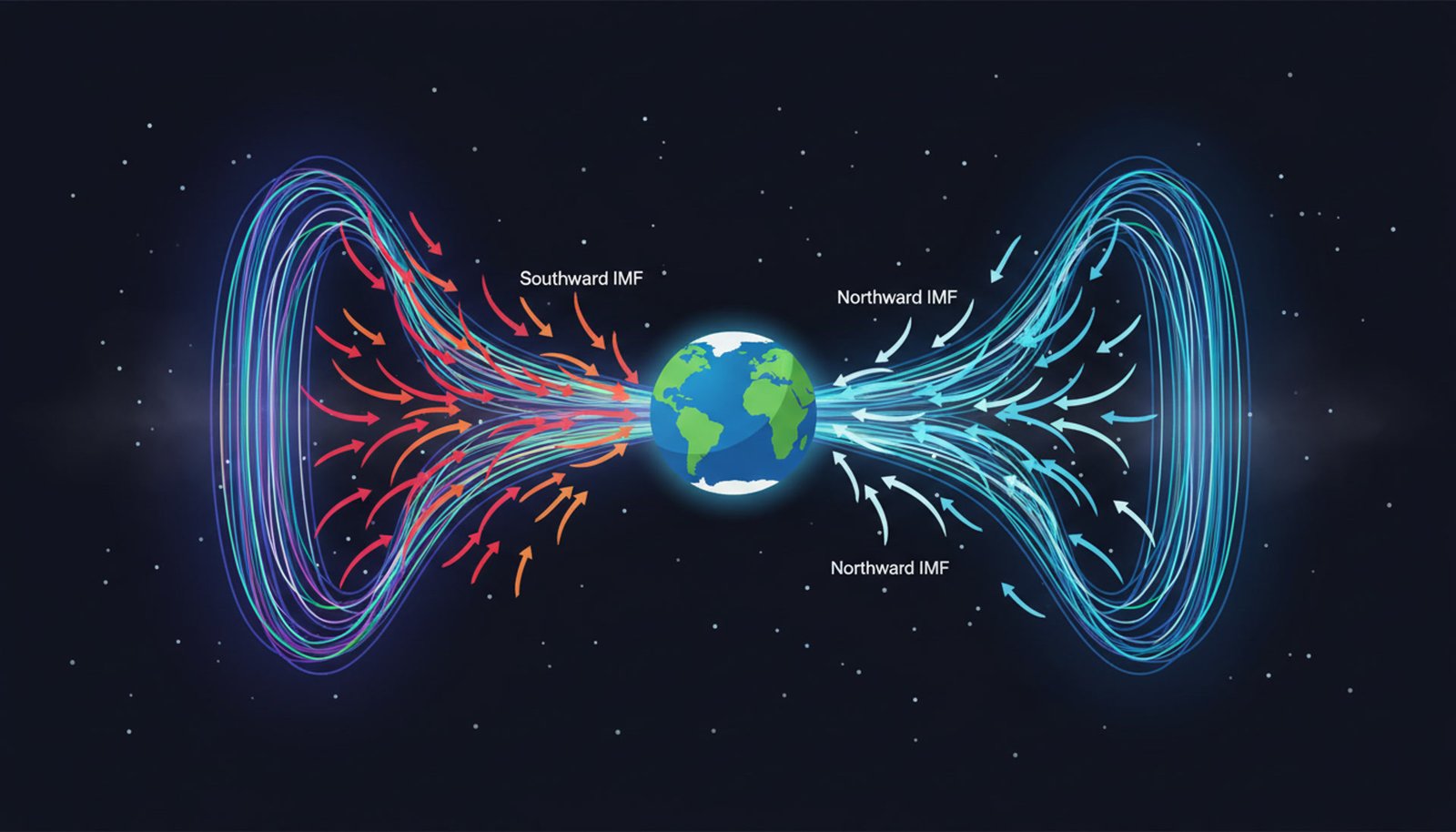
Earth's Magnetic Shield Breathes
Summary
By the end of this article, you will understand a powerful and simple new way to think about space weather: that Earth’s magnetosphere physically expands and contracts like it’s breathing, and how this simple idea explains the complex relationship between magnetic storms, substorms, and the aurora.
Quick Facts
- Surprise: A substorm, often seen as part of a storm, can actually weaken the main magnetic storm by rapidly releasing energy.
- It takes the auroral oval about 45 minutes to expand after the solar magnetic field turns south, but 8 hours to contract after it turns north.
- The model predicts that during long periods of calm, 'dents' should form on the pre-noon and post-noon sides of our magnetic shield.
- The mysterious 'theta aurora', a glowing bar across the polar cap, can be explained by a severely contracted magnetosphere splitting the magnetotail.
The Discovery: Solving a Cosmic Puzzle
For decades, scientists have used a complex model called ‘magnetic reconnection’ to explain space weather. But some observations never quite fit, like why the main phase of a magnetic storm begins *before* the first substorm, or why substorms can sometimes weaken a storm. This research proposes a simpler Story: what if the magnetosphere behaves like a simple physical object? The paper shows that by treating the interaction as an attraction or repulsion—like two magnets—many of these puzzles disappear. A southward Interplanetary Magnetic Field (IMF) attracts and expands Earth’s field, creating a storm. A northward IMF repels and contracts it. This ‘breathing’ model provides an intuitive framework that matches observations without the theoretical problems of older models.
Original Paper: ‘Magnetic Storm-substorm Relationship and Some Associated Issues’ by E. P. Savov
The expansion (contraction) of magnetosphere accounts for the observed expansion (contraction) of the auroral oval.
— E. P. Savov, Researcher
The Science Explained Simply
Imagine the Sun sends out a magnetic field (the IMF). When the IMF arriving at Earth points south, its field lines align with Earth’s in an attractive way. This pulls Earth’s magnetic shield outward, expanding it and allowing it to capture more energy and particles from the solar wind. This is the ‘growth phase’ of a storm. Now, let’s build a fence: this is NOT the same as ‘magnetic reconnection’ where field lines are thought to break and re-form. Think of it more as a balloon inflating. Conversely, when the IMF points north, the fields repel each other. This squeezes and contracts the magnetosphere, pushing the solar wind away more effectively and leading to calmer space weather. The Salient Idea is that this simple push-and-pull dynamic governs the entire system.
The Aurora Connection
The location of the aurora is a direct visual indicator of this breathing. During a magnetic expansion (southward IMF), the boundaries of the magnetosphere are pushed out, and the auroral oval shifts towards the equator. This is why auroras are seen at lower latitudes during big storms. During a contraction (northward IMF), the oval shrinks back towards the pole. What about a substorm? The model explains the explosive phase as a rapid, partial *contraction* of the over-stretched magnetotail. This contraction violently flings particles back towards Earth, creating the bright, dynamic auroral surges on the poleward edge of the oval. A very strong, prolonged contraction can even bifurcate the magnetotail, creating the rare and beautiful transpolar arc known as a ‘theta aurora’.
A Peek Inside the Research
This isn’t just an idea; it’s backed by calculation and a proposal for a physical test. The author calculated the expected average thickness of the magnetopause boundary layer based on the observed 45-minute expansion and 8-hour contraction times of the aurora. The result, about 0.44 Earth radii, matches spacecraft observations perfectly. To further prove the concept, the paper outlines an upgrade to the famous 19th-century ‘terrella’ experiment. By adding a second large magnetic coil to simulate the IMF, a lab could physically demonstrate the expansion and contraction of the artificial auroral oval by simply flipping the polarity of the external ‘solar’ magnet. This brings a grand cosmic theory down to a testable, hands-on experiment.
The suggested 3D-spiral magnetic reconfiguration… avoids the topological crisis.
— E. P. Savov, on why this model is simpler
Key Takeaways
- Southward IMF acts like an attracting magnet, causing Earth's magnetosphere to expand and create storms.
- Northward IMF acts like a repelling magnet, causing the magnetosphere to contract and become quiet.
- A magnetic storm is just a very large, prolonged expansion of the magnetosphere.
- A substorm's explosive phase is a rapid, partial contraction that releases accumulated energy, creating auroral surges.
Sources & Further Reading
Frequently Asked Questions
Q: So does a substorm cause a magnetic storm?
A: According to this model, no. A magnetic storm is a large expansion of the magnetosphere caused by a long period of southward IMF. A substorm is a smaller expansion (growth phase) followed by a rapid, partial contraction (expansion phase) that releases energy, often weakening the larger storm.
Q: Why is this model better than the old ‘magnetic reconnection’ one?
A: The author argues it’s simpler and avoids certain theoretical problems, a principle known as Occam’s Razor. It explains confusing observations, like the storm-substorm timing, more intuitively by likening the magnetosphere’s behavior to simple magnetic attraction and repulsion.
Q: What happens when the solar wind pressure increases?
A: Higher solar wind pressure pushes on the magnetosphere, creating a longer, thicker magnetotail. This thicker tail is better at ‘catching’ the southward IMF, which then drives an even stronger expansion and a more intense magnetic storm.
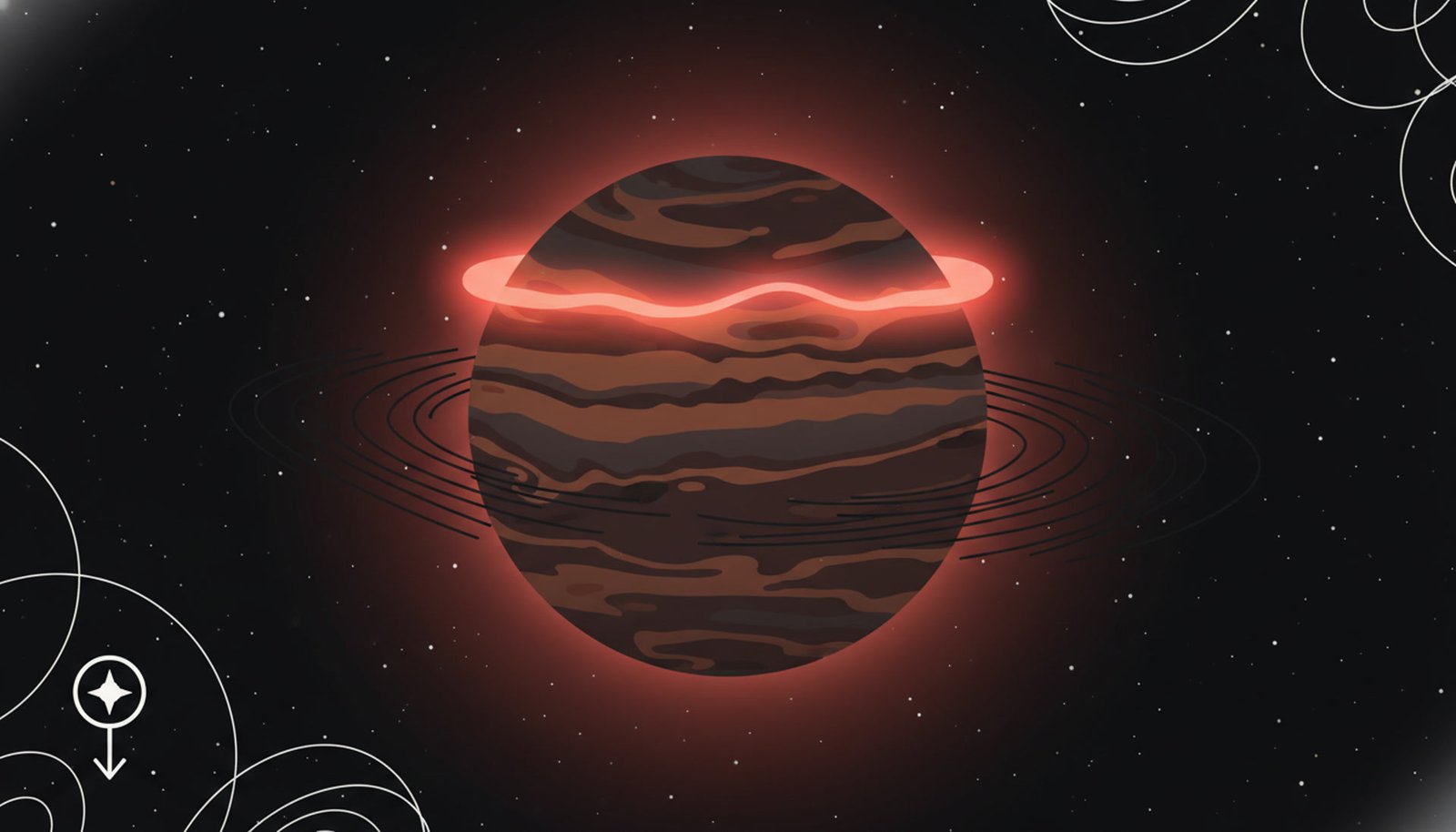
JWST's Weather Report: Auroras Heat a Brown Dwarf
Summary
By the end of this article, you will understand how astronomers create weather maps for worlds light-years away and learn that the ‘weather’ on some objects is driven by powerful auroras, not clouds.
Quick Facts
- Surprise: SIMP-0136 spins so fast its 'day' is only 2.4 hours long.
- The primary driver of its brightness changes isn't shifting clouds, but temperature changes deep in its atmosphere.
- It has a permanent 'thermal inversion'—a hot layer high up—that is 250°K warmer than expected.
- This heating is likely caused by an aurora powered by a magnetic field hundreds of times stronger than Jupiter's.
- Despite being a 'failed star', it generates its own powerful auroral displays without a nearby sun.
The Discovery: An Unexpected Atmospheric Fever
A team of astronomers used the JWST to stare at SIMP-0136, a nearby brown dwarf, for one full rotation. They expected a familiar Story: that the object’s flickering brightness was caused by patchy clouds rotating in and out of view. But their computer models, designed to work backward from the light spectra, revealed a Surprise. To explain the data, the clouds had to be mostly static. The real action was a dramatic temperature change high in the stratosphere. At all times, there was a ‘thermal inversion’—a layer about 250 Kelvin hotter than it should be. The primary variability wasn’t from clouds below, but from this mysterious heat from above.
This work paints a portrait of an L-T transition object, where the primary variability mechanisms are magnetic and thermodynamic in nature, rather than due to inhomogeneous cloud coverage.
— E. Nasedkin et al., Lead Authors
The Science Explained Simply
Normally, as you go higher in a planet’s troposphere, it gets colder. A thermal inversion flips this script: a layer of the atmosphere is hotter than the layer below it. This is NOT like the ground warming up on a sunny day. An inversion requires energy to be deposited directly into the upper atmosphere, like a heater installed in the ceiling. On Earth, our ozone layer does this with UV light. On SIMP-0136, with no star nearby, the energy source must be different. The Salient Idea is that this inversion acts as a giant fingerprint pointing to an external energy source—in this case, energetic particles guided by a magnetic field.
The temperature gradient inverts, and begins increasing with increasing altitude… This is clearly in contrast with the self-consistent forward models, which are usually monotonically decreasing.
— From the Research Paper
The Aurora Connection
The heat source is almost certainly a powerful aurora. Previous radio observations already hinted that SIMP-0136 has one. The research suggests a magnetic field of around 3000 Gauss—hundreds of times stronger than Jupiter’s—is accelerating particles and slamming them into the atmosphere. This is the same process that creates Earth’s Northern Lights, but on an epic scale. These particles dump their energy high in the stratosphere, creating the observed permanent ‘heat wave’. SIMP-0136 is a self-contained aurora generator, teaching us how magnetic fields can fundamentally shape planetary atmospheres, even in the lonely darkness between stars.
A Peek Inside the Research
This discovery relied on a technique called time-resolved atmospheric retrieval. The team didn’t just take one snapshot; they collected thousands of light spectra over 3.5 hours as the brown dwarf rotated. Each spectrum was fed into a complex computer model called `petitRADTRANS`. This program tested millions of possible atmospheric conditions—different temperatures, chemicals, and cloud structures—to find the combination that perfectly matched the JWST data for that specific moment. By comparing the ‘best-fit’ models from 24 different rotational phases, they built a dynamic weather map and proved the temperature, not the clouds, was the main thing changing.
Key Takeaways
- Atmospheric variability isn't always caused by clouds; magnetic forces can be the primary driver.
- A 'thermal inversion' is a key fingerprint of energy being deposited into an atmosphere from above, such as by an aurora.
- Using time-series spectroscopy, JWST can create dynamic 'weather maps' of distant brown dwarfs.
- Brown dwarfs can host powerful, self-generated auroras, providing a natural laboratory for studying magnetic fields.
Sources & Further Reading
Frequently Asked Questions
Q: If the clouds aren’t changing, why does SIMP-0136 have them?
A: The models show that patchy silicate clouds are necessary to explain the overall spectrum of SIMP-0136. However, these patches don’t seem to rotate in a way that causes the main brightness variations. They are a static feature of the landscape, while the temperature changes are the active ‘weather’.
Q: Can we see this aurora with our eyes?
A: Probably not. The auroral emission signatures typically sought, like H3+, haven’t been detected yet. The ‘aurora’ here is detected indirectly through the intense heating it causes in the atmosphere, which JWST can measure in the infrared.
Q: How can it have an aurora without a sun and solar wind?
A: The mechanism isn’t fully understood, but it’s believed that rapidly rotating brown dwarfs like SIMP-0136 can generate their own charged particles and powerful magnetic fields. This creates a self-contained system that powers its own aurora, independent of a nearby star.
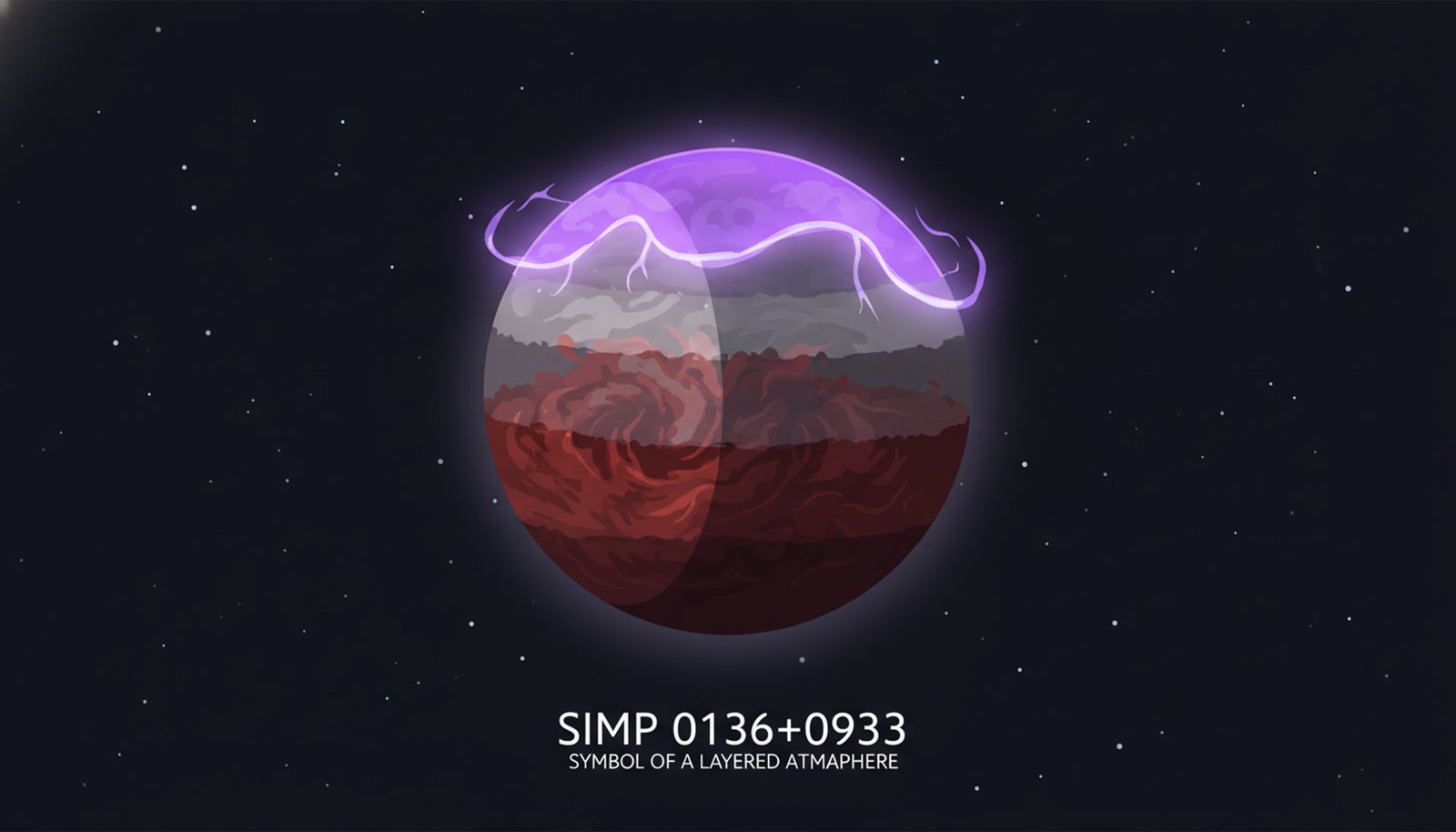
A Rogue Planet with Three Storms at Once
Summary
By the end of this article, you will understand how astronomers use the JWST to create a ‘weather report’ for a planet without a star, revealing a complex atmosphere where clouds, auroral hot spots, and chemical changes all happen simultaneously at different altitudes.
Quick Facts
- This object, SIMP 0136, is a 'rogue planet' that doesn't orbit a star.
- A full day on this world is only 2.4 hours long, making it spin incredibly fast.
- Surprise: Despite having no star, it has powerful aurorae detected via radio waves.
- The weather isn't the same everywhere; different phenomena occur at different atmospheric depths, or pressures.
- No single explanation, like just clouds, could account for the complex changes in brightness JWST observed.
The Discovery: Decoding a Cosmic Weather Report
Scientists pointed the James Webb Space Telescope at SIMP 0136+0933, a well-known rogue planet, to watch its weather over one full 2.4-hour rotation. The Story they uncovered was far more complex than just the patchy clouds seen before. As the planet spun, its brightness changed, but the pattern of that change was different depending on the wavelength of infrared light they looked at. Some patterns had one dip in brightness, others had two. To solve this puzzle, they realized they weren’t seeing one weather system, but several stacked on top of each other. JWST’s power allowed them to see that deep in the atmosphere, iron and silicate clouds were swirling. But higher up, a completely different mechanism was at play: a ‘hot spot’ and shifting carbon chemistry, likely supercharged by the planet’s powerful aurorae.
Original Paper: ‘The JWST Weather Report from the Isolated Exoplanet Analog SIMP 0136+0933’
We show that no single mechanism can explain the variations… these measurements reveal the rich complexity of the atmosphere of SIMP J013656.5+093347.3.
— Allison M. McCarthy et al.
The Science Explained Simply
The key concept is ‘pressure-dependent variability’. This is NOT like looking at Earth and just seeing one layer of clouds. Imagine having multiple pairs of X-ray glasses, each tuned to a different material. One pair lets you see bones, another sees muscle. JWST does this with infrared light. Different wavelengths can escape from different depths of a planet’s atmosphere. Light from deep inside (high pressure) is blocked by clouds, so we see variations from those clouds. Light from high up (low pressure) is affected by other things, like aurora-driven hot spots. By tracking the brightness of each individual wavelength over time, scientists can essentially create a 3D weather map and assign different weather phenomena to different altitudes. It’s a way to dissect an atmosphere light-years away.
The Aurora Connection
How can a planet without a star have aurorae? While Earth’s aurorae are powered by the solar wind, rogue planets can generate them through other means. SIMP 0136’s powerful magnetic field could be interacting with interstellar plasma as it travels through the galaxy, or it could have an undiscovered moon creating an electrical circuit, similar to Jupiter and its moon Io. The paper suggests this powerful auroral activity is the best explanation for the ‘hot spots’ observed high in the atmosphere. This intense energy injection from the magnetic field heats the gas, causing it to glow brightly in the infrared and altering the local chemistry. This finding confirms that magnetic fields are crucial drivers of atmospheric phenomena, even on the loneliest worlds.
Strong aurorae in SIMP 0136+0933… suggest that an aurorally-driven temperature inversion may be plausible…
— Allison M. McCarthy et al.
A Peek Inside the Research
The researchers faced a deluge of data: hundreds of individual light curves, one for each specific wavelength JWST measured. Analyzing them one by one would be impossible. Their clever Tool was a machine learning algorithm called K-means clustering. They fed all the differently shaped light curves into the algorithm, which automatically sorted them into groups based on similarity. It found 9 distinct families of light curves in the data. This grouping was the crucial step. It allowed scientists to say, ‘All these wavelengths in Cluster 7 behave the same way, so they must be probing the same deep silicate cloud layer.’ This use of data science turned a chaotic dataset into a clear, layered map of the planet’s atmosphere.
Key Takeaways
- Salient Idea: Weather on other worlds can be driven by multiple, stacked mechanisms at once.
- JWST's spectroscopy acts like a CAT scan for atmospheres, probing different layers using different infrared wavelengths.
- Rogue planets are not inert; they have dynamic, complex weather systems.
- Auroral activity can create high-altitude 'hot spots' that significantly alter atmospheric chemistry and brightness.
Sources & Further Reading
Frequently Asked Questions
Q: What is an ‘isolated exoplanet analog’?
A: It’s a planet-sized object that is not gravitationally bound to a star, so it drifts through space on its own. They are also called rogue planets, and they are useful for studying planetary atmospheres without the blinding glare of a nearby star.
Q: Why does the weather change with depth?
A: Just like on Earth, temperature and pressure change dramatically with altitude. On SIMP 0136, it’s only deep enough and hot enough for iron and silicate to form clouds. Higher up, the pressure is too low for those clouds, but that’s where auroral energy can create hot spots.
Q: Is this weather similar to Jupiter’s?
A: Yes, in some ways! The paper notes that Jupiter and Saturn also have multiple cloud layers and high-altitude hot spots. This discovery suggests that complex, layered atmospheric phenomena are common on gas giants, both in our solar system and beyond.

Two Auroras, One Sky: A Cosmic Spiral and a Polar Arc
Summary
By the end of this article, you will understand how a giant, straight aurora can appear at the same time as a small, swirling one, and what this rare event tells us about the invisible power grid in Earth’s magnetosphere.
Quick Facts
- A global-scale aurora (the Transpolar Arc) and a local one (the Spiral) appeared simultaneously.
- This happened during the late recovery phase of a geomagnetic substorm.
- The power source for the spiral was about three orders of magnitude (1,000 times) weaker than the arc's.
- The source of both auroras in the magnetotail was a long, stretched-out region, even though the spiral looked like a small spot in the sky.
- Scientists needed two different supercomputer simulations to replicate the event.
The Discovery: An Unexpected Cosmic Duo
The Story begins on January 10, 1997. As Earth was recovering from a magnetic substorm, satellite images from the Polar UVI instrument captured something unusual. A massive, faint ribbon of light, a Transpolar Arc (TPA), stretched across the entire north pole. At the same time, a ground camera in Svalbard, Norway, spotted a small, bright, whirlpool-like aurora, known as an auroral spiral. This was a puzzle; these two types of aurora are usually driven by very different conditions. Using modern global MHD (magnetohydrodynamic) simulations, scientists re-created the event. Their models confirmed the Surprise: both could exist at once, but the spiral was a ghost, powered by an electrical current about 1,000 times weaker than the arc.
A global-scale transpolar arc and local-scale auroral spiral can appear simultaneously.
— Nowada et al., Key Points
The Science Explained Simply
The key concept is Field-Aligned Currents (FACs). Think of them as invisible electrical wires connecting Earth’s distant magnetotail to our upper atmosphere, carrying particles that create auroras. To Build a Fence around this idea: it’s NOT that the spiral is just a smaller version of the arc. The TPA is like a huge, stable power line, drawing steady energy from a vast region of the magnetotail. The auroral spiral, however, is like a tiny, flickering, twisted wire formed by a much weaker and more localized process. The research suggests the spiral’s source region had lower plasma density and a stronger magnetic field, which physics predicts would create a weaker current, explaining the huge power difference.
The magnetotail field-aligned current (FAC) intensity of the auroral spiral was about 3 orders of magnitude weaker than that of the TPA.
— Nowada et al., Key Points
The Aurora Connection
These two coexisting auroras act as visual reporters for the complex state of Earth’s magnetic environment. They show us that the magnetosphere isn’t just ‘on’ or ‘off’. Even during a ‘recovery’ phase, it’s a dynamic place. The TPA tells us about large-scale, slow changes in the entire magnetotail, likely related to the orientation of the solar wind’s magnetic field. The spiral, on the other hand, hints at smaller, faster processes, possibly linked to plasma waves rippling through the magnetic field lines. Observing them together provides a more complete weather report of our planet’s shield against the solar wind, revealing both the calm, large-scale fronts and the small, local eddies.
A Peek Inside the Research
This discovery relied on combining three types of Knowledge and Tools. First, historical satellite data from Polar UVI provided the global picture. Second, two powerful but different global MHD simulation codes, BATS-R-US and REPPU, were used to model the physics of the magnetosphere and ionosphere. These simulations were the only way to estimate the strength of the invisible currents. Finally, ground-based magnetometer data from the IMAGE network provided ‘ground truth’, confirming the direction of the current associated with the spiral. This synergy—linking space observations, theoretical models, and ground measurements—is how scientists unravel the complex processes that drive space weather.
A new solar wind-magnetosphere-ionosphere coupling system with minimal substorm effects is required to explain weak spiral FAC formation.
— Nowada et al., Key Points
Key Takeaways
- Earth's magnetosphere can support large, stable energy flows and small, weak instabilities at the same time.
- An auroral spiral can be formed by surprisingly weak field-aligned currents (FACs).
- The shape of an aurora in the sky (e.g., a spot) can map to a very different shape in space (e.g., a long tail).
- Computer simulations are essential tools for understanding the complex physics behind what satellites observe.
- ULF (Ultra-Low-Frequency) waves in the magnetosphere might play a role in creating auroral spirals.
Sources & Further Reading
Frequently Asked Questions
Q: Why was the spiral’s current so much weaker?
A: The simulations showed the spiral’s source in the magnetotail was in a region with lower plasma density and a stronger magnetic field. Physics equations show that these conditions naturally produce a much weaker electrical current compared to the TPA’s source region.
Q: Could you see both auroras from the ground at the same time?
A: It would be extremely difficult. The auroral spiral is a small, local feature you might see if you were right underneath it. The Transpolar Arc is enormous and faint, stretching across the entire polar cap, making it very hard to see its full structure from one location.
Q: What is a geomagnetic substorm?
A: A substorm is a brief but intense disturbance in Earth’s magnetosphere that releases a huge amount of energy. This energy release causes the auroras to brighten dramatically and expand, creating the brilliant displays many people are familiar with. This event was observed after the main part of the substorm was over.
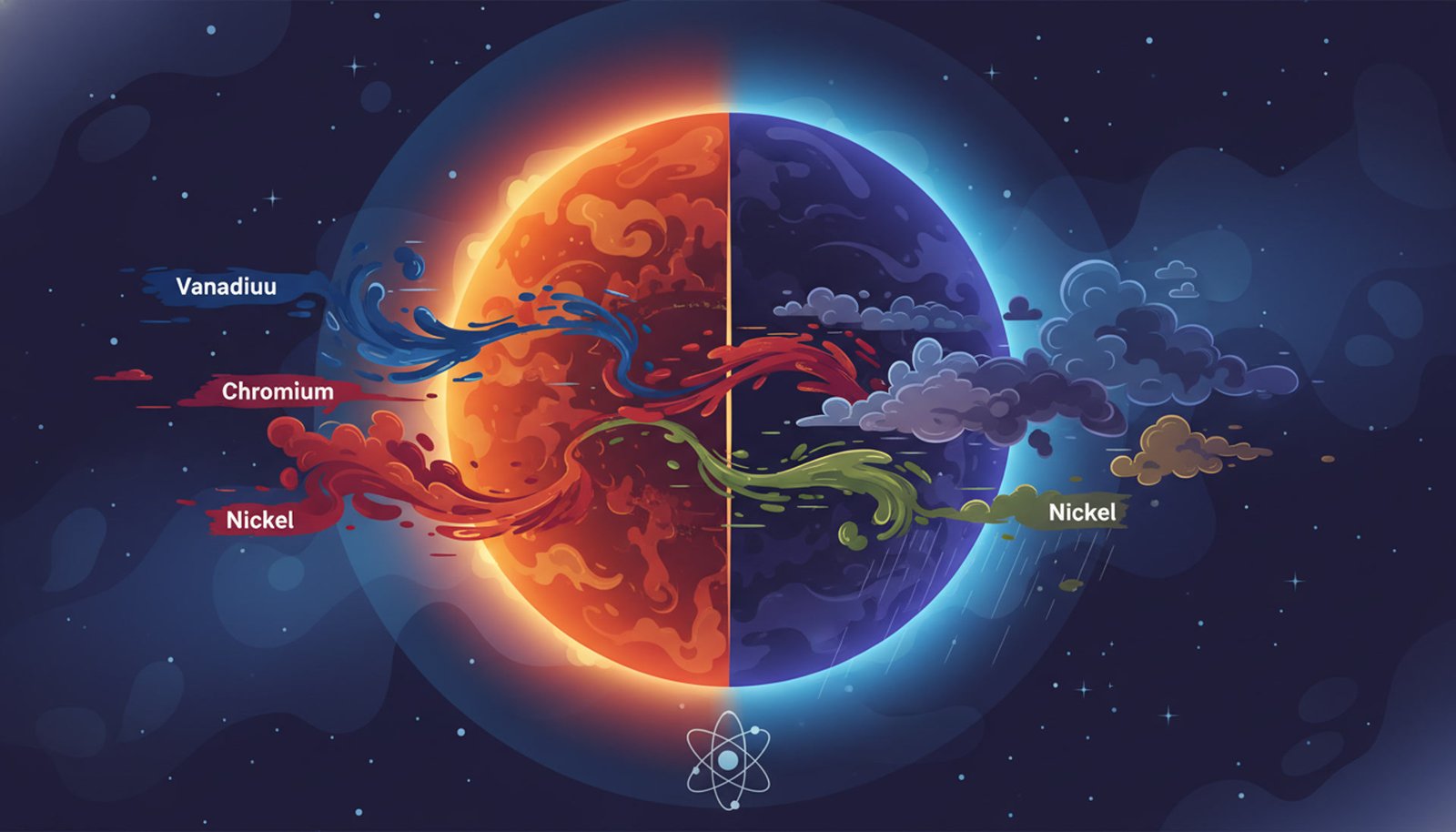
WASP-76b's Chemical Weather Map
Summary
By the end of this article, you will understand how astronomers analyze the light from a distant star to map the complex chemical weather on its planet, revealing a layered atmosphere where different metals condense and get blown around by different types of wind.
Quick Facts
- Five new elements were detected on WASP-76b for the first time: Vanadium, Chromium, Nickel, Strontium, and Cobalt.
- Key elements like Titanium and Aluminum are mysteriously missing, suggesting they've condensed into clouds of sapphire or other minerals.
- The atmosphere appears to have two zones: a lower layer with strong day-to-night winds and an upper layer with vertical winds or outflow.
- Some elements like Sodium and Potassium actually appear stronger on the cooler morning side because they are less ionized there.
- The planet's 'evening' terminator is significantly hotter than its 'morning' terminator, driving these extreme chemical changes.
The Discovery: Beyond the Iron Rain
After the groundbreaking discovery of iron rain on WASP-76b, scientists wondered: what else is in that atmosphere? Using the same high-resolution data from the ESPRESSO instrument, a team led by Aurora Kesseli went on a chemical survey. They used a technique called cross-correlation, essentially using a chemical ‘fingerprint’ for each element to hunt for its signal in the light filtering through the planet’s atmosphere. The Surprise was twofold: First, they found a whole new set of metals like Vanadium, Chromium, and Nickel behaving just like iron—disappearing on the cooler night side. Second, they *didn’t* find expected elements like Titanium and Aluminum. This told them the atmosphere was even more complex than imagined, a place where some metals rain out while others may have already formed permanent clouds.
These observations provide a new level of modeling constraint and will aid our understanding of atmospheric dynamics in highly irradiated planets.
— Aurora Y. Kesseli et al.
The Science Explained Simply
The asymmetry isn’t just one simple wind blowing from hot to cold. The data suggests two possibilities that could be happening at once. The first is chemical rain-out: as metal vapors are blown to the cooler night side, they hit a temperature where they condense and fall as liquid, removing their signature from the upper atmosphere. The second, more complex idea is a two-layered atmosphere. Imagine the lower atmosphere has strong day-to-night winds, which cause the Doppler shifts we see. But higher up, in the exosphere, the atmosphere is dominated by vertical winds or even a slow ‘outflow’ into space. This upper layer would broaden the spectral lines of elements found there (like Sodium and Lithium) but wouldn’t show the same strong day-to-night velocity shift. It’s a planet with different weather at different altitudes.
The lower atmosphere could be dominated by a day-to-night wind… while the upper atmosphere is dominated by a vertical wind or outflow.
— Abstract, Kesseli et al. 2022
The Aurora Connection
The paper’s suggestion of an ‘outflow’ from the upper atmosphere is a critical link. Planets this close to their star are blasted by intense radiation and stellar wind, which constantly tries to strip their atmospheres away. This process is called atmospheric escape. On Earth, our powerful magnetic field creates a shield—the magnetosphere—that protects our atmosphere, channeling stellar particles into the poles to create auroras. The evidence of outflow on WASP-76b shows this battle in action. Without a strong magnetic field of its own, its entire metal-rich atmosphere would have been scoured away long ago. Studying this extreme escape helps us appreciate the invisible magnetic shield that makes Earth’s stable climate, and beautiful auroras, possible.
A Peek Inside the Research
This discovery relies on Knowledge and Tools, not just a single observation. The core method is the cross-correlation function. Imagine you have a noisy radio station, and you want to know if it’s playing a specific song. You take a clean version of that song (the ‘template’) and slide it across the noisy signal. When it lines up perfectly, you get a huge spike in signal. Scientists do the same with light: they have a perfect spectral ‘template’ for iron, another for sodium, and so on. They compare these templates to the starlight that passed through WASP-76b’s atmosphere. This lets them detect the incredibly faint absorption signals—just a few parts per million—from each element and measure their precise velocity, revealing the atmospheric dynamics light-years away.
Key Takeaways
- High-resolution spectroscopy allows scientists to create a chemical 'weather map' of an exoplanet's atmosphere.
- The absence of an element can be as informative as its presence, pointing towards processes like cloud formation.
- Exoplanet atmospheres can be layered, with completely different wind dynamics at different altitudes.
- Chemical 'rain-out' is not uniform; different elements condense at different temperatures, creating a complex atmospheric chemistry.
- By studying the beginning vs. the end of a transit, we can probe the weather on the morning and evening sides of a tidally-locked planet.
Sources & Further Reading
Frequently Asked Questions
Q: Why can’t they find Titanium and Aluminum?
A: The leading theory is that it’s too ‘cold’ for them, even on WASP-76b! These elements condense at very high temperatures (~2000 K). They likely form clouds of minerals like Titanium Dioxide (TiO₂) and Aluminum Oxide (Al₂O₃)—the basis for sapphire—deep in the atmosphere, so we can’t see them as vapor higher up.
Q: What does a ‘vertical wind’ mean on a planet?
A: It means the atmospheric gas is moving up and away from the planet’s surface, rather than sideways across it. This can be caused by extreme heating from below or could be the beginning of the atmosphere ‘escaping’ into space due to the intense energy from the nearby star.
Q: Are all ‘hot Jupiters’ like this?
A: WASP-76b is an ‘ultra-hot Jupiter’, which is an extreme case. Cooler hot Jupiters have clouds made of different materials and don’t show such strong signatures of vaporized metals. Each one has its own unique atmospheric chemistry that scientists are just beginning to explore.

JUICE: ESA's Epic Voyage to Jupiter
Summary
The European Space Agency’s JUICE mission is embarking on a decade-long journey to Jupiter. It will create the most detailed picture ever of the gas giant’s chaotic atmosphere, powerful auroras, and mysterious depths, helping us understand giant planets across the universe.
Quick Facts
- JUICE stands for JUpiter ICy moons Explorer.
- The mission will study Jupiter for over three and a half years.
- It will create a '4D' map of Jupiter's atmosphere: 3D space plus time.
- JUICE will work in tandem with NASA's Juno mission to get a complete view.
- It will investigate Jupiter's 'energy crisis'—why its upper atmosphere is mysteriously hot.
The Discovery: Journey to a Giant
Jupiter isn’t just a planet; it’s a miniature solar system, a churning ball of gas so massive it shaped the orbits of all its neighbors. For centuries, we’ve gazed at its stripes and its famous Great Red Spot, but we still have fundamental questions about how it works. The ESA’s JUICE mission is designed to answer them. Building on the discoveries of missions like Galileo and Juno, JUICE will conduct a long-term stakeout of the gas giant. While Juno flies in a tight, polar orbit for close-up snapshots, JUICE will observe from further out, allowing it to monitor the entire planet over weeks and months. This will enable scientists to track storms as they evolve, map the global circulation, and create a complete, four-dimensional ‘climate database’ for Jupiter. It’s a mission to understand the entire Jovian system—from its deep, churning interior to the top of its electrically charged atmosphere.
Read the original research paper: ‘Jupiter Science Enabled by ESA’s Jupiter Icy Moons Explorer’
JUICE will provide our best four-dimensional characterisation of this archetypal giant planet.
— Leigh N. Fletcher, JUICE Interdisciplinary Scientist
The Science Explained Simply
Jupiter’s atmosphere is a chaotic masterpiece. The distinct reddish belts and white zones are bands of rising and sinking gas, stretched around the planet by its incredibly fast 10-hour rotation. These bands are separated by powerful jet streams, some blowing faster than 500 km/h. Giant storms, like the centuries-old Great Red Spot, are vortices larger than Earth, swirling in the upper cloud decks. Unlike Earth’s weather, which is driven by the Sun, Jupiter’s meteorology is powered mostly by internal heat left over from its formation billions of years ago. JUICE will use its cameras and spectrometers to track cloud movements, measure temperatures, and identify the chemical makeup of different regions. By observing in different wavelengths of light, from ultraviolet to infrared, it can probe different depths of the atmosphere, essentially creating a vertical weather report for this giant world and figuring out what makes it tick.
The goal is to understand the mechanisms driving zonal jets and meteorological activity.
— Ricardo Hueso, Atmospheric Scientist
The Aurora Connection
Like Earth, Jupiter has spectacular auroras, but they are thousands of times more powerful and they never stop. This is because Jupiter’s auroras have a dual power source. While some energy comes from the solar wind, most of it comes from Jupiter’s own system. Its volcanic moon, Io, spews tons of sulfur and oxygen into space every second. These particles get trapped by Jupiter’s immense magnetic field and funneled towards the poles, creating a constant, powerful light show. This process dumps a colossal amount of energy into Jupiter’s upper atmosphere, making it hundreds of degrees hotter than it should be—a mystery known as the ‘energy crisis’. JUICE will directly study this connection. Its UVS instrument will watch the auroras flicker and dance, while other instruments measure the temperature and wind changes below, revealing how this cosmic light show drives the climate of the entire upper planet.
A Peek Inside the Research
To untangle Jupiter’s secrets, JUICE is equipped with a suite of ten powerful instruments that work together. It’s a true multi-disciplinary mission. The JANUS camera will take high-resolution visible-light images of storms and clouds, allowing scientists to track winds. The MAJIS spectrometer will analyze infrared light to map the chemical composition of the atmosphere and measure the temperature of the auroras. The UVS spectrograph will look at the ultraviolet light from the auroras to understand the energy of the particles crashing into the atmosphere. Meanwhile, the RPWI instrument will act like a radio receiver, listening for the ‘whistler’ signals produced by powerful lightning strikes deep within Jupiter’s clouds. By combining data from all these instruments, scientists can see how lightning in the deep cloud layers might be connected to waves that travel up and influence the auroras high above. This synergistic approach will give us the most complete view of Jupiter ever obtained.
Key Takeaways
- JUICE will provide a comprehensive, long-term look at Jupiter's atmosphere and weather systems.
- A primary goal is to understand the connection between Jupiter's deep interior, its weather layer, and its magnetosphere.
- The mission will study Jupiter's powerful auroras to see how they dump energy into the planet's atmosphere.
- By observing Jupiter's clouds, storms, and composition, scientists can learn more about how our solar system formed.
- Understanding Jupiter, our local gas giant, provides a crucial blueprint for studying giant exoplanets in other star systems.
Sources & Further Reading
Frequently Asked Questions
Q: Why is it called the ‘Icy Moons Explorer’ if it also studies Jupiter?
A: Because the planet and its largest moons—Ganymede, Callisto, and Europa—are a deeply connected system. Material from the moons feeds Jupiter’s magnetosphere, which in turn powers the auroras. JUICE will study both the planet and its moons to understand how the whole system works together.
Q: How is the JUICE mission different from NASA’s Juno mission?
A: They are like teammates with different jobs! Juno flies in a close, polar orbit to study Jupiter’s deep interior and gravity field. JUICE will orbit further out, allowing it to stare at the planet for long periods to monitor weather and atmospheric changes, focusing on how the whole atmosphere is connected.
Q: Does Jupiter have auroras like the Northern Lights on Earth?
A: Yes, but they are much bigger, more powerful, and permanent! Unlike Earth’s auroras, which are mostly powered by the solar wind, Jupiter’s are mainly fueled by particles from its volcanic moon Io. This means Jupiter’s light show is always on.
Q: What is the ‘energy crisis’ on Jupiter?
A: It’s a long-standing mystery where Jupiter’s upper atmosphere is hundreds of degrees hotter than sunlight alone can explain. Scientists suspect the extra energy is dumped there by the powerful auroras or by atmospheric waves traveling up from deep inside the planet. JUICE’s instruments are designed to help solve this puzzle.

Jupiter's Secret Auroral Engine
Summary
NASA’s Juno spacecraft has uncovered a new twist in the mystery of Jupiter’s super-powered auroras. Scientists found they’re not just powered by steady electric currents, but also by turbulent, chaotic magnetic waves that surf electrons into the atmosphere.
Quick Facts
- Jupiter has the most powerful auroras in the entire solar system.
- They are mainly powered by the planet's rapid rotation and volcanic moon Io, not the solar wind like Earth's.
- Scientists found two power sources: steady electric currents (DC) and turbulent magnetic waves (AC).
- These magnetic waves, called Alfvén waves, act like cosmic surfers, accelerating electrons into the atmosphere.
- Juno's magnetometer had to be more than 4 Jupiter radii away to be sensitive enough to detect these tiny waves.
The Discovery: More Than a Simple Circuit
For decades, scientists had a leading theory for Jupiter’s auroras, based on a giant electric circuit. The idea was that Jupiter’s fast rotation creates a steady, direct current (DC) along its magnetic field lines, funneling electrons into the atmosphere to create the light show. But data from NASA’s Juno mission showed the picture was more complicated. By analyzing data from three different instruments simultaneously—the JEDI particle detector, the UVS auroral camera, and the MAG magnetometer—scientists found a second, more chaotic process at play. Alongside the steady currents, they detected fast, small-scale wiggles in the magnetic field. These fluctuations are the signature of powerful plasma waves, suggesting that Jupiter’s auroral engine is a hybrid, powered by both steady currents and turbulent waves.
Read the original research paper on arXiv
The consistent presence of small-scale magnetic field fluctuations supports that wave-particle interaction can dominantly contribute to Jupiter’s auroral processes.
— A. Salveter et al., Research Paper Authors
The Science Explained Simply
Imagine trying to power a light bulb. You could use a battery, which provides a steady, direct current (DC). This is like the old model for Jupiter’s aurora: a smooth river of electrons flowing in one direction. This process creates very organized auroras with electrons all at a similar energy level. But you could also power the bulb with the alternating current (AC) from a wall socket, which pushes and pulls electrons back and forth rapidly. On Jupiter, the equivalent of this AC power comes from Alfvén waves. These are magnetic waves that travel along field lines like a vibration on a guitar string. Instead of a smooth river, they create a turbulent ocean, sloshing electrons around and accelerating them to a wide range of energies. Juno’s data shows that most of Jupiter’s auroral electrons are of this mixed-energy ‘broad-band’ type, suggesting the turbulent wave-particle interactions are a key part of the story.
The Aurora Connection
Here at NorthernLightsIceland.com, we know Earth’s auroras are created when our planet’s magnetic field guides particles from the solar wind into our atmosphere. Jupiter’s system is on a whole different level. Its massive magnetic field and rapid 10-hour day create an internal powerhouse, with its volcanic moon Io supplying most of the particles. The discovery that turbulent Alfvén waves are a major power source for Jupiter’s aurora has huge implications for Earth too. While our auroras are less intense, we also see evidence of these waves contributing to the most dynamic and colourful displays. By studying the extreme case at Jupiter, where the waves are supercharged, scientists can build better models for how these magnetic vibrations transfer energy in space. This helps us understand not just the beauty of auroras, but also the fundamental physics that protects our planet from cosmic radiation.
The coexistence of these acceleration mechanisms underscores Jupiter’s magnetospheric variability and helps us understand similar processes at Earth.
— NorthernLightsIceland.com Science Team
A Peek Inside the Research
This discovery was a huge scientific challenge, requiring incredible precision. The team used Juno’s Fluxgate Magnetometer (MAG) to measure the magnetic field. The problem is that Jupiter’s main magnetic field is immensely powerful. When Juno was close to the planet, the background field was so ‘loud’ that the tiny, whispering fluctuations from Alfvén waves were completely drowned out by the instrument’s digital noise. It’s like trying to hear a pin drop during a rock concert. But when Juno’s orbit took it farther away (beyond 4 Jupiter radii), the background field became weaker. In this quieter environment, the magnetometer’s sensitivity was high enough to finally detect the ‘whisper’ of the small-scale waves. By correlating these faint signals with intense UV aurora and energetic electron data, the team confirmed that these waves were indeed powering the light show below.
Key Takeaways
- Jupiter's auroras are powered by a complex mix of processes, with wave-particle interactions being a major contributor.
- Most of the electrons creating the aurora have a wide range of energies ('broad-band'), which points to a chaotic, wave-like acceleration mechanism.
- Large-scale, steady currents are associated with some auroral features, but turbulent, small-scale magnetic fluctuations are present over the main emission zone.
- Technological limits, like instrument sensitivity, play a huge role in discovery; the key magnetic waves were only detectable when Juno was far from Jupiter.
- Studying Jupiter's extreme auroras helps us understand the fundamental physics of magnetic fields and particle acceleration throughout the universe.
Sources & Further Reading
Frequently Asked Questions
Q: What’s the main difference between Jupiter’s and Earth’s auroras?
A: The biggest difference is the power source. Earth’s auroras are primarily powered by the solar wind, a stream of particles from the Sun. Jupiter’s auroras are mostly self-generated by its incredibly fast rotation and particles spewed out from its volcanic moon, Io.
Q: What are Alfvén waves in simple terms?
A: Think of a magnetic field line in space like a guitar string. An Alfvén wave is a vibration or a ‘pluck’ that travels along that string. These waves are made of plasma (hot, ionized gas) and can carry huge amounts of energy across space, eventually dumping it into a planet’s atmosphere to create auroras.
Q: Why was it so hard to detect these magnetic waves?
A: Jupiter’s main magnetic field is thousands of times stronger than Earth’s. The magnetic waves are tiny fluctuations on top of this giant field. When Juno was close, the instrument’s measurements were dominated by the main field, making the small wiggles impossible to resolve, like trying to measure a ripple in a tidal wave.
Q: So are all auroras powered by waves?
A: Not entirely, but we’re learning waves play a much bigger role than we thought! Both Earth and Jupiter use a mix of steady electric currents and wave acceleration. This Juno research suggests that for the most powerful auroral systems like Jupiter’s, these turbulent waves might be the dominant engine.

Cosmic Winds: Peeling Back an Alien Planet's Layers
Summary
Scientists have developed a new technique to map the winds on the ultra-hot Jupiter WASP-76b at different altitudes. By studying how iron absorbs light, they’ve created the first-ever vertical weather profile of this extreme world, revealing how its atmosphere works from the inside out.
Quick Facts
- WASP-76b is a scorching hot exoplanet famous for its 'iron rain'.
- Scientists used iron absorption lines like an X-ray to see different atmospheric depths.
- Stronger iron lines probe higher altitudes, while weaker lines see deeper.
- The planet's powerful, day-to-night winds persist at all altitudes.
- The research suggests magnetic fields play a key role in controlling the planet's weather.
The Discovery: Beyond Iron Rain
We already knew WASP-76b was wild. It’s a world so hot that iron vaporizes on its day side and then rains down as molten metal on its night side. But researchers wanted to look deeper. How do the planet’s ferocious winds, which carry this iron vapor, behave at different altitudes? A team led by Aurora Kesseli and Hayley Beltz pioneered a new method using data from the ESPRESSO spectrograph. They sorted the light-absorbing signatures of iron (Fe I) based on their strength, or opacity. Very opaque lines can only be seen from the very top of the atmosphere, while less opaque lines allow us to peer deeper down. By analyzing these different sets of lines, they could measure the wind speed at different layers for the first time, effectively creating a vertical slice of an alien planet’s weather.
We’re moving from a 2D picture to a 3D understanding of these incredible atmospheres.
— Aurora Y. Kesseli, Lead Author
The Science Explained Simply
Imagine you’re trying to see the ground from a plane on a foggy day. A very thick, dense fog bank (a strong opacity line) would only let you see the very top layer. But if the fog were a much thinner mist (weak opacity), you might be able to see all the way down to the ground. Astronomers used this exact principle with iron atoms in WASP-76b’s atmosphere. Iron absorbs light at many specific wavelengths. Some of these absorption lines are naturally ‘stronger’ than others. The strong lines get blocked high up in the atmosphere, giving us information about the winds there. The weaker lines aren’t fully absorbed until the starlight has traveled much deeper, revealing the wind patterns in the lower layers. By separating and analyzing these, scientists could compare the ‘high-altitude winds’ to the ‘low-altitude winds’ and build a vertical profile.
The Aurora Connection
A key question on a world like WASP-76b is what controls its atmosphere. The researchers tested three different climate models, but the most interesting part was the role of magnetic fields. On Earth, our magnetic field channels the solar wind to create beautiful auroras. On a hot Jupiter, a magnetic field can act like a giant brake, creating friction—or ‘magnetic drag’—on the hot, ionized gases whipping around the planet. The study found that a model including a realistic magnetic field (the ‘3G’ model) did a better job of explaining the observed wind patterns than a simple model with no magnetism or one with a crude, uniform drag. This is strong evidence that, just like on Earth, magnetic fields are a dominant force in shaping a planet’s climate and space weather, even one 640 light-years away.
The data seems to favor a model with magnetic effects, suggesting these invisible forces are shaping the entire planet.
— Hayley Beltz, Lead Author
A Peek Inside the Research
The goal was to see which computer simulation of WASP-76b best matched reality. After using the binary mask technique to isolate the weak and strong iron lines from the ESPRESSO data, the team measured key properties like the wind speed (velocity shift) and the wind’s turbulence (line width) for each atmospheric layer. They then compared these real-world measurements to the predictions from three Global Circulation Models (GCMs): one with no drag, one with uniform drag, and one with a sophisticated magnetic drag. The uniform drag model failed, predicting trends opposite to what was seen. The battle was between the no-drag (hydrodynamic) and magnetic models. While neither was perfect, the magnetic model better matched subtle trends in the data, especially how the signal changed from the start to the end of the transit. This work provides a powerful new way to test and refine our theories about how exoplanet atmospheres work.
Key Takeaways
- A new method allows astronomers to study exoplanet atmospheres in vertical layers, not just as a single slab.
- On WASP-76b, there's a trend of stronger, more focused winds deeper in the atmosphere.
- Computer models that include magnetic fields ('magnetic drag') better explain the observations than models without.
- This is a major step toward creating 3D weather maps of alien worlds.
- Even the best models today can't fully account for the incredible wind speeds on WASP-76b, hinting at missing physics.
Sources & Further Reading
Frequently Asked Questions
Q: So, are the winds different at different heights on WASP-76b?
A: Yes, that’s what the data suggests. The research found tentative trends that winds are more blueshifted (moving towards us faster) and the flow is less turbulent deeper in the atmosphere. Higher up, the wind patterns appear wider and more complex.
Q: What is ‘magnetic drag’?
A: It’s a force that occurs when a magnetic field interacts with a moving, electrically conductive fluid, like the hot ionized gas in WASP-76b’s atmosphere. It acts like a form of friction, slowing down and redirecting the atmospheric winds.
Q: Why can’t the models perfectly match the wind speeds?
A: Exoplanet atmospheres are incredibly complex. There’s likely ‘missing physics’ in the models, such as the effects of hydrogen atoms splitting apart at high temperatures, or perhaps the magnetic field is even stronger or more complex than assumed. This study helps pinpoint where those models need to improve.
Q: Can this technique be used on other planets?
A: Yes, absolutely! This method can be applied to any exoplanet with a clear atmosphere and strong absorption lines observed with a high-resolution spectrograph. As telescopes like the Extremely Large Telescope (ELT) come online, we’ll be able to do this for more planets with even higher precision.

Jupiter's Auroras: Cosmic Chemical Thieves!
Summary
Decades after a comet crashed into Jupiter, scientists discovered its powerful auroras are actively scrubbing a specific chemical from the atmosphere, revealing that these beautiful light shows are also massive chemical factories.
Quick Facts
- In 1994, Comet Shoemaker-Levy 9 slammed into Jupiter, delivering new chemicals.
- Jupiter's auroras are hundreds of times more powerful than Earth's.
- A chemical called hydrogen cyanide (HCN) has vanished from Jupiter's auroral regions.
- Another chemical from the comet, carbon monoxide (CO), remains evenly spread.
- The auroras likely create a type of 'smog' that traps and removes the HCN.
The Discovery: The Case of the Missing Chemical
Back in 1994, the world watched as fragments of Comet Shoemaker-Levy 9 spectacularly crashed into Jupiter. This cosmic collision was more than just a fireworks display; it delivered a cocktail of new chemicals, including carbon monoxide (CO) and hydrogen cyanide (HCN), into the gas giant’s stratosphere. Scientists have been tracking these chemicals ever since, using them as tracers to understand Jupiter’s winds and chemistry. Fast forward to 2017. Using the powerful ALMA telescope, researchers mapped these two molecules with stunning detail. The results were puzzling. The CO had spread out evenly across the entire planet, just as expected. But the HCN was a different story. In the regions around Jupiter’s north and south poles, where the brilliant auroras dance, the HCN had almost completely vanished. It was a cosmic mystery: two chemicals delivered together were now behaving in completely different ways.
Seeing CO spread so uniformly confirmed our models, but the massive depletion of HCN in the auroral regions was a total surprise.
— T. Cavalié, Lead Researcher
The Science Explained Simply
Imagine dropping two different colored dyes into a swimming pool. You’d expect them both to spread out and mix evenly over time. That’s what scientists thought would happen with CO and HCN in Jupiter’s stratosphere. Both were deposited at similar altitudes by the same comet impact. The fact that CO is now found everywhere from the equator to the poles tells us that Jupiter’s high-altitude winds are very effective at mixing things up. This makes the disappearance of HCN even weirder. If the winds are mixing everything, why is there a giant hole in the HCN distribution right over the poles? A simple ‘dynamical barrier’ or wind pattern can’t be the answer, because it would block CO as well. The solution had to be chemical, and it had to be something happening only at the poles.
The Aurora Connection
The prime suspect? Jupiter’s incredibly powerful auroras. Just like on Earth, auroras are created when energetic particles from a planet’s magnetosphere slam into atmospheric gases. But on Jupiter, this process is supercharged. The paper proposes that this intense energy drives the formation of complex organic molecules, which then clump together to form aerosols — essentially a fine, high-altitude haze or smog. This is where the story takes a turn. The researchers believe that HCN molecules are ‘sticky’ and readily bond to the surface of these auroral aerosol particles. In contrast, the more stable CO molecules do not. Once HCN is locked onto these heavier aerosol particles, they slowly sink deeper into the atmosphere, effectively removing, or ‘scrubbing’, the HCN from the upper layers where ALMA can observe it. The aurora isn’t just a light show; it’s an active chemical trap!
We propose that heterogeneous chemistry bonds HCN on large aurora-produced aerosols… causing the observed depletion.
— The Research Team
A Peek Inside the Research
This discovery was made possible by the Atacama Large Millimeter/submillimeter Array (ALMA) in Chile. ALMA isn’t one telescope, but an array of 66 high-precision radio antennas working together. This allows it to act like a single, giant telescope, achieving incredible resolution. By tuning to the specific frequencies (or colors) of light emitted by CO and HCN molecules, ALMA can create detailed maps of their location and abundance. The key was its ability to resolve Jupiter’s disk and isolate the polar regions from the rest of the planet. The team analyzed the lineshape of the signal, which reveals the vertical distribution of the gas—telling them not just *if* the chemical was present, but at what altitude. By combining this with temperature data from the Gemini telescope, they could confidently confirm that the HCN wasn’t just hiding; it was truly gone from the upper stratosphere in the auroral zones.
Key Takeaways
- A 1994 comet impact provided a natural experiment to track Jupiter's atmospheric chemistry.
- Carbon monoxide (CO) from the comet has spread evenly across the planet, showing how winds mix the atmosphere.
- Hydrogen cyanide (HCN) is severely depleted (by up to 99%) in the polar regions.
- This suggests Jupiter's auroras drive unique chemistry, creating aerosol particles that capture HCN.
- Auroras are not just light shows; they are powerful engines that actively change a planet's atmospheric composition.
Sources & Further Reading
Frequently Asked Questions
Q: What is hydrogen cyanide?
A: Hydrogen cyanide (HCN) is a simple molecule made of hydrogen, carbon, and nitrogen. While it’s toxic on Earth, it’s a common building block for more complex organic molecules found throughout space, especially in comets.
Q: Why doesn’t carbon monoxide (CO) get trapped too?
A: Carbon monoxide is a very stable and less reactive molecule. The leading theory is that its chemical properties don’t allow it to easily bond to the surface of the organic aerosol particles in the way that HCN can. It simply bounces off while the HCN gets stuck.
Q: Are Jupiter’s auroras like the ones on Earth?
A: They are created by a similar process—charged particles hitting the atmosphere—but Jupiter’s are on a completely different scale. They are thousands of times more energetic and are mainly driven by Jupiter’s immense magnetic field and particles from its volcanic moon, Io. Earth’s auroras are primarily driven by the solar wind.
Q: So the auroras are both destroying and creating HCN?
A: It’s a fascinating paradox! The research suggests that in the upper layers, auroral aerosols are removing HCN. However, deep inside the main auroral oval, there’s evidence that the same energetic particles are creating *new* HCN from nitrogen gas welling up from below. It’s a complex cycle of creation and destruction happening in the same region.

Aurora's Twin Spies: A Mission to Solve a Polar Mystery
Summary
Scientists have designed an exciting new mission called AuroraMag, which uses two identical satellites to simultaneously study the Northern and Southern Lights. Their goal is to finally solve the long-standing mystery of why these incredible light shows are often not perfect mirror images of each other.
Quick Facts
- The mission concept is named AuroraMag.
- It uses two identical 'smallsats', one for each pole.
- The goal is to study 'hemispheric asymmetry' - why the auroras aren't perfect twins.
- It will take the first simultaneous X-ray images of both auroral ovals.
- The satellites would fly in a high elliptical orbit, swooping from 400 km to 10,000 km above Earth.
The Discovery: The Aurora's Uneven Glow
We often picture the auroras as perfect mirror images, with the Northern Lights (Aurora Borealis) perfectly matching the Southern Lights (Aurora Australis). But for decades, scientists have known this isn’t always true. Sometimes one is brighter, larger, or shifted to a different position. This phenomenon, called hemispheric asymmetry, is a major puzzle in space physics. Why does Earth’s magnetic shield respond unevenly to the solar wind? To solve this, scientists led by Ankush Bhaskar proposed AuroraMag. This mission concept uses two identical spacecraft, one orbiting over the North Pole and the other over the South Pole. By observing both auroras at the same time with the same instruments, AuroraMag would provide the side-by-side comparison needed to finally understand the forces that create these beautiful, lopsided light shows.
Read the original research paper on arXiv: ‘AuroraMag: Twin Explorer of Asymmetry in Aurora’
This would be the first dedicated twin spacecraft mission to simultaneously study hemispheric asymmetries.
— Ankush Bhaskar, Space Physics Laboratory, ISRO
The Science Explained Simply
Several factors can throw off the symmetry of the auroras. First, Earth’s magnetic axis is tilted, so the poles aren’t perfectly aligned with its rotation. This, combined with the seasons, means one pole is often tilted more towards the Sun, changing how it interacts with the solar wind. The biggest factor, however, is the Interplanetary Magnetic Field (IMF) – the Sun’s magnetic field that flows through space with the solar wind. The IMF can have a sideways component (called ‘By’) that effectively ‘twists’ Earth’s magnetosphere. This twist pulls the magnetic connection points in the northern and southern hemispheres in different directions, causing the auroras to form in non-mirrored patterns. AuroraMag would be able to directly measure how this twisting effect channels energy and particles differently into each hemisphere, turning theory into hard data.
Understanding this asymmetry is crucial for deciphering the intricacies of magnetospheric interactions.
— Jayadev Pradeep, Mission Concept Co-Author
The Aurora Connection
Auroras are more than just pretty lights; they are a visual sign of space weather in action. They show us where energy and particles from the Sun are slamming into our upper atmosphere. For satellite operators and power grid managers, understanding this energy input is vital. A major geomagnetic storm can damage technology, but our current view is often incomplete, like trying to understand a storm by looking out of only one window. AuroraMag would give us a total, global picture. By measuring the energy dumping into *both* hemispheres at once, scientists can calculate the full energy budget of a storm. This data would dramatically improve our space weather models, leading to better predictions that can help protect our vital infrastructure. It’s about understanding the aurora not just as a regional phenomenon, but as a key piece of a planet-wide electrical system.
A Peek Inside the Research
The AuroraMag mission design is incredibly clever. It uses two small, cost-effective satellites, AuroraMag-N and AuroraMag-S. They would be placed in identical but opposite elliptical orbits, flying from a low altitude of 400 km up to a high point of 10,000 km. This ‘rollercoaster’ orbit is key. When far from Earth (at apogee), the X-ray Imager has a wide-angle view to capture the entire auroral oval in one shot. When the satellite swoops in close (at perigee), its other instruments can perform *in-situ* measurements—like taking the temperature of the plasma with the Electron Temperature Analyser, counting particles with the MERiT sensor, and measuring powerful electric currents with its magnetometer. By having two spacecraft perform this dance simultaneously over opposite poles, AuroraMag would provide an unprecedented 3D view of how our planet responds to the Sun.
Key Takeaways
- The Northern and Southern Lights, while connected, often differ in shape, brightness, and location.
- AuroraMag would be the first dedicated mission to observe both auroras at the exact same time.
- It combines imaging (seeing the aurora in X-rays) with in-situ measurements (directly sensing particles and fields).
- Understanding these differences is crucial for creating more accurate space weather forecasts.
- The mission will provide a complete picture of how energy from the solar wind affects Earth's entire magnetosphere.
Sources & Further Reading
Frequently Asked Questions
Q: Why do we need two satellites? Can’t one just fly back and forth?
A: Space weather changes in minutes. For a true comparison, you need to see both the north and south poles at the exact same time. Using two identical satellites is the only way to get a true ‘apples-to-apples’ snapshot of how the auroras are behaving simultaneously.
Q: Why study the aurora in X-rays instead of visible light?
A: Visible light auroras are created by lower-energy electrons. X-ray auroras are produced by the most powerful, high-energy electrons bombarding the atmosphere. Studying the X-rays gives scientists a much clearer picture of where the most intense energy is being deposited during a space weather event.
Q: Is the AuroraMag mission actually being built?
A: Currently, AuroraMag is a ‘mission concept’. This research paper is a detailed proposal presented to the scientific community and space agencies to show why the mission is important and how it could be done. The next step would be for a space agency like ISRO, NASA, or ESA to fund and develop it.
Q: How does knowing about auroral asymmetry help me?
A: This knowledge is key to improving space weather forecasting. Better forecasts help protect the satellites that provide GPS and communications, ensure the stability of our power grids, and keep astronauts safe. It’s fundamental research that strengthens the technology we rely on every day.

Ganymede's Broken Auroras
Summary
Scientists using the Hubble Space Telescope created the first complete map of the aurora on Ganymede, Jupiter’s largest moon. They discovered its auroral lights aren’t complete ovals like Earth’s, but are split into two glowing crescents, a pattern unique in our solar system.
Quick Facts
- Ganymede is the largest moon in our solar system, bigger than the planet Mercury.
- It's the only moon known to have its own magnetic field.
- Its aurora is created by glowing oxygen atoms, visible in ultraviolet light.
- The auroral lights form two bright 'crescents' instead of a continuous ring.
- This map was created using 46 observations from the Hubble Space Telescope over 19 years.
The Discovery: Mapping a Moon's Crescent Lights
For years, scientists knew Ganymede had an aurora, a faint glow powered by its unique magnetic field. But seeing the whole picture was impossible. Using a massive dataset of 46 observations from the Hubble Space Telescope spanning from 1998 to 2017, a team of researchers painstakingly stitched together the first-ever global brightness map of Ganymede’s ultraviolet aurora. The result was a huge surprise. Instead of a continuous oval of light at each pole, like the ones we see on Earth or even Jupiter, Ganymede’s aurora is distinctly broken. The map revealed two intensely bright auroral crescents on opposite sides of the moon, while the regions in between were dramatically dimmer. This structure had never been seen anywhere else and points to the strange and complex physics happening around Jupiter’s giant moon.
Read the original research paper on arXiv
Our map reveals Ganymede’s auroral ovals are structured in upstream and downstream ‘crescents’.
— Joachim Saur, Corresponding Author
The Science Explained Simply
Imagine Ganymede as a large rock in a fast-moving river. The ‘river’ is the plasma—a gas of charged particles—that fills Jupiter’s enormous magnetosphere and flows past Ganymede at incredible speed. The brightest parts of the aurora, the crescents, appear on the upstream side (where the plasma hits the moon head-on) and the downstream side (in its wake). This is where the interaction is most intense, accelerating particles into Ganymede’s thin oxygen atmosphere and making it glow. The sides of the ‘rock’ parallel to the flow—the flanks facing toward and away from Jupiter—experience a much weaker interaction. This causes the aurora to be 3 to 4 times fainter in these regions, creating the ‘broken’ or crescent shape. It’s a visual map of how Ganymede battles the constant stream of plasma from its parent planet.
The Aurora Connection
Auroras are the ultimate sign that a planet or moon has a magnetic field. Ganymede is the only moon in our solar system with one, creating what scientists call a mini-magnetosphere. This map of its broken aurora is a stunning visualization of that mini-magnetosphere in action. Unlike Earth’s global magnetic field which stands strong against the solar wind, Ganymede’s field is tiny and completely embedded within Jupiter’s colossal magnetosphere. The crescent shape shows us exactly where Ganymede’s magnetic field lines connect with Jupiter’s, creating channels for energetic particles to slam into its atmosphere. Studying this unique, ‘sub-Alfvénic’ interaction helps scientists understand the physics of magnetism on a smaller scale and provides clues about how moons can protect a fragile atmosphere even in the harshest environments.
This map will be useful to understand the processes that generate the aurora in Ganymede’s non-rotationally driven, sub-Alfvénic magnetosphere.
— The Research Team
A Peek Inside the Research
Creating this map was a cosmic puzzle. The researchers used the Space Telescope Imaging Spectrograph (STIS) on Hubble, which observes in ultraviolet light invisible to the human eye. Each of the 46 exposures only captured one hemisphere of Ganymede at a time. The science team had to precisely determine Ganymede’s position and orientation for each image, carefully subtract the glare of reflected sunlight from its icy surface, and correct for the viewing angle. They then projected each clean image onto a flat, global map, similar to how a map of Earth is made from satellite photos. By averaging all 46 maps together, weighted by their exposure time, they built up a complete, high-quality picture of the entire auroral system. This meticulous process turned nearly two decades of snapshots into the first definitive atlas of Ganymede’s alien auroras.
Key Takeaways
- Ganymede's auroral ovals are not continuous rings like Earth's.
- The brightest parts are two crescents on the sides facing into and away from the plasma flow from Jupiter.
- The sides facing directly toward and away from Jupiter are 3-4 times fainter, creating a 'broken' appearance.
- This unique shape is caused by the interaction between Ganymede's small magnetic field and Jupiter's giant one.
- The map serves as a blueprint for understanding 'mini-magnetospheres' and their plasma interactions.
Sources & Further Reading
Frequently Asked Questions
Q: What color are Ganymede’s auroras?
A: Ganymede’s auroras glow primarily in ultraviolet (UV) light, which our eyes cannot see. The color comes from oxygen atoms in its thin atmosphere being excited by charged particles. If we could see in UV, they would likely appear as a purple or faint whitish glow.
Q: Why is Ganymede the only moon with a magnetic field?
A: Scientists believe Ganymede has a molten iron core, similar to Earth’s. The churning motion within this liquid metallic core generates a magnetic field. Other moons are either too small to have retained enough internal heat, or their core composition is different.
Q: Why is it important to map Ganymede’s aurora?
A: The aurora acts like a giant TV screen, showing us what’s happening in Ganymede’s invisible magnetic field and how it interacts with Jupiter. Mapping its brightness and shape helps scientists test their models of plasma physics and understand how this unique ‘mini-magnetosphere’ works.
Q: Will we get a closer look at these auroras?
A: Yes! The European Space Agency’s JUICE (JUpiter ICy moons Explorer) mission is on its way to the Jupiter system and will eventually orbit Ganymede. It carries instruments designed to study Ganymede’s magnetic field and aurora in unprecedented detail, giving us an up-close view of these amazing crescent lights.

Hunting for Iron Skies on Alien Worlds
Summary
Scientists scoured the atmospheres of 12 massive exoplanets for signs of iron hydride, a molecule that acts like a cosmic thermometer. While they didn’t find a conclusive signal, they found tantalizing hints on two super-hot worlds, pushing the limits of how we study alien weather.
Quick Facts
- The search targeted iron hydride (FeH), a molecule made of one iron and one hydrogen atom.
- Data from 12 different hot and ultra-hot Jupiter exoplanets were analyzed.
- The CARMENES spectrograph in Spain was used to collect the high-resolution light data.
- Two planets, WASP-33b and MASCARA-2b, showed weak but possible signals of FeH.
- FeH is a key atmospheric component in cool stars and brown dwarfs.
The Discovery: Faint Clues in Fierce Atmospheres
In a comprehensive search of archived data, a team of astronomers led by Aurora Y. Kesseli went looking for a specific molecule, iron hydride (FeH), in the skies of 12 different hot Jupiters. Their goal was to use this molecule as a sensitive probe of atmospheric conditions. After carefully analyzing the light filtering through each planet’s atmosphere during a transit, they found no definitive detections. However, two planets stood out: WASP-33b and MASCARA-2b. Both showed faint, low-confidence signals right where the signature of FeH was expected to be. What makes this so intriguing is that these two planets have temperatures between 1800-3000°C, the exact ‘Goldilocks zone’ where scientific models predict FeH should be most abundant. While the signals are too weak to be a confirmed discovery, they provide a tantalizing hint that we are looking in the right place.
Read the original research paper on arXiv: ‘A Search for FeH in Hot-Jupiter Atmospheres…’
We found intriguing hints in the exact places we expected to, but the signals are just too faint to be certain yet.
— Aurora Y. Kesseli, Lead Author (paraphrased)
The Science Explained Simply
Why hunt for iron hydride (FeH)? Because it’s a fantastic atmospheric probe. Unlike molecules like water or carbon monoxide, which can exist across a huge range of temperatures, FeH is picky. It only forms in a narrow window of conditions. If an atmosphere is too hot (over 3000°C), the intense heat breaks the bond between the iron and hydrogen atoms. If it’s too cool (below 1500°C), the iron condenses out of the gas phase, forming clouds of solid particles, similar to how water vapor forms ice clouds on Earth. Therefore, finding a strong signal of FeH tells you the temperature of that atmospheric layer with remarkable precision. It acts like a chemical thermometer, giving scientists a clear reading on the conditions in these distant, extreme environments. Its presence, or absence, provides crucial clues for understanding the chemistry and physics of alien skies.
Metal hydrides exist in much more specific regimes… and so can be used as probes of atmospheric conditions.
— Kesseli et al., 2020
The Aurora Connection
At NorthernLightsIceland.com, we know auroras are born from the interaction between the solar wind and a planet’s magnetic field. That magnetic field is generated deep within a planet’s core, which on rocky worlds is made mostly of iron. While hot Jupiters are gas giants, the amount of heavy elements like iron in their composition is a key clue to their formation and internal structure. By searching for iron-bearing molecules like FeH in their atmospheres, scientists can estimate the planet’s overall metal content. A planet rich in heavy elements is more likely to have a dense, differentiated core capable of generating a powerful magnetic field. This invisible shield is crucial for protecting an atmosphere from being stripped away by fierce stellar winds from its nearby star. So, while atmospheric FeH doesn’t directly cause auroras, its detection is a step toward understanding the ingredients needed for a planet to build its own protective magnetic shield.
A Peek Inside the Research
The team used a technique called high-dispersion transmission spectroscopy. As a planet passes in front of its star, they use an instrument called CARMENES to capture the starlight that filters through the planet’s thin atmospheric layer. Molecules in this atmosphere absorb specific colors of light, leaving tiny dark lines in the star’s spectrum. The challenge is that this planetary signal is incredibly faint and buried in noise from the star itself and from molecules in Earth’s own atmosphere (telluric contamination). To find the signal, they use cross-correlation, comparing their noisy data to a clean, theoretical model of an FeH spectrum. This boosts any matching patterns. They also used an algorithm called SYSREM to systematically identify and remove the noise. This painstaking process of cleaning and amplifying the data allowed them to find the faint hints around WASP-33b and MASCARA-2b.
Key Takeaways
- Scientists use specific molecules like FeH to precisely measure the conditions in exoplanet atmospheres.
- No strong, conclusive evidence for FeH was found across the 12 planets studied.
- Weak hints of FeH were found on two ultra-hot Jupiters that are in the ideal temperature range for the molecule to exist.
- Detecting these faint signals is incredibly difficult and requires advanced techniques to remove noise from the host star and Earth's atmosphere.
- This research helps set upper limits on how much FeH can exist on these planets, guiding future studies.
Sources & Further Reading
Frequently Asked Questions
Q: What is Iron Hydride (FeH)?
A: Iron hydride is a simple molecule made of one iron atom bonded to one hydrogen atom (FeH). It’s most commonly found in the atmospheres of cool stars and brown dwarfs, objects with temperatures between stars and planets.
Q: Why didn’t they find it for sure?
A: The signal from an exoplanet’s atmosphere is incredibly tiny, representing just a small fraction of the star’s total light. This faint signal is easily lost in the noise from the star’s own activity and light absorption from Earth’s atmosphere. The possible signals they found were just not strong enough to be statistically certain they weren’t random noise.
Q: What makes WASP-33b and MASCARA-2b special?
A: These are ‘ultra-hot Jupiters’ with equilibrium temperatures over 2000°C. This puts them in the perfect temperature range where iron would still be a gas but cool enough to form molecules with hydrogen. That’s why scientists were hopeful, and not entirely surprised, to see faint hints there.
Q: Is this research a failure if it’s a ‘non-detection’?
A: Not at all! In science, a non-detection is still a valuable result. It places a limit on how much FeH can be in these atmospheres, which helps refine future models and search strategies. It tells other scientists that if the molecule is there, it’s in very small amounts or will require even more powerful telescopes to find.

Jupiter's Two-Speed Auroras Revealed
Summary
Scientists have decoded why Jupiter and Saturn have two different ‘invisible’ auroras—one in ultraviolet (UV) and one in infrared (IR)—that don’t always match. The secret lies in their radically different response times: one flashes in an instant, while the other relies on slower chemistry, acting like a glowing ember.
Quick Facts
- Jupiter and Saturn have auroras in ultraviolet (UV) and infrared (IR) light, invisible to the human eye.
- UV auroras are created instantly when electrons strike hydrogen molecules, taking less than a hundredth of a second.
- IR auroras come from the H3+ ion, which is created through a multi-step chemical process that can take from 10 seconds to several hours.
- The IR aurora's slow response acts like a 'memory' of recent auroral activity.
- This time difference explains why simultaneous images of UV and IR auroras can look surprisingly different.
The Discovery: Solving an Auroral Puzzle
For years, astronomers have observed the magnificent auroras on Jupiter and Saturn using telescopes that can see in ultraviolet (UV) and infrared (IR) light. But they noticed a puzzle: sometimes the UV and IR pictures would show auroras in the same place, but other times they looked completely different. Why would two types of auroras, happening at the same time, not match? Researchers led by Chihiro Tao realized the answer wasn’t in *where* the aurora was, but *when*. They built a detailed computer model to simulate the physics behind each type of emission. The model revealed that the UV aurora is like a flash of lightning—a direct, instantaneous result of an electron hitting a hydrogen molecule. The IR aurora, however, is a much more complex and slower process, giving it a unique character.
The observed differences between UV and IR emissions can be understood by the differences in their time scales.
— Chihiro Tao, Lead Researcher, ISAS/JAXA
The Science Explained Simply
Think of the two auroras like this: the UV aurora is a sprinter, while the IR aurora is a glowing ember.
The UV Sprinter: When a high-energy electron from Jupiter’s magnetosphere zips into the atmosphere, it smacks into a hydrogen molecule (H₂). This collision gives the H₂ a jolt of energy, and it releases that energy almost instantly as a flash of UV light. The whole process, from impact to flash, takes less than 0.01 seconds. It’s a direct, immediate reaction.
The IR Ember: The IR aurora starts the same way, but the electron impact is so hard it knocks an electron off the H₂, creating an H₂⁺ ion. This ion then finds another H₂ molecule and combines with it to form a new, crucial ion: H₃⁺. This chemical creation takes time. Once formed, the H₃⁺ gets heated by the surrounding atmosphere and starts to glow in infrared. Because it depends on this chemical chain, the IR aurora takes anywhere from 10 to 10,000 seconds to build up and fade away, like an ember that glows long after the initial fire has died down.
The ion chemistry, present in the IR but absent in the UV emission process, could play a key role.
— Tao, Badman, and Fujimoto
The Aurora Connection
This ‘two-speed’ system is incredibly useful for scientists. At NorthernLightsIceland.com, we know that Earth’s auroras are a direct window into the space weather hitting our planet. Jupiter’s dual auroras offer an even more detailed view. By comparing the fast UV aurora with the slow IR aurora, scientists can tell what kind of electron precipitation is happening. A sudden, short-lived UV flare with a weak IR response might mean a quick burst of electrons. But a steadily glowing IR aurora suggests a long, sustained shower of energy that has had time to build up the H₃⁺ ion population. It’s like having two different instruments to measure the same storm. This helps us understand the complex magnetic fields of giant planets and how they channel high-energy particles into their atmospheres, creating auroras far grander than our own.
A Peek Inside the Research
The researchers didn’t fly a probe into Jupiter’s aurora. Instead, they used powerful computer simulations to model every step of the process. Their model included the physics of how electrons travel through Jupiter’s hydrogen atmosphere, calculating the rates of different types of collisions. They then added a detailed ion chemistry model to track the creation and destruction of the H₃⁺ ion at different altitudes. Finally, they calculated the resulting UV and IR light emissions. To test their model, they applied it to real-life observations. For example, they simulated the Io footprint aurora—a spot of aurora caused by Jupiter’s moon Io. Their model correctly predicted that the IR glow from this fast-moving spot would be weaker than the main aurora, simply because the spot doesn’t stay in one place long enough for the H₃⁺ ’ember’ to get fully lit. This confirmed that time scales are the key to the puzzle.
Comparative UV-IR studies tell us more about the underlying mechanisms that produce the auroral features.
— Research Team
Key Takeaways
- UV and IR auroras are driven by different physical processes, giving us two ways to study a planet's atmosphere.
- The UV aurora is a direct snapshot of incoming electron energy, like a real-time activity monitor.
- The IR aurora reflects both current activity and the recent history of energy input due to its reliance on ion chemistry.
- The energy of the incoming electrons changes where the aurora forms in the atmosphere, which can make the IR aurora brighter or dimmer.
- This research provides a powerful tool to diagnose the type of 'space weather' hitting Jupiter and Saturn from their magnetospheres.
Sources & Further Reading
Frequently Asked Questions
Q: Why can’t we see these auroras with our own eyes?
A: These auroras shine in ultraviolet (UV) and infrared (IR) light, which are wavelengths outside the range of human vision. We need special telescopes and cameras to capture images of them and translate them into colors we can see.
Q: What is H3+ and why is it so important?
A: H3+ is an ion made of three hydrogen atoms. It’s one of the most common ions in the universe and plays a huge role in the chemistry of gas giant atmospheres and interstellar clouds. On Jupiter and Saturn, it’s a key atmospheric coolant, radiating heat away into space as infrared light.
Q: Does Earth’s aurora have different time scales too?
A: Yes, but in a different way. Earth’s aurora is created by electrons hitting nitrogen and oxygen. The green light from oxygen is relatively fast (about 1 second), while the red light from oxygen at higher altitudes is much slower (taking up to 2 minutes to glow). So the principle of different colors having different ‘lag times’ is universal!
Q: So is the IR aurora just a ‘delayed’ version of the UV?
A: It’s more than just delayed. Because it takes time to build up and fade away, the IR aurora smooths out rapid changes. While the UV aurora might flicker wildly during a magnetic storm, the IR aurora will show a slower, more gradual brightening and dimming, reflecting the average energy over the last several minutes or hours.

Radar Uncovers Invisible Energy Storms
Summary
Scientists in Antarctica have discovered that invisible showers of energetic electrons, a kind of ‘silent aurora’, bombard our atmosphere for hours after the visible light show fades. They used a powerful radar to detect these events, revealing they are far more common and long-lasting than previously thought.
Quick Facts
- The study used the SuperDARN radar at Syowa Station, Antarctica.
- These energy showers are called Energetic Electron Precipitation (EEP).
- EEP events cause a form of radio blackout in the upper atmosphere.
- They are most common in winter, occurring on over 50% of days.
- The invisible energy can continue raining down for 2-4 hours after sunrise.
- The average event detected by the radar lasted for over two hours.
The Discovery: Listening for a Silent Storm
At the remote Syowa Station in Antarctica, scientists were using a powerful high-frequency radar called SuperDARN to study the upper atmosphere. They noticed something peculiar: sometimes, their radar signal would just vanish. Both the signal they sent out and the background radio noise from space would suddenly go quiet. They realized this wasn’t an equipment failure; something in the atmosphere was absorbing the radio waves. By cross-referencing their data with an all-sky camera, they found a match: these radio blackouts happened during pulsating auroras. These are faint, patchy auroras caused by showers of high-energy electrons. The team had found a new way to track these invisible energy storms, even when clouds or daylight made the aurora impossible to see.
We can use the radar to detect this high frequency radio wave attenuation in the D region during energetic electron precipitation events.
— Emma C. Bland, Lead Author
The Science Explained Simply
Energetic Electron Precipitation (EEP) is like an invisible rain of high-speed electrons from space. Guided by Earth’s magnetic field, these particles funnel down towards the poles and slam into our atmosphere. While lower-energy electrons create the beautiful auroras we see at about 100-300 km altitude, these higher-energy electrons dive deeper, down into the D-region (60-90 km). Here, they crash into air molecules, knocking their electrons loose. This process, called ionization, creates a dense layer of charged particles. For high-frequency radio waves, like those used by the SuperDARN radar, this dense layer acts like a thick foam wall, absorbing the signal completely instead of letting it pass through or bounce back. This is why both the radar’s echo and the cosmic background noise disappear.
The Aurora Connection
Think of EEP as the powerful, invisible cousin of the aurora. While the Northern and Southern Lights are the beautiful, visible result of particles hitting our atmosphere, EEP represents a more intense energy transfer. This study specifically linked the radar blackouts to pulsating auroras, a type of aurora known to be driven by these energetic electrons. The most amazing discovery was what happened at dawn. As the sun rose, the camera would stop seeing the faint pulsating aurora. But the radar showed that the radio blackout—the EEP event—continued for another 2 to 4 hours! This means the energy kept pouring into our atmosphere long after the visible light show ended. This ‘invisible afterglow’ constantly affects the chemistry of our upper atmosphere, creating molecules that can impact the ozone layer.
The postmidnight and morning sector occurrence rates reach approximately 50% in the winter and 15% in the summer.
— Bland et al., 2019
A Peek Inside the Research
The scientists developed a clever detection method using two clues from the SuperDARN radar. The first clue was a sharp drop in backscatter power. This is the signal that bounces off the ionosphere and returns to the radar; if it disappears, it means it was absorbed on its way up and back. The second clue was a simultaneous drop in the background noise. This is the natural radio static from space, like lightning on other planets. If this background static also disappears, it confirms that a layer in our atmosphere is absorbing *all* incoming radio waves. When both clues appeared together, the team knew an EEP event was happening. They validated this method by perfectly matching the start times of these ‘double drops’ with the appearance of pulsating auroras in an all-sky camera located right next to the radar.
Key Takeaways
- Specialized radars can detect invisible space weather events that optical cameras miss.
- Energetic electrons create a dense layer in the D-region of our atmosphere that absorbs radio waves.
- The effects of an aurora can persist as an 'invisible afterglow' of energy long after the lights disappear.
- EEP has a strong seasonal cycle, peaking in the polar winter.
- Understanding EEP is crucial for modeling its impact on atmospheric chemistry, like ozone depletion.
Sources & Further Reading
Frequently Asked Questions
Q: Is this EEP stuff the same as the Northern Lights?
A: They are two sides of the same coin! The Northern Lights (aurora) are the visible light created by lower-energy particles. EEP is caused by higher-energy particles that penetrate deeper into the atmosphere, and while it’s associated with a faint type of aurora, its main effects (like radio absorption) are invisible to our eyes.
Q: Why does this only happen near the North and South Poles?
A: Earth’s magnetic field acts like a giant shield, but it has funnels at the North and South Poles. Energetic particles from the Sun and space get trapped by this field and are guided down these funnels into the polar atmosphere, which is why auroras and EEP events are concentrated there.
Q: Does this invisible energy storm affect us?
A: Yes, it can. EEP events can disrupt high-frequency (HF) radio communications, which are still used by aircraft on polar routes. Scientists are also studying the long-term chemical effects, as EEP produces nitrogen oxides (NOx) that can contribute to ozone destruction in the polar stratosphere.
Q: Why do more of these events happen in winter?
A: The polar atmosphere is different in the continuous darkness of winter. The lack of sunlight changes the chemistry and density at high altitudes, which can enhance the effects of EEP. Winter is the prime season for these invisible energy showers, with the radar detecting them on more than half the days.

Planets Control the Northern Lights?
Summary
Scientists analyzing a 438-year-old record of aurora sightings in Hungary discovered that the Northern Lights follow a secret rhythm. This cosmic beat perfectly matches the orbital cycles of the giant planets in our solar system, suggesting they influence the Sun’s activity.
Quick Facts
- The study used a record of aurora sightings in Hungary from 1523 to 1960.
- This 438-year record is longer than the telescopic sunspot record.
- Aurora frequency shows major cycles of about 43, 57, 86, and 171 years.
- These cycles line up with the combined orbital periods of the giant planets.
- The main 171-year cycle matches the time it takes for Uranus and Neptune to align.
The Discovery: A 400-Year-Old Weather Report
Imagine dusting off a centuries-old book and finding a secret code to the solar system’s behavior. That’s essentially what researchers Nicola Scafetta and Richard C. Willson did. They analyzed the historical Hungarian auroral record, a detailed log of Northern Lights sightings stretching from 1523 to 1960. Because auroras are rare in Hungary, they only appear during major solar storms, making this record a fantastic diary of the Sun’s most powerful tantrums. When the scientists graphed the number of auroras per year, they didn’t see a random jumble of data. Instead, they found a clear, repeating wave-like pattern—a harmonic rhythm hidden in the historical sightings for nearly 450 years. This discovery suggested that something was driving the Sun’s activity on a very long and predictable timescale.
These historical records are like time capsules, letting us see long-term patterns that are invisible in our own lifetime.
— Nicola Scafetta, Researcher
The Science Explained Simply
The researchers found that the rhythm in the aurora record wasn’t just any pattern—it was a planetary one. Think of the solar system as a giant spinning machine. The Sun sits at the center, but the massive outer planets—Jupiter, Saturn, Uranus, and Neptune—pull on it with their gravity, causing the Sun to wobble slightly around the solar system’s true center of mass. These pulls happen at regular intervals based on the planets’ orbits. The study found that the major cycles in the aurora record (especially a 171.4-year cycle) perfectly matched the combined orbital rhythms of these planets. It’s like the planets are giving the Sun tiny, synchronized pushes. Over long periods, these small nudges can influence the Sun’s internal dynamo, amplifying its natural cycles of activity and creating a predictable ‘heartbeat’ for the entire solar system.
The four frequencies are very close to the four major heliospheric oscillations… caused by Jupiter, Saturn, Uranus and Neptune.
— Scafetta & Willson, 2013
The Aurora Connection
So how does a planet’s orbit in the outer solar system create beautiful lights over Earth’s poles? It’s a cosmic chain reaction. When the planets align and ‘nudge’ the Sun, its activity level changes. A more active Sun produces more sunspots and unleashes more powerful solar winds and massive explosions called coronal mass ejections (CMEs). These events send a storm of energetic particles hurtling through space. If Earth is in the path of one of these storms, our planet’s protective magnetic field (the magnetosphere) channels the particles toward the poles. As these particles collide with atoms and molecules in our upper atmosphere, they release energy as light, creating the aurora. Therefore, the planetary rhythm gets translated into a solar rhythm, which in turn becomes an aurora rhythm here on Earth. More planetary influence means a more active Sun, which means more spectacular auroras.
A Peek Inside the Research
To uncover this hidden connection, the scientists used a powerful mathematical technique called harmonic analysis. This method is like taking a complex piece of music and isolating each individual instrument’s sound. They fed the 438-year aurora record into a computer model that identified the strongest, most dominant frequencies, or ‘notes,’ in the data. The results showed clear peaks at periods of roughly 43, 57, 86, and 171 years. Next, they performed the same analysis on data showing the Sun’s motion caused by the planets. When they laid the two graphs on top of each other, the peaks matched almost perfectly. This side-by-side comparison provided compelling evidence that the same planetary forces shaping the Sun’s wobble were also driving the long-term frequency of auroras seen from Earth.
Key Takeaways
- Long-term aurora activity isn't random but follows predictable, repeating patterns.
- These patterns strongly suggest a link between planetary positions and the Sun's activity level.
- The gravitational and magnetic forces from planets may 'nudge' the Sun, creating rhythms in its behavior.
- This research supports the 'planetary hypothesis' that planets can influence their host star.
- Historical records are a powerful tool for understanding long-term space weather cycles.
Sources & Further Reading
Frequently Asked Questions
Q: Are the planets really controlling the Sun?
A: It’s a strong hypothesis supported by this research. It’s not that planets ‘control’ the Sun with immense force, but rather that their tiny, rhythmic gravitational and magnetic pulls can synchronize with the Sun’s natural cycles over long periods, amplifying them.
Q: Why did they use an old record from Hungary?
A: Hungary is at a mid-latitude where auroras are rare, so they’re only seen during very strong solar storms. This makes the record a great indicator of major solar activity. Most importantly, it’s one of the longest, most consistent aurora records in the world, which is crucial for studying long-term cycles.
Q: What does this model predict for the future?
A: The model based on these planetary cycles predicts a prolonged period of low solar activity, often called a ‘prolonged solar minimum,’ centered around the 2030s. This could mean fewer intense solar storms and possibly less frequent aurora displays for a couple of decades.
Q: Does this mean planets on other solar systems affect their stars too?
A: Yes, and astronomers have observed this! Studies of other stars have shown that the presence of large, close-orbiting planets (like ‘Hot Jupiters’) can enhance the activity of their host star. This research suggests the same principle applies right here in our own solar system, just on a much longer timescale.

Decoding the Aurora's Erratic Pulse
Summary
Scientists used high-speed cameras to get a super-detailed look at ‘pulsating auroras’, the flickering patches of light in the sky. They discovered these auroras don’t have a steady beat at all, but rather an erratic, unpredictable flicker that challenges our understanding of how they work.
Quick Facts
- Pulsating auroras are patches of light that flicker on and off over seconds.
- Scientists once thought their rhythm was regular, like a heartbeat.
- This study found the blinking is highly variable and unpredictable.
- The 'on-time' of a flicker typically lasts 3-5 seconds, but can vary wildly.
- The 'off-time' between flickers is very short, usually less than a second.
- The researchers suggest calling them 'fluctuating auroras' instead.
The Discovery: The Aurora's Unsteady Heartbeat
For decades, scientists have been fascinated by pulsating auroras (PA), which appear as soft, glowing patches that seem to blink in the night sky. The common belief was that these pulsations were quasi-periodic, meaning they had a somewhat regular rhythm. However, a team of researchers led by B. K. Humberset decided to investigate this rhythm with unprecedented detail. Using a high-speed all-sky camera in Alaska, they filmed the aurora at over three frames per second. After carefully isolating six individual patches and tracking their brightness frame-by-frame, they found a surprising result: the rhythm was anything but regular. The time a patch stayed ‘on’ varied wildly, from 2 to over 20 seconds. The time it was ‘off’ was consistently short. This chaotic flickering suggests the underlying mechanism is far more complex and erratic than a simple on-off switch.
Historically, PA has been defined very loosely. Our findings show they are not regularly periodic, so a better term may be ‘fluctuating aurora’.
— B. K. Humberset, Lead Researcher
The Science Explained Simply
Imagine a faulty neon sign that flickers randomly. That’s a better analogy for pulsating auroras than a steadily blinking light. The researchers broke down the flicker into two parts: on-time (how long the patch is bright) and off-time (the dim period in between). They found that the on-time had a huge range, but most flickers lasted for about 3 to 5 seconds. The off-time, however, was almost always very brief, with a median of just 0.6 seconds. This discovery is crucial because it tells us that the processes starting the pulse and stopping it are very different. The short off-time means the system can ‘reset’ and trigger a new pulse almost immediately. Furthermore, the amount of energy released in each pulse was also completely variable. A long pulse wasn’t necessarily dimmer than a short, intense one. This randomness is a major clue for scientists trying to model the physics behind the phenomenon.
The large difference in on-times and off-times suggests these terms fit the fundamental characteristics of pulsating aurora better than ‘period’.
— Paraphrased from the research paper
The Aurora Connection
Pulsating auroras are a direct window into the invisible chaos of Earth’s magnetosphere, the magnetic bubble that protects us from the solar wind. These flickers are caused by complex interactions between plasma waves and electrons trapped in the magnetosphere, tens of thousands of kilometers away. These waves, like ‘whistler-mode chorus’, can kick electrons out of their trapped orbits and send them spiraling down into our atmosphere. When these electrons hit atmospheric gases, they create the glowing light we see as an aurora. The highly erratic, fluctuating nature of the pulses tells us that the wave-particle interactions are not a steady, simple process. Instead, they are likely turbulent and unpredictable. By precisely measuring the on- and off-times, scientists can test their models of these distant, invisible processes and get closer to understanding the engine that powers these beautiful light shows.
A Peek Inside the Research
To get this data, the team used an all-sky imager at the Poker Flat Research Range in Alaska. This is like a very sensitive digital camera with a fisheye lens that can see the entire sky at once. It was set to record at 3.3 Hz, meaning it took a new picture every 0.3 seconds. This high speed was essential to capture the rapid changes. The first challenge was to correct for the distortion of the fisheye lens and the rotation of the Earth. Then, they developed a contouring technique to precisely trace the outline of individual auroral patches in each frame. This allowed them to measure the total brightness of just the patch, without being confused by the background glow or neighboring patches. By following each of the six patches over several minutes, they built a detailed timeline of its brightness, revealing the chaotic flickering that had been hidden in lower-resolution studies.
Key Takeaways
- The term 'pulsating aurora' is misleading because the flickers are not periodic or regular.
- The brightness and duration of each pulse are highly variable from one flicker to the next.
- There's no 'charge-up' time; a long pause doesn't lead to a brighter pulse.
- This detailed data provides strict rules that any theory trying to explain these auroras must follow.
- Current theories, like the 'flow cyclotron maser' model, don't fully match these new, precise observations.
Sources & Further Reading
Frequently Asked Questions
Q: So, what is a pulsating aurora?
A: It’s a type of aurora that appears as scattered patches or blobs of light that flicker, seeming to turn on and off. Unlike the flowing curtains of a typical aurora, these are more localized and have a distinct blinking behavior.
Q: Why isn’t it actually ‘pulsating’?
A: The word ‘pulsating’ implies a regular, predictable rhythm, like a pulse or a beat. This research shows the timing of the flickers is actually highly irregular and chaotic. That’s why the scientists suggest ‘fluctuating aurora’ is a more accurate name.
Q: What makes the aurora flicker like that?
A: It’s caused by waves of energy in Earth’s magnetosphere that ‘scatter’ energetic electrons into the atmosphere in bursts. This study’s findings suggest the interaction between these waves and the electrons is very complex and erratic, leading to the unpredictable flickers we see.
Q: Does this discovery change our understanding of the Northern Lights?
A: Yes, it provides a much more detailed picture of this specific type of aurora. It sets new, stricter rules for any scientific theory that tries to explain them. It pushes scientists to develop more sophisticated models of the physics happening far out in Earth’s magnetic field.

The Lopsided Auroras Mystery
Summary
Scientists observing both of Earth’s poles at the same time discovered that the Northern and Southern Lights aren’t always perfect mirror images. A massive 3-hour offset revealed how the Sun’s magnetic field can twist our planet’s magnetic shield, and how Earth fights back to untwist itself.
Quick Facts
- The Northern and Southern auroras can be misaligned by up to 3 hours of local time.
- This is the largest misalignment ever reported from simultaneous observations.
- The twisting force comes from the Interplanetary Magnetic Field (IMF), the Sun's magnetic field carried by the solar wind.
- Earth's magnetic field acts like a stretched rubber band, always trying to snap back to a balanced state.
- This 'untwisting' process creates faster plasma flows in one hemisphere to let it 'catch up'.
The Discovery: A Tale of Two Auroras
On May 18, 2001, scientists got a rare opportunity. Two satellites, IMAGE and Polar, were positioned perfectly to see the North and South poles at the exact same time. What they saw was stunning. A huge, bright feature in the Southern aurora appeared near midnight, but its identical twin in the Northern aurora was located around 9 PM local time. They were offset by a massive 3 hours! This was the largest conjugate displacement ever recorded. It was like seeing the aurora over Iceland, while its southern partner appeared over the southern Atlantic instead of directly below Africa. This discovery was the smoking gun, providing clear evidence that the magnetic ‘footprints’ of the aurora in each hemisphere were severely lopsided, twisted out of their usual alignment by a powerful force from space.
Seeing a 3-hour shift was incredible. It showed us just how powerfully the solar wind can twist our planet’s magnetic field.
— J. P. Reistad, Lead Author
The Science Explained Simply
Imagine Earth’s magnetic field as a giant set of invisible rubber bands connecting the North and South poles. These are our magnetic field lines. The solar wind, a stream of particles from the Sun, carries its own magnetic field, the IMF. When the IMF’s side-to-side component (IMF By) is strong, it pushes on these rubber bands, twisting them. This causes the connection points (or ‘footpoints’) in the northern and southern atmosphere to become misaligned.
But our magnetosphere doesn’t just sit there and take it. It wants to return to its most stable, balanced state. As the twisted field lines are dragged by convection around to the nightside of Earth, the forces become unbalanced. The system then works to restore symmetry. To do this, the plasma on the field line has to move faster in one hemisphere to let its footpoint ‘catch up’ to its partner. This is the dynamic ‘untwisting’ process that scientists observed.
The magnetosphere is always trying to reach a lower energy state, much like a stretched rubber band wants to snap back.
— N. Østgaard, Co-author
The Aurora Connection
So, what does this have to do with the beautiful auroras we see? Everything! The aurora is caused by energetic particles, guided by the magnetic field, crashing into our upper atmosphere. The ‘restoring symmetry’ process isn’t gentle; it releases built-up magnetic stress. This release generates powerful electrical currents that flow along the magnetic field lines, known as Birkeland currents. These currents are the superhighways for the very electrons that create the aurora.
When the field is twisted and lopsided, the currents it creates are also lopsided and asymmetric. In the hemisphere where plasma is flowing faster to ‘catch up’ (the Southern Hemisphere in this study), the currents can become stronger and more concentrated. This directly affects the brightness and shape of the aurora. This research provides a physical model for why the Northern and Southern Lights are not always the perfect, serene mirror images we might imagine.
A Peek Inside the Research
Proving this theory required a trifecta of evidence. First, the IMAGE and Polar satellites provided the pictures. Their simultaneous images of both auroral ovals gave the visual proof of the 3-hour misalignment. Second, the SuperDARN radar network provided the motion. These ground-based radars can measure the speed of plasma in the ionosphere. Their data showed that the plasma in the Southern Hemisphere was indeed moving westward faster than its northern counterpart, confirming the ‘catch up’ motion. Finally, data from the AMPERE satellite constellation, which uses the Iridium communication satellites as a giant magnetic sensor, was used to map the Birkeland currents. The maps showed a clear dawn-dusk asymmetry in the strength of the currents, exactly as the ‘restoring symmetry’ model predicted. By combining these three different datasets, the scientists built an airtight case for their explanation.
Key Takeaways
- The Sun's magnetic field (specifically the IMF By component) directly influences the shape and position of Earth's auroras.
- Earth's magnetosphere is not a static shield; it's a dynamic system that constantly reacts to space weather.
- The process of restoring symmetry drives powerful electrical currents (Birkeland currents) that cause the aurora.
- This research explains why the Northern and Southern Lights are often asymmetric.
- Observing both poles at once is crucial for understanding the complete picture of how our planet interacts with the Sun.
Sources & Further Reading
Frequently Asked Questions
Q: So the Northern and Southern Lights are not always mirror images?
A: Correct! While they are created by the same process, the Sun’s magnetic field can stretch and twist Earth’s magnetic field, causing the location and intensity of the auroras to differ between the hemispheres. This study saw the biggest difference ever recorded.
Q: What is the Interplanetary Magnetic Field (IMF)?
A: The IMF is the Sun’s magnetic field that gets carried out into the solar system by the solar wind. It’s a key component of space weather and its orientation, especially the ‘By’ (side-to-side) component, has a huge effect on how Earth’s magnetosphere behaves.
Q: Can you see this auroral offset from the ground?
A: An individual person couldn’t, because you’d need to be in both the Arctic and Antarctic at the same time to compare! This is why satellite imagery is so essential for seeing the entire global picture of how our planet’s magnetic field works.
Q: Does this magnetic twisting affect us on Earth?
A: This process is a fundamental part of space weather. While the ‘untwisting’ itself happens far above our heads, the currents and energy it releases into our upper atmosphere can affect satellite communications and GPS signals. Understanding these dynamics is key to better space weather forecasting.

Aurora Storms Scramble GPS Signals
Summary
Scientists have discovered that intense, fast-moving auroras during a space storm called a ‘substorm’ can severely disrupt GPS signals, creating highly localized zones where navigation could fail.
Quick Facts
- Intense auroras can disrupt GPS, GLONASS, and Galileo signals simultaneously.
- This effect, called 'phase scintillation', messes with a signal's timing, not its strength.
- The most severe disruption happens at the leading edge of an expanding aurora during a substorm.
- The interference is extremely localized; two towns 120 km apart saw completely different effects.
- The study used specialized receivers in Svalbard, Norway to pinpoint the disruption.
The Discovery: A Storm in the Signals
On November 3, 2013, researchers in Svalbard, Norway, witnessed a spectacular auroral substorm. But they weren’t just watching the sky; they were also listening to signals from navigation satellites. Using highly sensitive GNSS receivers, they noticed something startling. As the aurora erupted and expanded rapidly across the sky, the signals from GPS, GLONASS, and Galileo satellites passing through the brightest, leading edge of the aurora became severely scrambled. It wasn’t the entire auroral display causing the problem, but a very specific, intense, and fast-moving part of the storm. The disruption was so localized that a receiver in Longyearbyen recorded severe interference on half its tracked satellites, while another receiver in Ny-Ålesund, just 120 km away, saw almost nothing. This was concrete proof that the aurora’s most violent moments can create invisible storms for our technology.
Original Research Paper: ‘Severe and localized GNSS scintillation…’ (J. Geophys. Res.)
The area of scintillation followed the intense poleward edge of the auroral oval.
— Christer van der Meeren, Lead Author
The Science Explained Simply
Imagine looking at a coin at the bottom of a perfectly still swimming pool. The image is clear. Now, imagine the water has ripples and waves. The coin’s image becomes distorted and blurry. GNSS scintillation is the same idea, but for radio waves. Satellites send signals through the ionosphere, a layer of our upper atmosphere filled with charged particles. Normally, this layer is relatively calm. But the aurora is caused by a storm of energetic particles from the Sun hitting the ionosphere, creating intense turbulence and swirling pockets of dense plasma. For a GPS signal passing through this chaos, it’s like trying to travel through those ripples in the pool. The smooth radio wave gets jiggled and distorted, messing up the precise timing information that receivers on the ground need to calculate your position. This study focused on phase scintillation, where the signal’s rhythm gets scrambled, rather than its volume.
The Aurora Connection
The Northern Lights are a beautiful result of Earth’s magnetic field protecting us from the solar wind. But sometimes, that interaction gets explosive. An auroral substorm is a dramatic energy release in Earth’s magnetic tail, like a magnetic short-circuit. This process blasts a huge amount of particles into our atmosphere, creating the most intense and rapidly moving auroras. This study proves it’s these violent events that cause the worst problems for GPS. The researchers also saw that polar cap patches—floating clouds of dense plasma—drifted into the auroral zone just as the substorm hit. When the intense auroral energy slammed into these patches, it created a super-turbulent region that caused the most extreme signal scrambling. This shows a direct chain of events: a disturbance in Earth’s magnetic field creates a substorm, which supercharges the aurora, which then disrupts our vital navigation technology on the ground.
This shows that severe irregularities in the nightside ionosphere can be highly localized.
— Kjellmar Oksavik, Co-author
A Peek Inside the Research
To connect the aurora with the signal problems, the science team used a clever combination of instruments. They had a network of special GNSS receivers in the Svalbard archipelago that could measure scintillation 50 times per second. This gave them a high-definition view of the signal disturbances. At the same time, they used All-Sky Imagers—essentially fisheye cameras pointed at the sky—to film the aurora’s every move. By layering the known positions of the satellites onto the all-sky images, they could see exactly which signals were passing through which parts of the aurora at any given moment. This allowed them to prove, without a doubt, that the most severe scintillation happened *only* when a signal’s line of sight went directly through the brightest, poleward-moving auroral arc. This multi-instrument approach turned a correlation into a cause-and-effect discovery.
Key Takeaways
- Auroral substorms are a major source of space weather that directly impacts our technology.
- The strongest GPS disruption is linked to bright, dynamic auroral arcs, not the gentle glows.
- Blobs of plasma from the polar cap amplify the disruption when they interact with the aurora.
- This space weather effect is highly localized, making it very difficult to predict.
- This research is crucial for improving GPS reliability for aviation and shipping in the Arctic.
Sources & Further Reading
Frequently Asked Questions
Q: Could my phone’s GPS stop working during an aurora?
A: It’s very unlikely in a city or at mid-latitudes. This severe effect is mostly confined to high-latitude regions like the Arctic and Antarctica. However, for aircraft, ships, and scientists in these regions who rely on high-precision GPS, this type of interference can be a serious problem.
Q: Are all auroras bad for GPS?
A: No, not at all. Faint, slow-moving auroras have very little effect. The problems occur during intense, energetic events called substorms, which create rapidly changing structures in the ionosphere that scramble the signals.
Q: What’s the difference between phase and amplitude scintillation?
A: Think of it like a radio station. Amplitude scintillation is when the signal gets weaker or stronger, like turning the volume up and down. Phase scintillation is when the timing or rhythm of the signal gets messed up. This study found the aurora mostly messes with the signal’s rhythm.
Q: Why is this research important?
A: As human activity increases in the Arctic—for shipping, aviation, and research—our reliance on GPS is growing. Understanding exactly when and where these signal blackouts can occur helps us build better, more resilient navigation systems and create more accurate space weather forecasts to warn users.

Hubble and Juno: Tag-Teaming Jupiter's Auroras
Summary
The Juno spacecraft is getting an up-close look at Jupiter’s powerful auroras, but it can’t see the whole picture. Scientists are using the Hubble Space Telescope to provide the wide-angle view, creating a cosmic tag-team to unlock the secrets of the gas giant’s magnetic storms.
Quick Facts
- Juno is the first mission designed to fly directly over Jupiter's poles.
- Jupiter's auroras are hundreds of times more powerful than Earth's Northern Lights.
- Juno only gets a close-up look at the aurora for about 6 hours every 14 days.
- Hubble provides the 'big picture' context for Juno's detailed snapshots from millions of miles away.
- This teamwork allows scientists to see both of Jupiter's poles at the same time for the first time ever.
The Discovery: A Cosmic Team-Up at Jupiter
In 2016, the NASA Juno mission arrived at Jupiter with a specific goal: to fly over the planet’s poles and understand its spectacular auroras. Juno is equipped to do something incredible – measure the energetic particles raining down into the atmosphere while simultaneously seeing the auroral light they create. This is like catching the rain and seeing the puddle form at the same exact time. However, there’s a big problem. Juno’s prime science time happens in a frantic, 6-hour window during its closest approach. For the rest of its two-week orbit, its view is limited. Scientists realized that without knowing what the *entire* aurora was doing before, during, and after this flyby, Juno’s data would be like a single puzzle piece with no box. This led to a proposal for a ‘Juno Initiative’, a plan to use the Hubble Space Telescope as Juno’s essential partner in the sky.
Read about the Hubble-Juno collaboration on NASA’s official site
It is of extreme importance that HST captures as much additional information as possible on Jupiter’s UV aurora.
— Denis Grodent, Lead Author
The Science Explained Simply
Imagine you’re a detective investigating a huge, city-wide blackout. The Juno spacecraft is like your agent on the ground, right at the power station, measuring the voltage spikes and seeing which specific wires are sparking. This data is incredibly detailed but tells you nothing about what’s happening in the rest of the city. The Hubble Space Telescope is like your eye in the sky, a satellite showing you a map of the entire city’s power grid. Hubble can see which neighborhoods went dark first and how the blackout spread over time. By combining Juno’s on-the-ground details with Hubble’s city-wide overview, you can finally understand the full story. Hubble provides the crucial global context, showing whether Jupiter’s auroras are having a calm day or are in the middle of a planet-wide magnetic storm while Juno makes its precise local measurements.
The HST UV instruments can greatly contribute to the success of the Juno mission by providing key complementary views.
— The Juno Initiative White Paper
The Aurora Connection
Here on Earth, our beautiful auroras are primarily caused by the solar wind, a stream of particles from the Sun, interacting with our planet’s magnetic field. Jupiter’s auroras are a different beast entirely. While the solar wind plays a role, Jupiter’s light show is mainly powered by its own ridiculously fast rotation—one day on Jupiter is less than 10 hours long! This rapid spin drags its enormous magnetic field through space, scooping up particles from its volcanic moon Io and slinging them into its atmosphere. This makes Jupiter a colossal ‘aurora factory’. Studying this system with both Juno and Hubble helps us understand the fundamental physics of magnetospheres. It teaches us how these invisible magnetic bubbles around planets work, protecting them from space radiation and creating the most spectacular light shows in the solar system, providing clues to how similar processes work around distant stars and exotic cosmic objects.
A Peek Inside the Research
This research wasn’t a discovery, but a crucial proposal to make discoveries possible. The authors argued that the panel reviewing telescope time should create a special category for ‘NASA Juno Mission Support’. This would set aside a large number of Hubble’s orbits specifically for Jupiter observations, ensuring the team-up could happen. The plan involved coordinating Hubble’s STIS and ACS instruments, which see in ultraviolet light (the main wavelength of Jupiter’s aurora), with Juno’s close flybys. For the first time, this would allow for simultaneous views of both the northern and southern auroras—with Hubble watching one pole while Juno flies over the other. This coordinated campaign is a masterclass in mission planning, turning two separate observatories into one powerful, planet-studying machine to solve the long-standing mysteries of Jupiter’s auroras.
We recommend that a category of HST time be allocated specifically for ‘NASA Juno Mission Support’ … a ‘Juno initiative’.
— Grodent et al.
Key Takeaways
- Combining close-up (Juno) and distant (Hubble) observations is critical for understanding Jupiter's complex magnetosphere.
- Hubble provides a global map of Jupiter's auroral activity, giving context to Juno's specific, in-situ measurements.
- Simultaneous observations of both the north and south auroral poles can reveal how they are magnetically connected.
- Because Juno's data transmission is limited, Hubble's continuous monitoring fills in crucial gaps in our understanding of Jupiter's weather.
- Studying Jupiter's massive 'aurora factory' helps us understand giant planets and powerful magnetic objects across the universe.
Sources & Further Reading
Frequently Asked Questions
Q: Why can’t Juno just look at the whole aurora?
A: When Juno is close enough to make detailed measurements, it’s too close to see the entire aurora at once. It’s like trying to take a picture of a whole football stadium while standing on the field – you can only see the seats right in front of you. Hubble provides the view from the Goodyear blimp.
Q: Are Jupiter’s auroras like the Northern Lights?
A: Yes and no. They are created by similar physics—charged particles hitting an atmosphere in a magnetic field. But Jupiter’s are permanent, thousands of times bigger than Earth itself, and hundreds of times more powerful. They also glow brightest in ultraviolet light, which is invisible to our naked eyes.
Q: What can we learn from seeing both poles at once?
A: It helps scientists test their models of Jupiter’s magnetic field. They can see if an event at the north pole, like a sudden brightening, has an immediate and matching effect at the south pole. This reveals how the two poles are connected through the deep interior of the planet.
Q: Why is Juno’s main mission only one year long?
A: Jupiter is surrounded by intense radiation belts that are deadly to spacecraft electronics. Juno’s orbit is designed to minimize its time in the harshest regions, but the cumulative damage will eventually cause the spacecraft to fail. The nominal mission was designed to get the most critical science done before that happens.

Listening to the Aurora's Electric Current
Summary
Scientists used a powerful radar to tune into faint ‘plasma lines’—tiny ripples in the upper atmosphere—to measure the invisible electric currents that power the Northern Lights. This groundbreaking technique provides a new window into the energetic heart of the aurora.
Quick Facts
- The aurora is powered by huge electric currents flowing along Earth's magnetic field lines.
- Scientists used the EISCAT incoherent scatter radar in Scandinavia to study these currents.
- The E-region of the ionosphere, where this happens, is about 100-150 km high.
- The research measured faint signals called 'plasma lines', which are enhanced by auroral electrons.
- They discovered a general upward-flowing current in the faint, diffuse aurora.
The Discovery: Tuning into the Aurora's Hum
In the winter of 1999, a team of Swedish and Japanese scientists pointed the powerful EISCAT radar towards the sky, but they weren’t just looking for the Northern Lights—they were trying to listen to them. Their goal was to measure the invisible river of electricity, known as field-aligned currents, that flows between space and Earth’s upper atmosphere, causing the aurora to glow. To do this, they hunted for an incredibly faint and elusive signal called the plasma line. These signals are like tiny, high-frequency ripples in the ionosphere, created by the same energetic electrons that paint the sky with light. By capturing and analyzing these weak echoes, the team was able to map the direction and behavior of the auroral currents with unprecedented detail, revealing the hidden electrical engine behind the celestial display.
We’ve moved from just seeing the aurora to directly measuring the currents that bring it to life.
— Dr. Ingemar Häggström, Lead Researcher
The Science Explained Simply
Imagine the ionosphere—the electrically charged upper layer of our atmosphere—is a calm pond. When a radar sends a pulse into it, the main reflection is like a big, slow wave bouncing back. This is called the ‘ion line’. But there are also much smaller, faster ripples on the pond’s surface called Langmuir waves. The radar echoes from these tiny ripples are the ‘plasma lines’. Normally, these ripples are too small to detect. However, when the aurora is active, a stream of energetic suprathermal electrons rains down from space. This stream is like constantly skipping thousands of tiny pebbles across the pond, making the ripples much stronger and easier for the radar to ‘hear’. Crucially, these plasma line echoes are split into two types: upshifted and downshifted. By measuring which type is stronger, scientists can tell which way the current of electrons is flowing.
The Aurora Connection
The currents measured in this study are the final link in a gigantic electrical circuit that starts at the Sun. The solar wind, a stream of charged particles, flows past Earth and interacts with our planet’s magnetic field (magnetosphere), acting like a massive generator. This process creates enormous currents that travel through space along magnetic field lines. When these currents are funneled down into our atmosphere near the poles, they’re called field-aligned currents. They deposit huge amounts of energy, exciting atmospheric atoms and molecules and causing them to emit light—the aurora. This research provides a direct measurement of this energy deposition in action. It’s like putting a multimeter on the final wire of the circuit to see exactly how much power is being delivered to light up the sky.
These measurements give us a ground-truth look at the power lines of space weather.
— NorthernLightsIceland.com Science Team
A Peek Inside the Research
Measuring auroral plasma lines is incredibly difficult. The signals are extremely weak and can change in fractions of a second as an auroral arc sweeps across the sky. The research team used a highly optimized experiment with a special transmission technique called an alternating code to boost sensitivity. Even then, the raw data required careful analysis. To determine the altitude and strength of the echoes, they had to fit theoretical signal shapes to the noisy measurements. The team went even further by creating a new theoretical model of the incoherent scatter spectrum that included both the normal, warm ‘thermal’ electrons of the ionosphere and the hot, fast ‘suprathermal’ electrons from the aurora. In one breakthrough case, they successfully performed a full 7-parameter fit to their data, simultaneously measuring the temperatures, densities, and—most importantly—the drift speeds of both electron populations, and thus the electric current.
The highly optimised measurements enabled investigation of the properties of the plasma lines, in spite of the rather active environment.
— Häggström et al., 1999
Key Takeaways
- Incoherent scatter radar is a powerful tool for directly measuring auroral electric currents.
- The strength of faint 'plasma line' signals is directly related to the energetic electrons that cause auroras.
- By comparing upshifted and downshifted plasma lines, scientists can determine the direction of the current.
- Faint, diffuse auroras are typically powered by an upward current carried by electrons raining down from space.
- This research provides a detailed look at the 'final step' of the energy transfer from space that creates the Northern Lights.
Sources & Further Reading
Frequently Asked Questions
Q: What is an ‘incoherent scatter radar’?
A: It’s a very powerful type of radar that can probe the ionosphere. It works by bouncing radio waves off individual electrons, and the faint, ‘incoherent’ echoes carry a wealth of information about the plasma’s temperature, density, composition, and velocity.
Q: What’s the difference between diffuse aurora and an auroral arc?
A: Diffuse aurora is a faint, widespread glow that can cover large parts of the sky, looking like a dim cloud. An auroral arc is a much brighter, more structured, and dynamic feature, often appearing as a sharp ribbon or curtain of light that moves and changes shape rapidly.
Q: What is a ‘suprathermal’ electron?
A: It’s an electron that has significantly more energy than the surrounding ‘thermal’ electrons in the ionosphere. In the context of the aurora, these are the high-energy electrons that have been accelerated in space and are precipitating down into the atmosphere.
Q: Why is it important to measure these currents?
A: These currents are a key component of ‘space weather’. They can heat the upper atmosphere, interfere with satellite orbits, disrupt radio communications, and even induce currents in power grids on the ground. Understanding them helps us predict and mitigate these effects.

Mercury's Secret X-Ray Auroras
Summary
Using powerful supercomputer simulations, scientists have confirmed for the first time how the solar wind creates ghostly, invisible auroras made of X-rays on the surface of Mercury.
Quick Facts
- Mercury has a weak magnetic field, about 1% as strong as Earth's.
- Unlike Earth, Mercury has almost no atmosphere, so solar particles hit the ground directly.
- These impacts cause the rocky surface to glow, but in X-rays, which are invisible to our eyes.
- The location of these 'surface auroras' changes with the solar wind's magnetic direction.
- Mercury's magnetosphere accelerates incoming electrons to 100 times their original energy.
The Discovery: A Planet's Invisible Glow
For years, scientists have puzzled over strange X-ray emissions detected from Mercury by NASA’s MESSENGER spacecraft. They suspected these were a type of aurora, but the exact cause was a mystery. Now, a team of researchers led by Federico Lavorenti has provided the answer using a massive 3D computer simulation. Their model, which is the first to track individual electrons on a planetary scale, shows exactly how the solar wind—a stream of charged particles from the Sun—is responsible. When these electrons are captured by Mercury’s weak magnetic field, they get accelerated to incredible speeds. They then slam into the planet’s rocky surface, causing the atoms in the rock to release energy as X-rays. This process creates an ‘aurora’ not in an atmosphere, but on the solid ground itself, providing a clear explanation for the ghostly glow MESSENGER saw.
We’ve shown for the first time, using a numerical approach, that solar-wind electrons are the source of Mercury’s X-ray auroras.
— Federico Lavorenti, Lead Researcher
The Science Explained Simply
Think of Mercury’s magnetic field as a leaky shield. It’s not strong enough to block all of the incoming solar wind like Earth’s field does. Instead, it acts more like a funnel or a slingshot. It captures some of the electrons from the solar wind and channels them towards the planet. As the electrons spiral down the magnetic field lines, they get a massive energy boost, accelerating to about 100 times their initial energy. This is a crucial difference compared to a body with no magnetic field, like our Moon. The Moon gets hit by solar wind over its entire sun-facing side, but the particles arrive with low energy. On Mercury, the magnetic field focuses these super-charged electrons into specific zones, making their impact much more powerful and capable of generating X-rays. This ‘filtering and acceleration’ effect is what makes Mercury’s space environment so unique and dynamic.
The Aurora Connection
Here on Earth, the Northern and Southern Lights are born when solar wind particles, guided by our powerful magnetic field, collide with oxygen and nitrogen atoms high in our atmosphere. Those atoms get excited and release their energy as visible light. But Mercury has no significant atmosphere to create a light show in the sky. Instead, the super-charged electrons crash directly into the rocky surface. The impact is so energetic that it excites the atoms in the planet’s crust—like silicon, magnesium, and calcium—causing them to emit X-rays. So while the underlying cause is the same (charged particles guided by a magnetic field), the result is totally different. Earth has atmospheric auroras you can see; Mercury has surface auroras that are completely invisible. This discovery highlights the critical role a magnetic field plays in creating auroral phenomena, whether in the sky or on the ground.
Mercury’s magnetosphere turns the planet’s surface into the screen for its own unique auroral light show.
— NorthernLightsIceland.com Science Team
A Peek Inside the Research
To solve this puzzle, scientists couldn’t just watch Mercury—they had to build a virtual one inside a supercomputer. They used a fully-kinetic plasma model, a type of simulation so detailed it tracks the motion of billions of individual virtual electrons and ions as they interact with magnetic fields. The team ran two main scenarios. In one, the Sun’s magnetic field (called the Interplanetary Magnetic Field or IMF) pointed northward. In this case, the simulation showed electrons raining down on Mercury’s polar cusps. When the IMF was flipped southward, the model showed electrons hitting the planet’s night side near the equator. These predicted ‘hotspots’ of X-ray emission perfectly match the fragmented observations from past missions and give scientists a map of what to look for with future spacecraft, like the joint European-Japanese BepiColombo mission currently on its way to Mercury.
Key Takeaways
- Mercury's interaction with the solar wind is a key driver of its 'space weather'.
- The planet's magnetosphere acts as both a shield and a particle accelerator, creating highly energetic impacts.
- This research provides the first independent, computer-modeled evidence of X-ray auroras on Mercury.
- The findings explain observations from past missions like MESSENGER and will help guide the future BepiColombo mission.
- Studying Mercury helps us understand how rocky planets with weak magnetic fields interact with their stars.
Sources & Further Reading
Frequently Asked Questions
Q: Can we see Mercury’s auroras with a telescope?
A: No, you can’t. These auroras are made of X-rays, which are a high-energy form of light that is invisible to the human eye. We can only detect them using special X-ray telescopes on spacecraft orbiting the planet.
Q: Why are they called auroras if they’re invisible and on the ground?
A: They’re called auroras because the fundamental process is the same as Earth’s: energetic particles from the Sun are guided by a planet’s magnetic field and cause something to glow. The main difference is what’s being hit—our atmosphere versus Mercury’s rocky surface.
Q: Does this mean Mercury is radioactive?
A: No, not in the way we usually think of it. The X-rays are only generated when the solar wind is actively hitting the surface, a process called fluorescence. The rock itself isn’t radioactive; it’s just temporarily glowing in response to being bombarded by energetic electrons.
Q: Why is it important to study this?
A: Understanding Mercury helps us learn about the thousands of rocky exoplanets being discovered around other stars, many of which may have weak magnetic fields and thin atmospheres. Mercury is our closest natural laboratory for studying how these types of worlds survive in their stellar environments.

Jupiter's Super-Powered X-Ray Auroras
Summary
Scientists have detected super-energetic ‘hard’ X-rays coming from Jupiter’s auroras for the first time. This discovery solves a long-standing mystery, revealing that these powerful light shows are generated by processes surprisingly similar to those behind Earth’s own auroras, just on a much grander scale.
Quick Facts
- Jupiter's magnetic field is nearly 20,000 times stronger than Earth's.
- These are the highest-energy X-rays ever detected from Jupiter's auroras.
- The discovery was made using NASA's NuSTAR X-ray space telescope.
- The X-rays are created by energetic electrons crashing into Jupiter's atmosphere.
- Jupiter's southern aurora was surprisingly brighter in these powerful X-rays.
The Discovery: A New Light from a Gas Giant
For decades, we’ve known Jupiter has spectacular auroras, but we could only see their lower-energy glow. Scientists suspected something more powerful was happening, but they couldn’t prove it. Using NASA’s Nuclear Spectroscopic Telescope Array (NuSTAR), a team of researchers aimed a powerful X-ray eye at Jupiter. For the first time, they detected ‘hard’ X-rays—a form of light with much higher energy than ever seen from the gas giant. This discovery confirmed that Jupiter’s auroral engine is even more powerful than we imagined. The observations revealed a persistent, energetic glow coming from the planet’s poles, a signature of an extreme physical process at work in its upper atmosphere. It was a groundbreaking moment that opened up a new chapter in understanding the solar system’s largest planet.
We were stunned to see Jupiter producing these incredibly energetic X-rays. It showed us there was a whole new story to uncover about its auroras.
— Kaya Mori, Columbia University
The Science Explained Simply
What’s the difference between these new X-rays and the old ones? It’s all about how they’re made. Think of a hot frying pan: it glows red because it’s hot. That’s a thermal glow. Scientists used to think Jupiter’s X-rays might come from super-heated gas in its atmosphere. But this new discovery points to a different process: a non-thermal one. Imagine a metal grinder throwing off bright, individual sparks. Each spark is a tiny particle moving at incredible speed. That’s what’s happening on Jupiter. Instead of a general sizzle, individual electrons are being accelerated to tremendous speeds and then slamming into the atmosphere, releasing their energy as a ‘spark’ of a hard X-ray. This explains the specific energy signature NuSTAR saw, and it paints a much more dynamic picture of Jupiter’s atmospheric physics.
The Aurora Connection
Here at NorthernLightsIceland.com, we’re obsessed with auroras, and this discovery is thrilling because it connects directly to our home planet. Both Earth and Jupiter have massive magnetic fields that act like giant funnels, guiding charged particles from space toward the poles. When these particles—mostly electrons—crash into atmospheric gases, they create the light we see as an aurora. The basic physics is the same! The main difference is scale. Jupiter’s magnetic field is a behemoth, thousands of times stronger than Earth’s. This allows it to accelerate electrons to much, much higher energies. So while Earth’s auroras glow in visible light, Jupiter’s are so powerful they glow in X-rays. Studying Jupiter’s extreme space weather helps us understand the fundamental forces that protect planets and create the most beautiful light shows in the solar system.
The results highlight the similarities between the processes generating hard X-ray auroras on Earth and Jupiter.
— The Research Team
A Peek Inside the Research
Solving this mystery required a brilliant strategy and two amazing spacecraft. While NuSTAR observed Jupiter from afar, capturing the big picture of the X-ray emissions, another spacecraft was already there: Juno. Juno has been orbiting Jupiter for years, and its JADE and JEDI instruments were able to fly right through the regions where the auroras begin. It acted like a space-weather station, directly measuring the flood of high-energy electrons pouring down into the atmosphere. The science team then used a powerful computer simulation to ask: ‘If these electrons that Juno measured were to hit Jupiter’s atmosphere, what kind of X-rays would they make?’ The result was a near-perfect match for what NuSTAR saw. This incredible one-two punch of remote and in-situ observations gave scientists the ‘smoking gun’ evidence they needed to pinpoint the origin of these powerful X-rays.
It was a unique opportunity to have Juno measuring the electrons at the same time NuSTAR was measuring the X-rays. This is how we connected the cause and effect.
— Charles Hailey, Columbia University
Key Takeaways
- Jupiter produces much higher-energy auroral X-rays than previously known.
- The X-rays are 'non-thermal', meaning they're from high-speed particles, not just super-hot gas.
- The process mirrors how Earth's diffuse auroras are made, linking planetary aurora physics across the solar system.
- Combining data from a distant telescope (NuSTAR) and a close-up probe (Juno) was crucial.
- This research provides a new window into understanding the extreme space weather around giant planets.
Sources & Further Reading
Frequently Asked Questions
Q: What are ‘hard’ X-rays?
A: Hard X-rays are a type of light with very high energy. They are more powerful and can penetrate farther through materials than ‘soft’ X-rays, like the ones used for medical imaging. Finding them on Jupiter means there are incredibly energetic processes happening there.
Q: Can we see Jupiter’s X-ray auroras with a telescope from Earth?
A: No, unfortunately. Earth’s atmosphere absorbs X-rays from space, which is good for us! To see these auroras, we need to send special X-ray telescopes like NuSTAR into orbit above the atmosphere.
Q: Why is this discovery important?
A: It helps us understand the physics of the most powerful auroras in our solar system. By confirming the process is similar to Earth’s, it shows us that the same fundamental laws of physics are at work, just under much more extreme conditions. This helps us model and understand other planetary systems, too.
Q: Does this mean Jupiter’s auroras are dangerous?
A: For any spacecraft orbiting Jupiter, yes. The same energetic particles that create the X-rays create an intense radiation environment that can damage electronics. That’s why missions like Juno are built with heavy shielding, like a tiny armored tank.

The Pale Green Dot: Alien Auroras
Summary
Scientists predict that Proxima Centauri b, our closest exoplanet neighbor, could have auroras 100 times stronger than Earth’s. Detecting this ‘pale green dot’ would be a revolutionary way to confirm its atmosphere and learn about its potential for life.
Quick Facts
- Proxima b is the closest known exoplanet, just 4.2 light-years away.
- Its star, Proxima Centauri, is an active red dwarf that unleashes powerful stellar flares.
- Its auroras could be 100x stronger than Earth's due to its incredibly close orbit.
- During a stellar storm, the auroras might become a staggering 10,000x stronger!
- Detecting the aurora's green glow would be strong evidence for an oxygen-rich atmosphere.
The Discovery: Hunting for an Alien Glow
What if we could spot an exoplanet not by the starlight it blocks, but by its own atmospheric light? That’s the incredible idea behind the ‘Pale Green Dot’ concept. Researchers led by Rodrigo Luger focused on Proxima Centauri b, our nearest exoplanetary neighbor. They knew its host star is an active red dwarf, constantly blasting the planet with a ferocious stellar wind. If Proxima b has an Earth-like magnetic field and atmosphere, it should produce auroras. Because the planet is so close to its star—about 20 times closer than Earth is to the Sun—these auroras wouldn’t just be a minor flicker. The scientists calculated they would be at least 100 times more powerful than Earth’s Northern Lights. During a solar storm, that power could jump by thousands of times, making the planet briefly glow in a specific shade of green light from excited oxygen atoms.
This method would yield an independent confirmation of the planet’s existence and constrain the presence and composition of its atmosphere.
— Rodrigo Luger, Lead Author
The Science Explained Simply
Auroras are like giant neon signs in a planet’s sky, and they work the same way everywhere. First, a star spews out a stream of charged particles called the stellar wind. If a planet has a magnetic field, this field acts like a shield, deflecting most of the particles. However, some get trapped and funneled down toward the magnetic poles. These high-energy particles then slam into atoms and molecules in the planet’s atmosphere. This collision excites the atoms, and when they calm down, they release that extra energy as light. On Earth, when particles hit oxygen high up, we get the famous green glow. The researchers predict the same thing would happen on Proxima b. The key difference is the intensity. Proxima b is getting hit by a stellar wind that’s more like a fire hose than a sprinkler, leading to a much more intense and constant light show.
The Aurora Connection
Here at NorthernLightsIceland.com, we know that auroras are more than just a pretty sight—they are the visible signature of a planet’s protective shield. The same magnetic field that creates auroras is essential for life, as it deflects harmful stellar radiation and prevents the star’s wind from stripping the atmosphere away into space. For a planet like Proxima b orbiting an angry red dwarf, this protection is even more critical. Detecting an aurora there would be monumental. It wouldn’t just confirm an atmosphere; it would prove the existence of a magnetic shield strong enough to help that atmosphere survive. It would tell us that this nearby world has two of the key ingredients necessary for potential habitability: a blanket of air and a planetary force field. The pale green dot is a beacon of hope for finding a protected, and possibly living, world right next door.
Detection of aurorae would constrain the presence of an atmosphere… a crucial step in assessing habitability.
— NorthernLightsIceland.com Science Team
A Peek Inside the Research
So, how do you find a tiny green glow from 4.2 light-years away? The team first looked at existing data from the HARPS instrument, a high-precision spectrograph that originally helped discover Proxima b. They scanned the data for the specific wavelength of green light from oxygen (5577 Ångströms), but found no signal. This wasn’t a failure; it confirmed the aurora wasn’t ridiculously bright and set a baseline. Next, they calculated what it would take for future telescopes to succeed. Their models showed that an Extremely Large Telescope (ELT), paired with a sophisticated coronagraph to block the star’s glare, could detect a powerful aurora from a stellar storm in just a few hours. Detecting the fainter, steady-state aurora would be a bigger challenge, requiring an advanced, nearly noiseless telescope to stare at the system for several nights. This research provides a roadmap for the next generation of planet hunters.
Key Takeaways
- Proxima b's tight orbit and its star's intense activity create ideal conditions for powerful auroras.
- The most likely auroral signal would be a green glow from oxygen, the same element that creates Earth's most common aurora.
- While we can't detect these auroras yet, future Extremely Large Telescopes (ELTs) might be able to.
- A successful detection would confirm the planet has an atmosphere and a protective magnetic field.
- This research pioneers a new method for studying distant, non-transiting worlds.
Sources & Further Reading
Frequently Asked Questions
Q: So Proxima b has auroras just like Earth?
A: The physics would be the same, but the show would be far more intense! Scientists predict its auroras would be at least 100 times stronger than ours on a normal day, and potentially thousands of times stronger during a stellar storm from its very active host star.
Q: What color would the auroras be?
A: If Proxima b has an Earth-like atmosphere, the dominant color would be green. This is because the 5577 Ångström emission from excited oxygen atoms is one of the strongest and most common auroral lines we know of.
Q: Can we see these alien auroras with a telescope right now?
A: Unfortunately, no. The signal is far too faint and buried in the glare of the host star. The paper shows that even our best current telescopes aren’t sensitive enough, but the next generation of 30-meter class telescopes might just be able to spot them.
Q: Does this mean there’s life on Proxima b?
A: Not necessarily, but it’s a very positive sign! Detecting an aurora would confirm the planet has an atmosphere and a magnetic field. These two features are crucial for protecting a planet’s surface and are considered essential ingredients for a world to be habitable.

Saturn's Two-Speed Auroras Revealed
Summary
Using the Cassini spacecraft, scientists discovered that Saturn’s auroras are more complex than ever imagined. By observing in radio, ultraviolet, and infrared light simultaneously, they found parts of the main aurora spin with the planet while other ‘hot spots’ lag behind, revealing a dynamic dance in Saturn’s atmosphere.
Quick Facts
- Saturn's auroras shine brightly in ultraviolet and infrared light, invisible to the human eye.
- The main auroral oval contains features that spin at two different speeds simultaneously.
- Some auroral brightenings are caused by 'substorm-like' events from within Saturn's own magnetic tail.
- Saturn emits powerful radio waves called Saturn Kilometric Radiation (SKR) from its auroral regions.
- The study used four different instruments on the Cassini spacecraft to get a complete picture.
The Discovery: A Cosmic Dance at Two Speeds
In January 2009, NASA’s Cassini spacecraft stared at Saturn’s southern pole for a full planetary rotation, about 11 hours. What it saw changed our understanding of the ringed planet’s auroras. Scientists expected to see a single, unified light show spinning in sync with Saturn’s powerful magnetic field. Instead, they saw two different dances happening at once. The main auroral oval hosted a huge, bright region that was locked in step with the planet’s rotation, a phenomenon known as corotation. But simultaneously, smaller, isolated ‘hot spots’ were also seen drifting along the oval at a slower pace. This sub-corotation matches the speed of the cold plasma trapped further out in Saturn’s magnetosphere. This was the first time both motions were clearly observed co-existing, revealing a far more complex and layered auroral system than previously thought.
Read the original research paper on arXiv
We saw a complex dance: a huge, steady waltz accompanied by smaller, slower-moving spotlights all within the same auroral ring.
— L. Lamy, Lead Researcher
The Science Explained Simply
Like on Earth, Saturn’s auroras are created when energetic charged particles spiral down the planet’s magnetic field lines and collide with gases in the upper atmosphere. The main auroral oval marks the boundary between magnetic field lines that close near the planet and those that stretch far out into space. The discovery of two speeds tells us about the different sources of these particles. The large, co-rotating feature is likely powered by a massive electrical current system that is rigidly tied to Saturn’s fast rotation. In contrast, the smaller, sub-corotating spots are thought to be footprints of plasma blobs moving more slowly in the middle region of the magnetosphere. As these plasma blobs drift, they rain down electrons, creating glowing spots that lag behind the planet’s spin. Seeing both at once means we’re watching two different layers of the magnetosphere interacting with the atmosphere simultaneously.
The Aurora Connection
Here at NorthernLightsIceland.com, we often talk about how the Sun’s solar wind triggers Earth’s auroras. But this study revealed Saturn can create its own ‘space weather’. During the observation, Cassini witnessed a powerful substorm-like event—a massive injection of energetic ions into the inner magnetosphere. This wasn’t caused by the Sun, but by an instability in Saturn’s own stretched-out magnetic tail, likely a plasmoid ejection where a magnetic bubble of plasma is violently released. This internal explosion of energy caused the aurora to flare up dramatically on the dawn side. This shows that while the Sun has an influence, giant planets like Saturn are powerful enough to drive their own auroral activity from within. It’s a reminder that every planet’s magnetic field and atmosphere interact in unique and spectacular ways.
It’s like finding out Saturn can create its own storms, independent of the Sun. The magnetotail stores energy and then releases it in powerful bursts.
— NorthernLightsIceland.com Science Team
A Peek Inside the Research
This groundbreaking discovery was only possible because Cassini used a whole suite of instruments at the same time. The Ultraviolet Imaging Spectrograph (UVIS) captured detailed images of the auroral shapes. The Visual and Infrared Mapping Spectrometer (VIMS) measured the temperature and energy of the aurora in infrared. The Radio and Plasma Wave Science (RPWS) instrument listened for Saturn’s natural radio emissions, known as SKR. And the Ion and Neutral Camera (INCA) detected the injection of energetic particles that fueled the storm. By combining these datasets, scientists could directly link events. They saw that a specific type of flickering radio signal, called an SKR arc, perfectly corresponded to a sub-corotating UV hot spot. It was like hearing a sound and seeing exactly what was making it, a true multi-spectral ‘aha!’ moment in planetary science.
Key Takeaways
- Saturn's main aurora has a dual personality, with a large structure co-rotating with the planet and smaller spots sub-corotating with the surrounding plasma.
- Saturn can generate its own 'space weather' through internal processes, like plasmoid ejections in its magnetotail, which trigger intense auroras.
- Specific radio signals (SKR arcs) have been directly linked to isolated, slower-moving 'hot spots' in the ultraviolet aurora.
- Studying auroras in multiple wavelengths at once is key to understanding the complex energy flow from a planet's magnetosphere to its atmosphere.
- The dynamics of Saturn's aurora provide a window into the structure and behavior of its massive magnetic field and the plasma trapped within it.
Sources & Further Reading
Frequently Asked Questions
Q: Why do parts of Saturn’s aurora move at different speeds?
A: The different speeds reflect different regions of Saturn’s magnetosphere. The fast, co-rotating part is tied to the inner magnetic field which spins rigidly with the planet. The slower, sub-corotating spots are connected to plasma further out, which can’t keep up and lags behind.
Q: What is a ‘plasmoid ejection’?
A: It’s when a planet’s magnetic tail becomes so stretched and loaded with energy that it snaps back like a rubber band. This process violently ejects a massive bubble of plasma (a plasmoid) away from the planet, while sending another burst of energy and particles rocketing back towards it, causing intense auroras.
Q: Could we see Saturn’s aurora with a telescope from Earth?
A: No, not really. Saturn’s auroras are primarily in ultraviolet and infrared wavelengths, which are blocked by Earth’s atmosphere. To see them in their full glory, we need space-based telescopes like Hubble or spacecraft in orbit around Saturn, like Cassini was.
Q: How is Saturn’s aurora different from Earth’s?
A: While both are caused by particles hitting the atmosphere, Saturn’s auroras are more influenced by its rapid rotation and internal magnetospheric processes. Earth’s auroras are much more directly and immediately controlled by the activity of the solar wind blowing from our Sun.

Listening for Alien Auroras: The Mystery of the Silent Planet
Summary
Scientists were thrilled by a faint radio signal from the distant planet τ Boötis b, a potential sign of a massive aurora. But when they listened again with the same powerful telescope, the planet was silent, creating a cosmic mystery.
Quick Facts
- τ Boötis b is a 'hot Jupiter'—a giant gas planet orbiting extremely close to its star.
- It completes a full orbit in just 3.3 days.
- The radio signals scientists are looking for are likely caused by incredibly powerful auroras.
- The LOFAR telescope is a massive network of thousands of antennas spread across Europe.
- The first signal was only a 'tentative detection,' meaning it was a hint, not a confirmation.
The Discovery: The Signal That Vanished
Imagine tuning an old radio and hearing a faint, mysterious broadcast from a station you’ve never heard before. That’s what happened in 2017 when scientists using the LOFAR radio telescope found a tentative signal from the τ Boötis system, 51 light-years away. They suspected it was coming from the planet τ Boötis b, a massive ‘hot Jupiter’. This whisper from across the stars was incredibly exciting because it suggested the planet had a powerful magnetic field—a key ingredient for planetary evolution. But science demands proof. A follow-up campaign was launched in 2020 to listen again, covering more of the planet’s orbit than ever before. The telescope was aimed, the data poured in, but this time… there was only static. The signal was gone.
If confirmed, this detection will be a major contribution to exoplanet science. However, follow-up observations are required to confirm this detection.
— Jake D. Turner et al., Abstract
The Science Explained Simply
So, what kind of signal were they looking for? It’s created by a process called the Cyclotron Maser Instability (CMI). Think of it like a natural cosmic laser. When energetic particles from the star (the stellar wind) slam into a planet’s magnetic field, they get trapped and spiral around the magnetic field lines at incredible speeds. This spiraling motion makes the electrons radiate powerful, focused beams of radio waves. It’s the same basic physics that creates auroras on Earth, but on a ‘hot Jupiter’ like τ Boötis b, this process would be thousands of times more powerful. The radio waves are beamed out like a lighthouse, and we can only detect them if that beam happens to sweep across Earth. This is why finding such a signal is both difficult and incredibly informative.
CMI radio emission is circularly polarized, beamed, and time-variable.
— Philippe Zarka et al., Introduction
The Aurora Connection
On Earth, our magnetic field funnels solar particles to the poles, creating the beautiful Northern and Southern Lights. The signal from τ Boötis b would be the radio equivalent of an aurora on a colossal scale. Finding a magnetic field tells us so much about a planet. It acts as a shield, deflecting harmful stellar radiation and preventing the planet’s atmosphere from being stripped away into space. For rocky planets in the habitable zone, a magnetic field might even be essential for life. For a gas giant like τ Boötis b, it gives us clues about its deep interior, where the field is generated. While this planet is far too hot for life, understanding its magnetic environment helps us build better models for all kinds of planets, including potentially habitable ones.
A magnetic field might be one of the many properties needed on Earth-like exoplanets to sustain their habitability.
— Jean-Mathias Grießmeier et al., Introduction
A Peek Inside the Research
How did the scientists know the silence wasn’t just a problem with their telescope? Their method was clever. For every observation, they used an ‘ON-beam’ pointed directly at τ Boötis and three simultaneous ‘OFF-beams’ aimed at empty patches of sky nearby. This allowed them to subtract any background noise or radio interference from Earth, ensuring that any real signal would have to come from the target. When they compared the ON-beam to the OFF-beams in the new data, they were identical—just cosmic static. The lack of a signal is now a puzzle. Was the first detection an error? Or is the planet’s radio broadcast variable? The star itself has a rapid 120-day magnetic cycle, which could be turning the planet’s radio show on and off. The detectives need more clues.
Our new observations do not show any signs of bursty or slow emission from the τ Boötis exoplanetary system. The cause for our non-detection is currently degenerate.
— Jake D. Turner et al., Abstract
Key Takeaways
- Detecting radio waves is a key method for finding magnetic fields on exoplanets, which are crucial for protecting atmospheres.
- A promising radio signal from τ Boötis b, detected in 2017, could not be found in new, more extensive observations in 2020.
- The signal might have been a fluke, or the planet's radio emissions could be variable—like a radio station that isn't always broadcasting.
- The host star's own magnetic cycle could be influencing the planet's auroras, turning them 'on' and 'off'.
- This research highlights the challenges and excitement of hunting for clues about distant worlds, where even silence tells a story.
Sources & Further Reading
Frequently Asked Questions
Q: So, does the planet τ Boötis b have a magnetic field or not?
A: We still don’t know for sure. The first hint of a signal suggests it might, but the follow-up non-detection makes it an open mystery. More observations are needed to solve it.
Q: Why would the signal disappear?
A: There are a few possibilities. The first signal could have been a very rare fluke or an instrumental glitch. More likely, the planet’s radio emission is variable. The host star’s own activity changes, which could affect the ‘power’ of the planet’s aurora, making it sometimes too faint for us to detect.
Q: What is a ‘hot Jupiter’?
A: A hot Jupiter is a type of gas giant planet, similar in size to our Jupiter, but that orbits extremely close to its star. This makes them incredibly hot, with temperatures reaching thousands of degrees.
Q: Why is it important to find magnetic fields on other planets?
A: Magnetic fields act like a protective shield for a planet, deflecting harmful particles from its star. This can prevent the atmosphere from being blown away into space, which is considered a critical factor for a planet’s long-term habitability.

The Hunt for Alien Northern Lights
Summary
Scientists used one of the world’s most powerful telescopes to hunt for the glowing auroras on two distant ‘hot Jupiter’ planets. But the search came up empty, creating a cosmic mystery about these strange and stormy worlds.
Quick Facts
- Scientists were looking for auroras on two 'hot Jupiters' named WASP-80b and WASP-69b.
- Instead of visible light, they searched for an infrared 'glow' from a molecule called H3+.
- This H3+ molecule is the main source of auroras on Jupiter, Saturn, and Uranus in our own solar system.
- They used the powerful Keck/NIRSPEC instrument in Hawaii to search for the signal.
- Despite the advanced search, no auroras were detected on either planet.
The Discovery: The Search for a Cosmic Glow
Imagine a planet bigger than Jupiter, orbiting so close to its star that its year lasts only a few days. These are ‘hot Jupiters’, and scientists believe they should have spectacular auroras, far more powerful than Earth’s Northern Lights. Researchers aimed the giant Keck telescope at two of these worlds, WASP-80b and WASP-69b, hoping to catch the tell-tale infrared glow of a special molecule called H3+. This molecule is created when energetic particles from the star slam into the planet’s atmosphere, guided by a magnetic field. Finding this glow would be a huge discovery, but after hours of staring into the cosmos, the light just wasn’t there.
The Science Explained Simply
On Earth, auroras happen when solar wind particles hit oxygen and nitrogen, making them glow green and red. But on gas giants like Jupiter, the atmosphere is mostly hydrogen. When charged particles funnel down the planet’s powerful magnetic field lines and crash into the hydrogen gas, they create a new, energized molecule called H3+ (pronounced ‘H-three-plus’). This molecule is unstable and quickly releases its extra energy as infrared light—light that is invisible to our eyes but can be seen by special telescopes. Scientists call H3+ the ‘thermostat’ of Jupiter’s upper atmosphere because this process is the main way the planet cools itself down. Finding this specific infrared light on an exoplanet is the best way to confirm an aurora is happening.
The Aurora Connection
Auroras aren’t just pretty light shows; they are giant signposts in space. The single most important thing an aurora tells us is that a planet has a magnetic field. A magnetic field acts like a planetary shield, deflecting harmful radiation and stopping the star’s wind from blowing the atmosphere away. Finding a magnetic field on an exoplanet would be a first, and it would give us vital clues about the planet’s interior and its potential to hold onto an atmosphere over billions of years. Studying these distant auroras also helps us understand the ‘space weather’ created by the host star, giving us a window into the violent interactions between stars and their planets.
Observations of auroras on exoplanets would provide numerous insights into planet-star systems, including potential detections of the planetary magnetic fields.
— Richey-Yowell et al. (2025)
A Peek Inside the Research
Finding a faint aurora from trillions of miles away is like trying to hear a whisper in a rock concert. The planet’s light is completely overwhelmed by its star. To find the signal, astronomers used high-resolution spectroscopy, a technique that splits the incoming light into thousands of different shades of color. Then, they used a powerful data-sifting method called cross-correlation. They created a computer model of what the H3+ aurora ‘fingerprint’ should look like, with all its dozens of individual light lines. They then compared this model to the real data, shifting it around to match the planet’s velocity as it orbited its star. If a real signal was hidden in the noise, it would pop out when it lined up perfectly with the model. But even with this clever trick, no signal appeared.
Key Takeaways
- Finding auroras on exoplanets would be the first proof of magnetic fields on worlds outside our solar system.
- Magnetic fields are crucial because they can protect a planet's atmosphere from being stripped away by its star.
- Scientists used a clever technique called 'cross-correlation' to hunt for the faint signal, like using a template to find a hidden image.
- This research set the strictest limits yet on how bright these auroras can be, meaning if they exist, they are very faint.
- The mystery continues: are the auroras just too weak to see, or is the H3+ molecule being destroyed in the planet's hot atmosphere?
Sources & Further Reading
Frequently Asked Questions
Q: Does this mean these planets have no auroras or magnetic fields?
A: Not necessarily. It just means that any auroras they have are too faint for our current telescopes to see. The magnetic fields might be weaker than expected, or something else in the atmosphere could be interfering with the aurora’s glow.
Q: Why can’t we just take a picture of the auroras like we do on Earth?
A: These planets are incredibly far away and extremely faint compared to their bright host stars. We can’t resolve them into a picture; all we receive is a single point of light that contains the combined light of the star and the planet, which we must then carefully separate using techniques like spectroscopy.
Q: What is a ‘hot Jupiter’?
A: A hot Jupiter is a type of gas giant exoplanet, similar in size to our own Jupiter, but that orbits extremely close to its star. This makes them incredibly hot, with temperatures reaching thousands of degrees, and gives them very short orbital periods (a ‘year’ can be just a few Earth days).
Q: What’s the next step in the search for alien auroras?
A: The next step is to use even more powerful observatories, like the upcoming class of Extremely Large Telescopes (ELTs). With their giant mirrors, they will be sensitive enough to either finally detect these faint auroras or confirm that they are truly absent, deepening the mystery.

Mars' Epic Scar: The Impact That Split a Planet
Mars' Split Personality
Ever looked at Mars and wondered why it looks so different from one side to the other? Scientists call this the Martian Dichotomy, and it's one of the biggest mysteries of our solar system! Imagine our red neighbor having two distinct "faces": the northern hemisphere is mostly flat and low, with a thin crust, almost like a giant smooth plain. But travel south, and you'll find a rugged, mountainous terrain with a much thicker crust, towering high above the north. For decades, scientists have puzzled over how Mars ended up with such a dramatic, planet-spanning scar. Was it a cosmic accident, or something even more spectacular?
The Giant Impact Theory

For a long time, the leading idea was that a giant asteroid smashed into Mars' northern hemisphere early in its history. This colossal collision was thought to carve out a massive basin, known as the Borealis Basin, creating the flat northern plains we see today. It sounded like a perfect explanation for Mars' split personality! However, many of the earlier studies used simplified models, like trying to understand a complex car engine with just a few basic drawings. They didn't fully account for things like the strength of Mars' rocky interior or how crust actually forms after such an immense event. This meant the "Borealis" theory might have been missing some crucial pieces of the puzzle.
Simulating a Cosmic Catastrophe

To truly solve this Martian mystery, our brilliant scientists went back to the drawing board, armed with supercomputers and advanced physics. They used something called Smoothed-Particle Hydrodynamics (SPH) simulations, which are like creating a digital movie of a cosmic crash, but with incredibly detailed physics. Crucially, their models included the strength of Mars' rock and a more sophisticated way to understand how new crust forms from molten rock. They ran thousands of scenarios, testing giant impacts on both the northern and southern hemispheres, trying to find the perfect cosmic "fingerprint" that matched Mars' current appearance. It was like a planetary detective story, but with super high-tech tools!
The Southern Hemisphere's Secret

And the results were a huge surprise! The classic "Borealis" impact in the north, as previously imagined, just didn't work out. It would have created too much new crust and left strange effects on the opposite side of Mars that we don't see today. Instead, the simulations pointed to a giant impact in the southern hemisphere! This colossal crash wouldn't just make a crater; it would have created a massive, localized magma ocean deep beneath the surface. As this molten rock slowly cooled and solidified, it would have produced the incredibly thick crust we observe in Mars' southern highlands today, leaving the north relatively untouched and thin.
The Culprit Revealed

So, what kind of cosmic cannonball caused all this? Our best-fitting simulations suggest the object that hit Mars was enormous – a projectile between 500 and 750 kilometers in radius! That's bigger than some dwarf planets! It didn't hit Mars head-on, but rather at a glancing angle of 15-30 degrees, traveling at an incredible speed of about 6-7 kilometers per second. This specific combination of size, angle, and velocity created the perfect conditions for that southern magma ocean, forever changing Mars and giving it its distinctive, two-faced appearance. This new understanding completely rewrites a major chapter in Mars' dramatic history!
Video Explanation

Jupiter's Cosmic Light Show: When the Sun Flexes Its Muscles
Jupiter's Own Northern Lights
Imagine the most spectacular light show you've ever seen, but on a planet far, far away! Jupiter, the solar system's giant, boasts its own incredible aurorae – dazzling displays of light at its poles, much like Earth's Northern and Southern Lights. For a long time, we knew that most of the energy for these lights came from Jupiter's super-volcanic moon, Io. Io constantly spews out material, filling Jupiter's massive magnetic bubble. But recent research shows there's another powerful force at play, one that originates much closer to home: our very own Sun!
The Sun's Fiery Breath Reaches Jupiter

The Sun isn't just a giant ball of light; it's constantly sending out a stream of charged particles called the solar wind. Think of it as the Sun's fiery breath, traveling across space at incredible speeds. When this solar wind reaches Jupiter, it slams into the planet's enormous magnetosphere – its protective magnetic shield. Sometimes, the solar wind is particularly strong, causing a 'compression' of Jupiter's magnetosphere. This intense pressure can squeeze the magnetic field, releasing huge amounts of energy and, you guessed it, powering even more spectacular auroral displays!
Two Ways Jupiter's Lights Respond

Scientists have now identified two distinct ways Jupiter's aurorae respond to these solar wind events. First, there are transient localized enhancements – imagine quick, bright flashes of light that appear in specific spots. These can happen even when the solar wind isn't particularly strong. But then there are long-lasting global enhancements – these are massive, widespread light shows that cover huge areas of Jupiter's poles and last for much longer. Crucially, this second type of aurora only appears when the solar wind is intensely compressing Jupiter's magnetosphere. It's like Jupiter has two different 'modes' for its light show!
Jupiter: A Giant Solar Wind Detector

This discovery is super exciting because it means Jupiter's aurorae aren't just pretty lights; they're a powerful diagnostic tool! By observing the type of aurora Jupiter is displaying, scientists can actually figure out what the solar wind is doing at that moment, even without a spacecraft directly measuring it. This is incredibly useful for studying distant planets where sending a probe might not be possible. Jupiter's cosmic light show acts like a giant, natural solar wind detector, helping us understand how planets across the universe interact with their stars and the space environment around them. Pretty cool, right?
Video Explanation

The Planet Where It Rains Molten Iron!
Summary
Scientists studying WASP-76b — a giant planet 640 light-years away — discovered that its skies may rain molten metal. This strange world helps us understand how heat, magnetism, and space weather shape the Northern Lights on Earth.
Quick Facts
-
WASP-76b is an ultra-hot gas giant where iron can vaporize and fall as molten rain.
-
It’s tidally locked, meaning one side always faces its star.
-
Temperatures reach up to 2,400 °C (4,350 °F) on the day side.
-
Winds move metal vapor to the cooler night side, causing metallic rainfall.
-
Similar magnetic interactions drive auroras on Earth and other planets.
The Discovery: A World of Fire and Iron
In 2020, astronomers using the European Southern Observatory’s Very Large Telescope (VLT) observed something extraordinary on a distant exoplanet known as WASP-76b. Spectroscopic data revealed clear signatures of ionized and neutral metals, including vaporized iron, in its upper atmosphere — a discovery that sparked intense interest across the astrophysics community.
Building on that initial detection, a 2021 analysis led by Ehrenreich et al., published on arXiv as “The three-dimensional structure of the ultrahot Jupiter WASP-76 b” (arXiv:2102.01095v1), explored how the planet’s extreme temperature differences drive such exotic chemistry. Their findings suggest that the day side of WASP-76b — blasted by constant stellar radiation — reaches over 2400 °C (≈4350 °F), hot enough to vaporize metals like iron.
Intense supersonic winds then carry these metallic vapors toward the cooler night side, where the temperature drops dramatically. There, the vapor condenses into molten droplets of iron rain — a literal storm of liquid metal falling through alien skies.
“It’s like a cosmic foundry — one side acts as a furnace, the other a cooling chamber,” explains Dr. David Ehrenreich of the University of Geneva, lead author of the study.
The Science Explained Simply
WASP-76b is what scientists call an ultra-hot Jupiter — a gas giant similar in size to Jupiter but orbiting extremely close to its star. It’s so close, in fact, that a full “year” on the planet lasts less than two Earth days. Because of this tight orbit, WASP-76b is tidally locked, meaning one side permanently faces its star while the other remains in endless night.
This leads to staggering temperature contrasts. On the day side, conditions are so extreme that molecules break apart and metals like iron literally turn into vapor. Meanwhile, the night side is much cooler — still thousands of degrees hot, but cold enough for those metal vapors to condense back into liquid.
The study by Ehrenreich et al. (2021, arXiv:2102.01095v1) used a method called high-resolution transmission spectroscopy to map how gases move across the planet. By watching how starlight filters through different parts of the atmosphere during its orbit, researchers could trace wind speeds, temperature gradients, and chemical signatures in three dimensions.
What they found was a massive heat-driven circulation system — winds likely exceeding 5 km per second (about 18,000 km/h) transporting vaporized metals from the scorching day side to the cooler night hemisphere. Once there, the vapor condenses and falls as molten iron droplets before being re-vaporized when the winds carry it back into daylight again.
In essence, WASP-76b operates like a planet-sized metal recycling machine, continuously melting and raining iron in a dramatic loop powered by stellar radiation.
This discovery matters not just for its strangeness, but because it gives astronomers a glimpse into how extreme heat, magnetism, and atmospheric flow interact — processes that also influence space weather and auroral activity throughout the galaxy, including here on Earth.
The Aurora Connection
Why does a planet hundreds of light-years away matter to Icelanders watching the Northern Lights?
Because the same forces are at work.
The way charged particles move in WASP-76b’s magnetic field mirrors how the solar wind interacts with Earth’s magnetosphere to produce auroras.
Studying these alien storms helps scientists predict how radiation and plasma behave in extreme conditions — improving models of space weather that affect satellites, GPS, and auroral activity.
A Peek Inside the Research
The discovery relied on spectroscopy — analyzing starlight as it passes through a planet’s atmosphere.
Different elements absorb specific wavelengths, creating a chemical “fingerprint.”
By detecting these signatures, scientists can tell which gases are present — even from hundreds of light-years away.
“Spectroscopy is our interstellar thermometer and barometer,” explains Dr. Ehrenreich. “It tells us what’s happening in atmospheres we can’t physically reach.”
Future missions like the James Webb Space Telescope will look for similar signs of metallic weather — and possibly even aurora-like glows on other worlds.
Key Takeaways
-
WASP-76b is a tidally locked, ultra-hot Jupiter about 640 light-years away.
-
Its day side is so hot that iron turns to vapor and condenses into metal rain.
-
Spectroscopy lets scientists detect these processes remotely.
-
Studying such planets deepens our understanding of magnetism and auroras.
-
It’s a vivid reminder that space weather is universal — not just an Earthly phenomenon.
Sources & Further Reading
-
-
Nature Astronomy (2025): Extreme Weather on Ultra-Hot Jupiter WASP-76b
-
ESO News Release: Evidence of Iron Vapor on WASP-76b
-
NASA Exoplanet Archive: WASP-76b Overview
-
Frequently Asked Questions
Q: What is WASP-76b?
A: It’s an ultra-hot gas giant orbiting very close to its star. The extreme heat vaporizes metals like iron.
Q: Does it really rain metal there?
A: Yes — iron gas from the day side likely condenses and falls as molten droplets on the night side.
Q: What does this have to do with auroras?
A: Both involve the movement of charged particles and magnetic fields — studying one helps us understand the other.
Q: Can telescopes actually see the rain?
A: Not directly. Scientists infer it from the light signatures captured by spectrographs like ESPRESSO and HARPS.
Q: How far away is WASP-76b?
A: Roughly 640 light-years from Earth, in the constellation Pisces.

Jupiter's Unstoppable Lights: A Twisted Magnetic Mystery!
Jupiter's Unstoppable Light Show!
Imagine a light show so powerful, it never stops! That's what Jupiter's polar aurora is like – incredibly bright and persistent. Unlike the beautiful but often fleeting Northern Lights we see on Earth, Jupiter's glow is a constant, dazzling spectacle. This huge difference immediately tells scientists that something fundamental about Jupiter's magnetic field, its invisible shield, must be completely unlike our own planet's. It's a cosmic mystery: what makes Jupiter's light show so unique and unstoppable?
Earth's Magnetic Shield: Open for Business

On Earth, our planet has a fantastic magnetic shield that mostly protects us from the sun's energetic particles. But at our poles, this shield has 'open doors.' When the sun's particles hit these areas, our magnetic field lines can reconnect with the sun's, creating a path for particles to stream in and light up our skies – that's our aurora! Scientists call this an 'open' polar cap. But Jupiter's colossal magnetic field doesn't easily do this. The reconnection rate is super slow, meaning Jupiter’s poles are mostly 'closed off' to the solar wind, or so we thought. So, where does its constant light come from?
Jupiter's Wild, Helical Magnets

Here's where Jupiter gets really weird! Instead of 'open doors,' most of Jupiter's polar cap is threaded by something called helical magnetic flux. Think of these as giant, twisted, glowing rubber bands of magnetic energy that actually close back within the planet itself, rather than stretching out into space and connecting with the sun's field. These incredibly strong, twisted field lines extend far into Jupiter's outer magnetosphere. As Jupiter spins incredibly fast, this powerful rotation drags and pulls these magnetic lines, causing them to pile up and compress near its 'dawnside flank' – basically, the side of the planet facing the direction of its spin.
The Twist That Powers the Lights

This unusual magnetic topology – these twisted, internal magnetic field lines that get stretched and compressed by Jupiter's rapid spin – is the secret sauce behind its distinctive aurora. It's not primarily about particles from the sun slamming into an 'open' magnetic field, as on Earth. Instead, the constant twisting, stretching, and piling up of Jupiter's own magnetic field lines generates immense amounts of energy. This energy then funnels charged particles down into Jupiter's atmosphere, creating those incredibly bright, persistent, and powerful auroras. It’s a self-sustaining light show, powered by Jupiter’s own internal magnetic gymnastics!